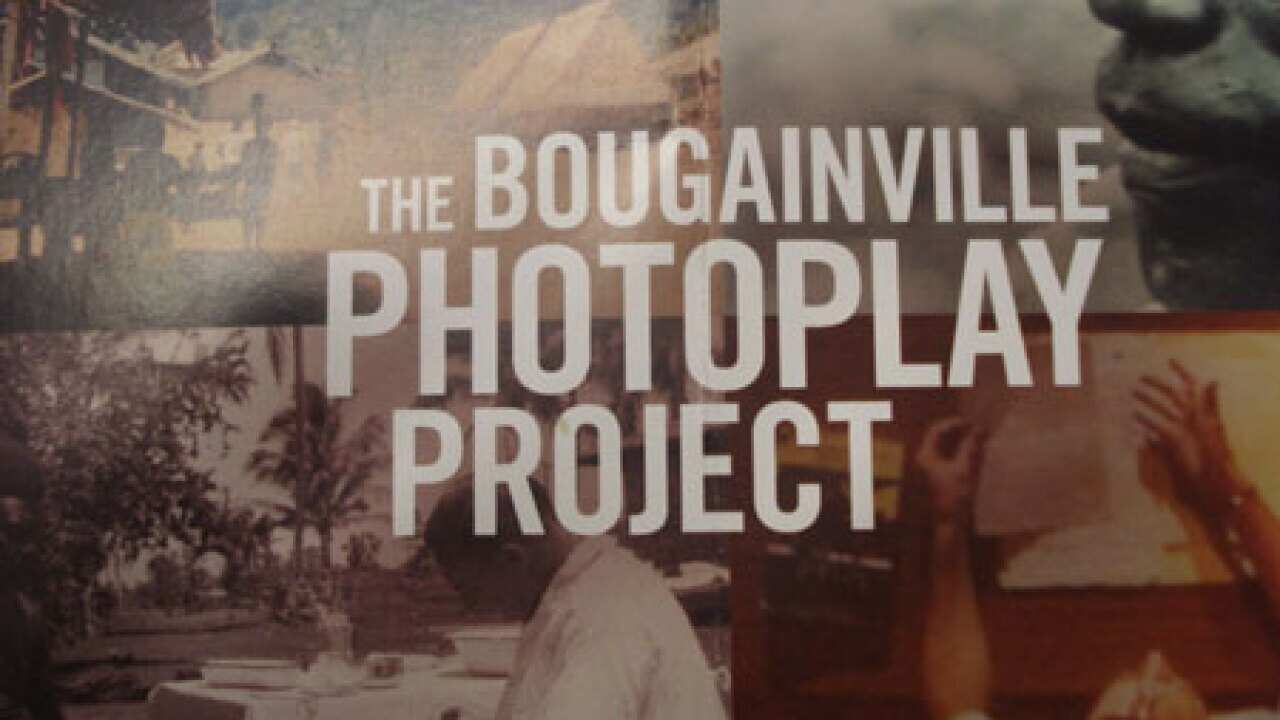
The 'Bougainville Photoplay Project', now on show in Sydney, reanimates the forgotten history of Australia as a colonial power and its role in the development of the Panguna mine and the Bougainville conflict.
In this play, academic, writer and performer Paul Dwyer retraces three journeys made by his father, Dr Allan Dwyer, to Bougainville during the 1960s.
It was only when Paul went to Bougainville on holidays in 2004 that he discovered that his father had been working there as an orthopaedic surgeon. From that point he decided to follow on his footsteps, meet his patients and check on their status.
While he was there, he learnt about the history of the Bougainville conflict and about the role that a mine owned by Australian company Bougainville Copper Ltd played in the lead up to the war.
Dr Dwyer's take on history is passionate and political. If you want to know more about the Bougainville conflict, go here:
News that makes sense
Your trusted source for staying up-to-date with the world around you. Get free daily news updates and analysis, straight to your inbox.
Foreign Affairs referred an inquiry into the Bougainville peace process to the Joint Standing Committee on Foreign Affairs, Defence and Trade in May 1998. Click here to read the report.
VIDEO: The Bougainville Revolutionary Army (Dateline, 1992)
VIDEO: Human rights lawyer returns from Bougainville (1993)
VIDEO: PNG and Australia in dispute over Bougainville (1996)
VIDEO: Alleged massacre of civilians (1996)
VIDEO: Protests in Australia over Boungainville war (1996)
VIDEO: Bougainville-PNG peace deal signed (2001)
A BIT OF HISTORY
The Panguna mine
The mine at Panguna had been perhaps the most major sticking point between Bougainville and the mainland.
It was vitally important to the economy of Papua New Guinea, but the people of Bougainville were seeing little benefit from it.
Bougainvillean leaders accused Bougainville Copper Ltd of being responsible for poisoning the entire length of the Jaba River, and causing birth defects, as well as the extinction of the flying fox on the island.
These grievances led to the decision in late 1988 of two cousins and local leaders, Francis Ona and Pepetua Serero, to take up arms against the Papuan government.
Ona himself had worked for Bougainville Copper, and had witnessed the effects the mine was having on the landscape of the island.
Peace keeping troops
In May 1990, Papua New Guinea imposed a blockade on Bougainville. Francis Ona responded by unilaterally declaring independence. He set up the Bougainville Interim Government, but it had little power and the island began to descend into disarray.
The PNG government requested the Australian and New Zealand governments to provide a monitoring group to oversee the cease fire on the island. This group was made up of both civilian and defence personnel from Australia, New Zealand, Fiji and Vanuatu.
Peace deal
In 2001, the Bougainville Peace Agreement decreed that all personnel should be withdrawn from the island by December 2002.
The total cost of Australia's development and military assistance to Bougainville from the financial year 1997-98 until FY 2002-03 was $243.2 million.
Over 3500 Australian defence personnel and 300 Australian civilians served in the Peace Monitoring Group during Operation Bel Isi.
On stage, Paul Dwyer's monologue performance combines field notes, oral history, a crash course in pidgin English, reconstructions of complex surgical procedures, letters, diaries as well as slides, super-8 footage and film installations.
The Boungainville Photoplay is on show at the Upstairs Theatre, in Belvoir Street in Surry Hills, Sydney, until November 28.







