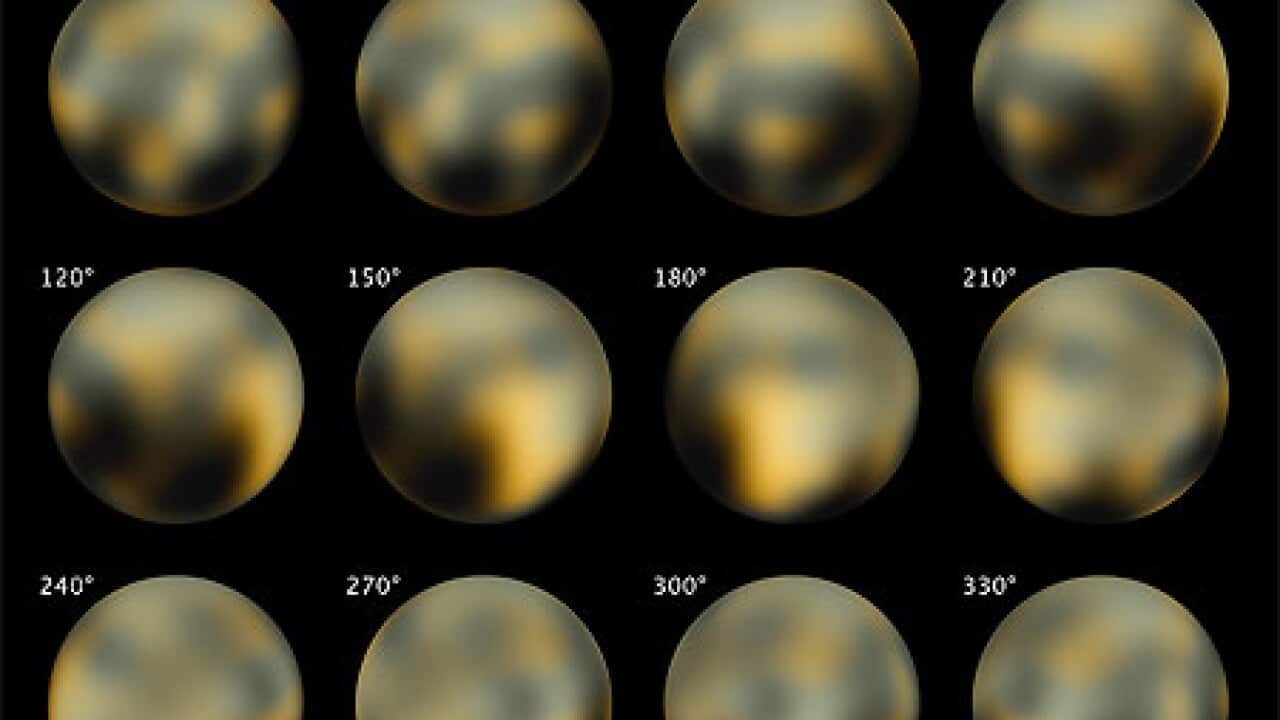
The US space agency has released new images taken by the orbiting Hubble space telescope that show Pluto's northern hemisphere growing brighter and the entire planet looking redder.
"These changes are most likely consequences of surface ice melting on the sunlit pole and then refreezing on the other pole, as the dwarf planet heads into the next phase of its 248-year-long seasonal cycle," NASA'S Space Telescope Science Institute in Baltimore said.
News that makes sense
Your trusted source for staying up-to-date with the world around you. Get free daily news updates and analysis, straight to your inbox.
"The Hubble pictures confirm Pluto is a dynamic world that undergoes dramatic atmospheric changes, and not simply a ball of ice and rock."
New Horizons probe
It is believed the dramatic change in colour occurred between 2000 and 2002.
Pluto was discovered by astronomers in 1930, and classified as a planet from then until 2006, when scientists downgraded it to a 'dwarf planet'.
More of Hubble's pictures of Pluto can be seen at the Hubble telescope website.
They will remain the most detailed images of the dwarf planet available, until NASA's New Horizons probe passes Pluto in 2015.
But while the probe will capture a series of much sharper pictures, it will shoot past Pluto at such a speed that it will only be able to photograph one of its hemispheres.







