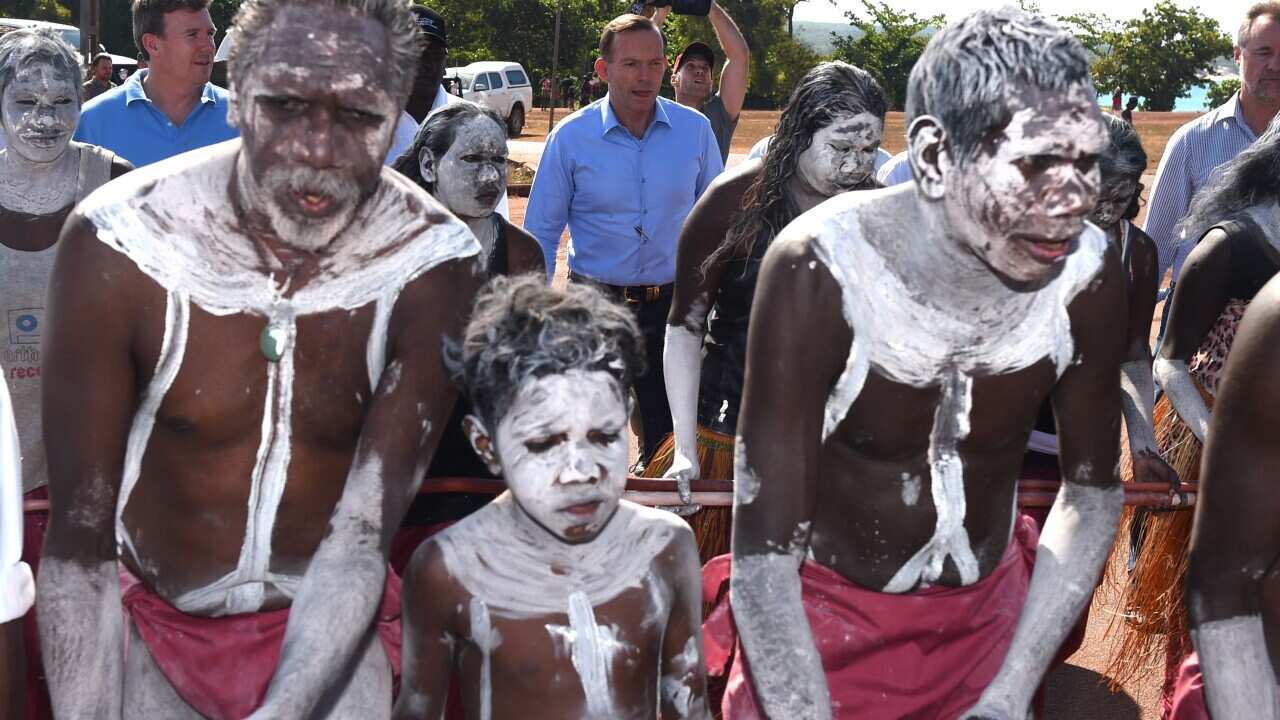
The prime minster was officially invited into the region during a ceremonial welcome to country by locals, spanning all ages from toddlers to elderly.
Mr Abbott announced 600 troops would be sent to Iraq minutes before boarding a plane to Nhulunbuy, where the government will operate from tents for the next week.
The deployment is part of a multi-national effort to combat Islamic State, who released a third execution video showing the apparent beheading of British aid worker, David Haines.
Despite the announcement, Mr Abbott remains committed to his pre-election promise to stay in indigenous communities for the week.
"It is important that the government carry on as usual despite the grave decision we have made this morning," he told reporters in Darwin on Sunday.
However, it is likely to redirect some of his attention away from indigenous issues like constitutional recognition.
He will be in regular contact with officials in Canberra over the deployment through secure communications set up by the Australian Defence Force.
Mr Abbott was welcomed to the Yirrikala Arts Centre along with his parliamentary secretary Alan Tudge and Indigenous Affairs Minister Nigel Scullion.
The decision to deploy troops to Iraq came after Australia received a specific request from the US government to contribute forces to to the region.
Australia is not yet at war in Iraq but Mr Abbott left open the possibility of deploying combat troops.
On Friday, Australia lifted its terror alert level from medium to high, but the government says that does not mean an attack is imminent.
Mr Abbott, and members of his cabinet, will carry out usual government functions from the outskirts of Nhulunbuy, where a compound of tents has been set up.
He will participate in conservation work with rangers on a remote island, meet school attendance officers and visit local business.
The prime minster will return to Canberra on Friday days before heading to New York where further measures to fight IS will be on the agenda.
Share


