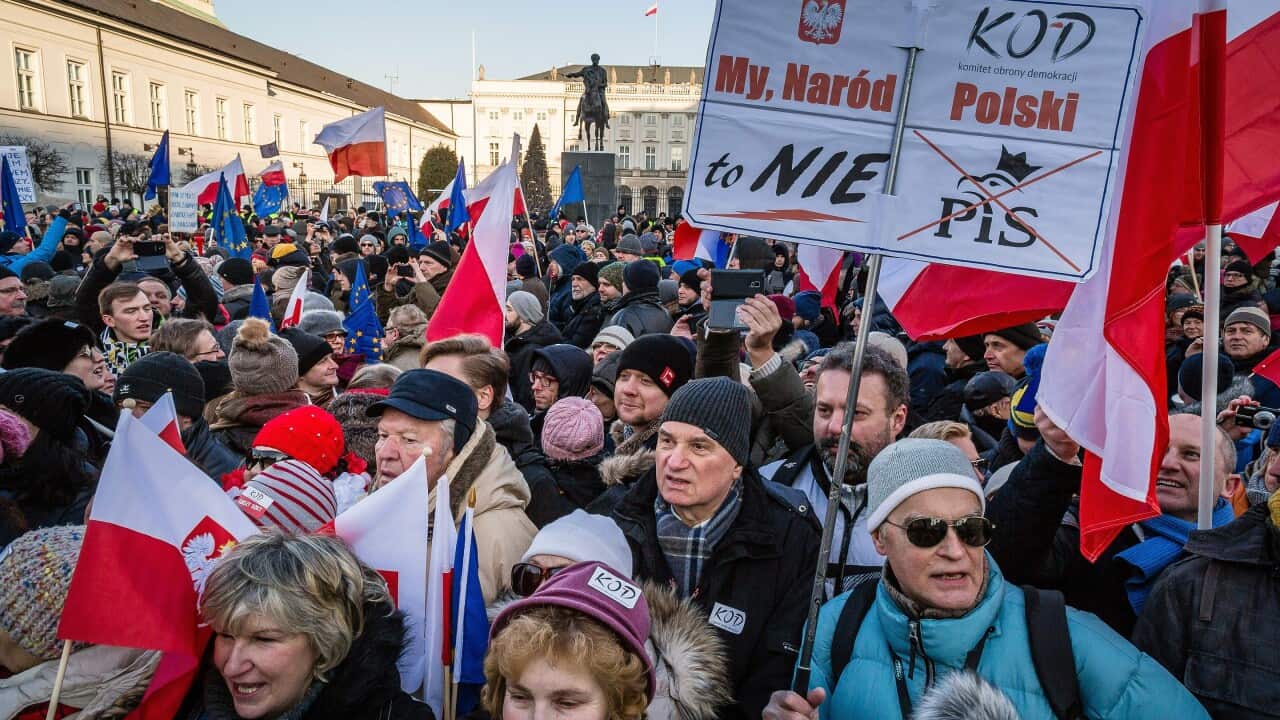
Thousands of Poles have marched through Warsaw to protest against their new conservative government's plan to increase its surveillance powers, with some saying they feared Poland was following Hungary towards an "illiberal democracy."
Since Poland's Law and Justice (PiS) party took power in November, its moves to take more control of the judiciary and the media have divided Poland and raised alarm bells in the Europe Union, which has started investigating charges that Warsaw is undermining democratic principles.
Waving Polish and European Union flags, the protesters on Saturday demanded that the Law and Justice party withdraw its planned changes to the surveillance law.
"You're supposed to listen, not listen in," read one of the banners. The proposed changes would expand the government's access to digital data and loosen the legal framework of using surveillance in law enforcement.
The ruling party, which scored a landmark election victory in October, says it has to swiftly amend the bill in order to implement a constitutional court ruling.
News that makes sense
Your trusted source for staying up-to-date with the world around you. Get free daily news updates and analysis, straight to your inbox.
"Our privacy, intimacy is under threat, we can be followed, watched over both in our homes, and online," Mateusz Kijowski, one of the organisers, told the protesters, who were peaceful. There were no figures available on the size of the crowd.
Critics say Poland's new government is emulating Hungary's Prime Minister Viktor Orban in trying to impose its political agenda by undermining democratic checks and balances and limiting democratic freedoms.
Orban has locked horns with Hungary's European partners for years, most recently over his hard line on the refugee crisis, one that PiS' leader Jaroslaw Kaczynski has also embraced, at one point warning refugees could bring "parasites" into Europe.
Orban has also packed Hungary's constitutional court with candidates backed by his party Fidesz since 2010.
Kaczynski's overhaul of Poland's top court provoked mass protests and a strong backlash from the opposition. It also attracted condemnation from the European Union.
Earlier this week, Polish Prime Minister Beata Szydlo told EU lawmakers that her government had not breached European or Polish laws with its changes to the constitutional court and by putting public media under its direct control.
The probe could eventually lead to the suspension of Poland's voting rights in the 28-nation bloc if the Commission decides that Warsaw has not observed the rule of law.







