
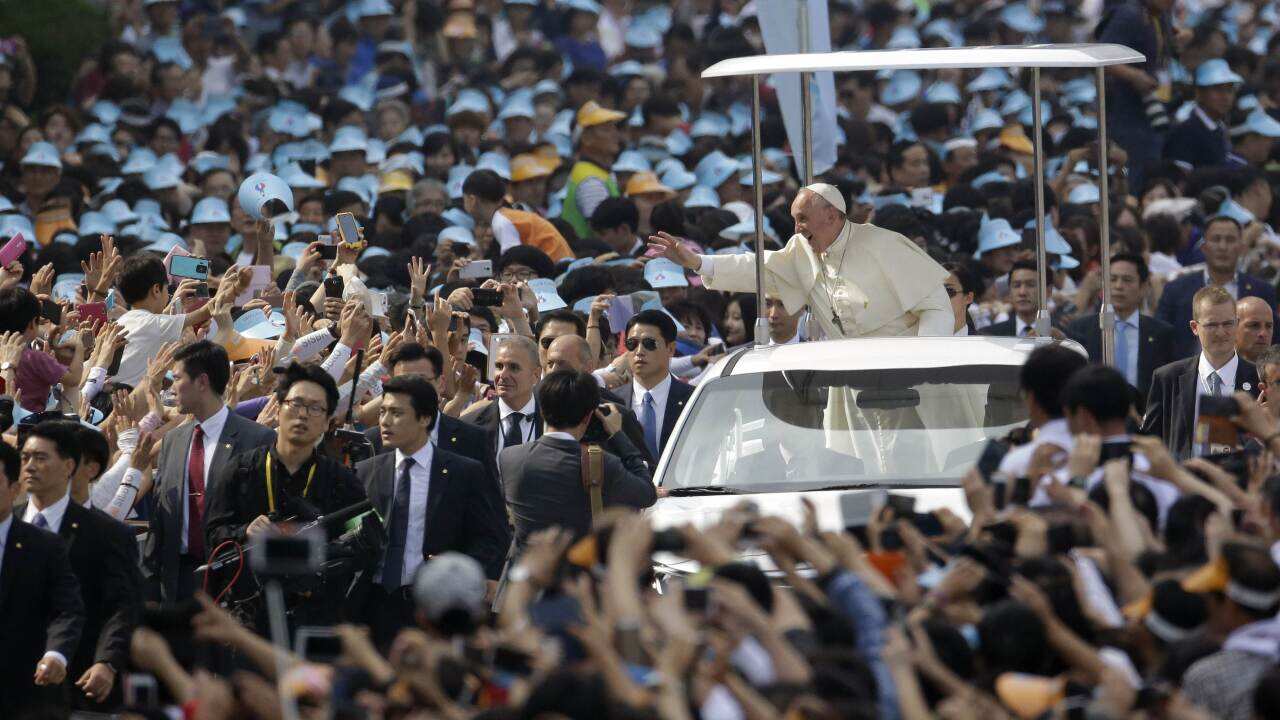
Hundreds of thousands of believers, most of them invited church groups from across South Korea, attended the open-air ceremony, held in hot, humid conditions on Saturday in Gwanghwamun plaza - the city's main ceremonial thoroughfare.
The centrepiece of the pope's five day visit, the beatification mass was the subject of a massive security operation, with bridges, roads and subway stations closed, and police snipers posted on the roofs of overlooking office buildings, which had their windows sealed.
The most prominent among those to be beatified was an 18th century nobleman, Paul Yun Ji-chung, who became Korea's first Catholic martyr when he was executed in 1791 after clashing with Confucian officials.
According to the church, around 10,000 Koreans were martyred in the first 100 years after Catholicism was introduced to the peninsula in 1784.
"They knew the cost of discipleship ... and were willing to make great sacrifices," Francis said in his sermon after the brief beatification ceremony, which gives the martyrs the title "blessed" and marks their first step towards sainthood.
Continuing the theme that has dominated his visit, Pope Francis said the lessons to be learned from the martyrs were as important as ever.
"Their example has much to say to us who live in societies where, alongside immense wealth, dire poverty is silently growing; where the cry of the poor is seldom heeded," he said.
Up to one million people had been expected to converge on the mass venue, although only 200,000 who pre-registered were allowed to pass through dozens of metal detectors placed along a 4.5-kilometre long security ring around the main plaza.
As the sun rose, Gwanghwamun boulevard was already crammed with spectators for a one-kilometre stretch north of City Hall.
The papal stage, topped with a giant cross stood at the top of the boulevard, backed by the giant tiled roof of the Joseon dynasty Gyeongbokgung Palace.
In the 18th and 19th centuries, unrepentant Catholics were generally paraded from Gwanghwamun southwest to Seosomun Gate where they were publicly executed.
Pope Francis began the day at a martyrs' shrine at Seosomun and then made the journey of the condemned in reverse to Gwanghwamun, riding in an open-topped vehicle and waving to the ecstatic crowds on either side.
Up to 600 relatives of victims of April's Sewol ferry disaster were invited to attend the mass, effectively incorporating a planned protest into the event.
The pope's visit is very much aimed at fuelling a new era of growth for Catholicism in Asia, where the Church is making some spectacular gains in Asia, but where Catholics still only account for 3.2 per cent of the continent's population.