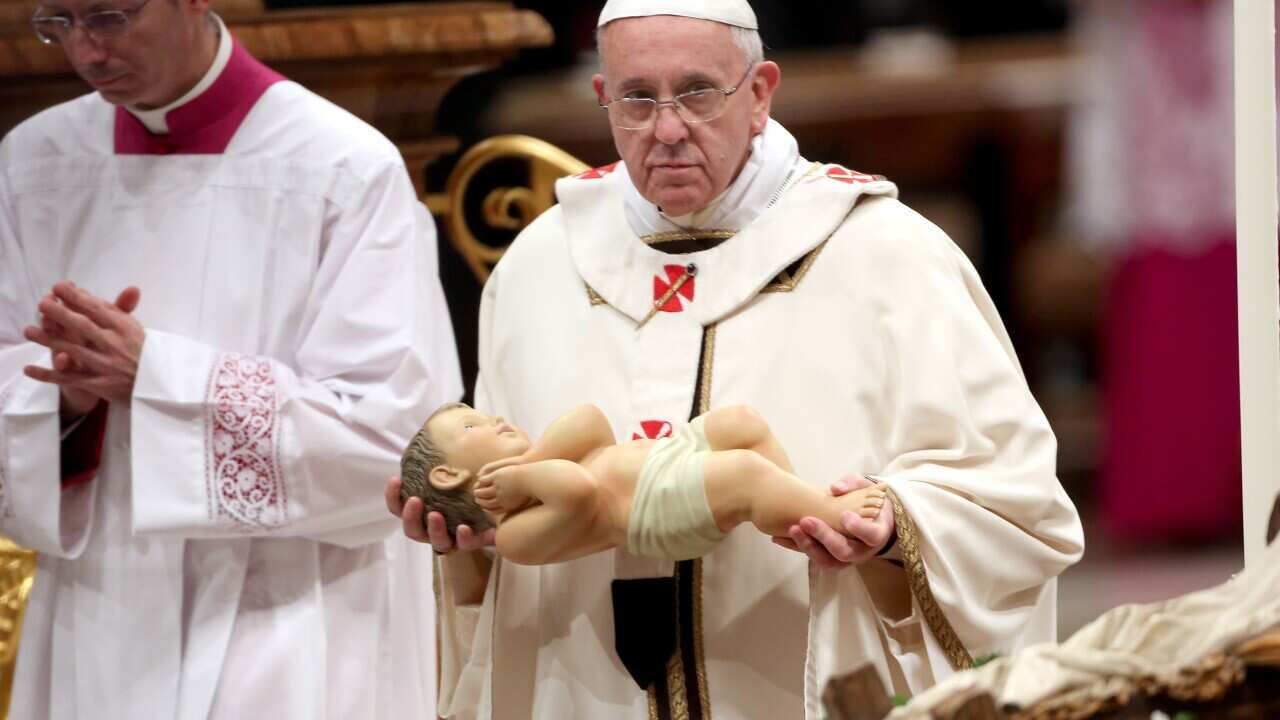
Pope Francis has hailed God's guiding power and urged the faithful to be selfless as he conducted Christmas celebrations for the first time since his election this year as leader of the world's 1.2 billion Catholics.
Francis led a procession in front of thousands of faithful and senior clergymen, who packed Saint Peter's Basilica for a Christmas Eve Mass that started at 9.30pm local time and lasted less than two hours.
The Argentine-born pope has also encouraged his flock to be a joyful church, and he called Jesus' "the light who brightens the darkness."
In the world's history and our own personal history, Francis said, "there are both bright and dark moments, lights and shadows. " He added "if our heart is closed, if we are dominated by pride, deceit, self-seeking, then darkness falls within us and around us."
In a change from practice, he personally kissed and placed a baby Jesus in a manger at the start of the solemn service.
At the end, Francis placed the statue in a nativity scene, then kissed a group of children on their foreheads.
Watch: The Pope's full Christmas Eve address
Meanwhile, thousands have celebrated Christmas in Bethlehem at a time when unrest across the Middle East threatens to drive even more Christians from the cradle of their faith.
In the West Bank town of Bethlehem, the historic site of Jesus's birth, Jerusalem's Latin patriarch Fuad Twal was to celebrate midnight mass attended by Palestinian President Mahmoud Abbas and other dignitaries.
Thousands of pilgrims and tourists made their way past Israel's controversial separation wall to reach the Palestinian hilltop town, where snow remains on the ground from a rare winter blizzard this month.
In a homily to be delivered at the Christmas Eve mass, Twal called for a "just and equitable solution" to the decades-old Israeli-Palestinian conflict.
Australians urged to reflect during festive period
"This painful reality raises numerous questions concerning our future in this country and causes us much worry," the 73-year-old patriarch planned to say, according to a copy of the homily obtained by AFP.
But "the answer lies neither in emigration nor in closing in on ourselves. It consists in staying here and in living and dying here," he said.
"From this Holy Place, we remember all the adversities in our world: from civil wars in Africa to the typhoon in the Philippines, the difficult situation in Egypt and in Iraq, the tragedy playing out in Syria," Twal said.
Among the millions displaced by the Syrian war are thousands of residents of the historic Christian village of Maalula, many of whom still speak the ancient Aramaic of Jesus.
Juliana, a 22-year-old Maalula refugee in Damascus, recalled past Christmas at home as "joyful. We would decorate the Christmas tree, and friends and relatives would get together for midnight mass. People were happy."
"This year, we will attend mass of course but there won't be any Christmas tree or manger. We are refugees now."
In the Philippines it was not war but a devastating act of nature, Super Typhoon Haiyan, which flattened entire towns and left nearly 8,000 people dead or missing.
Filipinos who survived the disaster defiantly prepared to celebrate Christmas in their ruined communities, where hogs were roasted and churches filled to overflowing.
On a lighter note, the US government said it had officially cleared Santa Claus for entry to the United States after the authorities waived stringent livestock checks on his reindeer.





