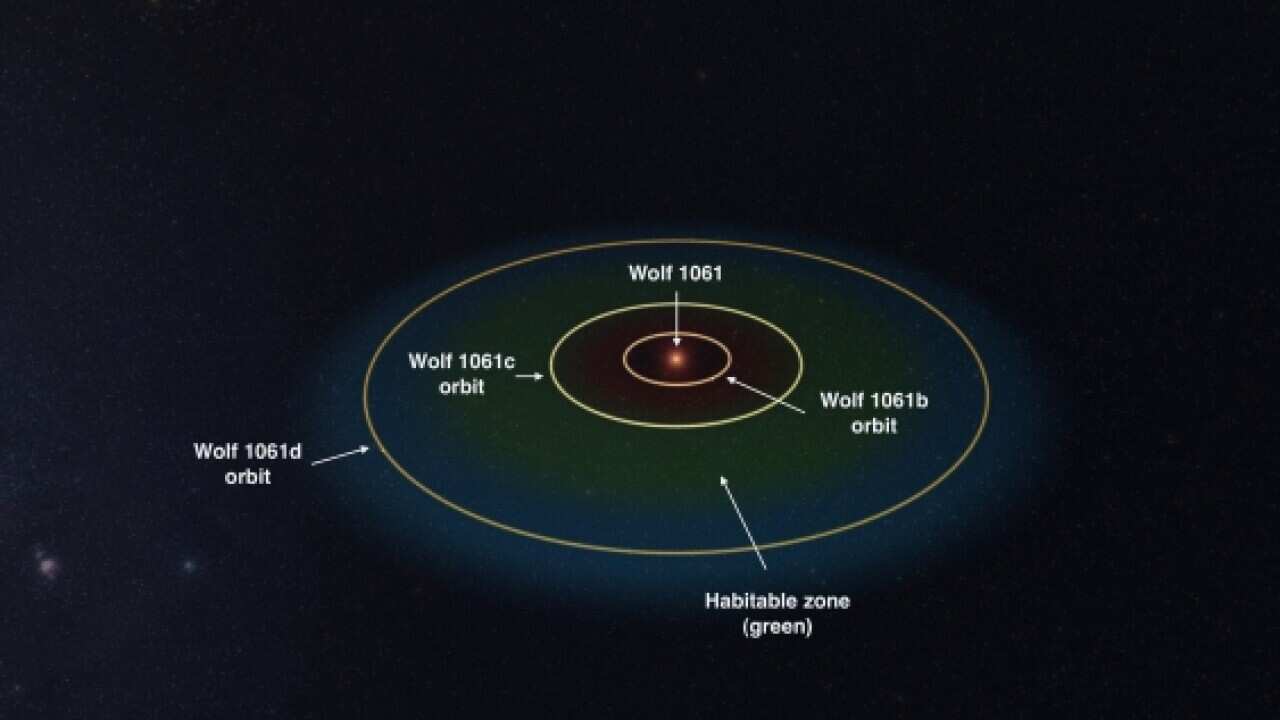
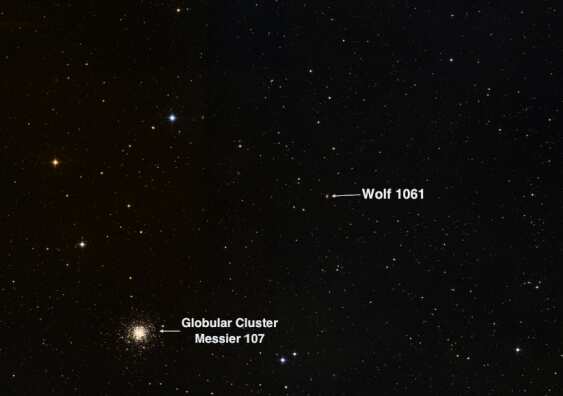
The new planet is one of three circling the red dwarf star Wolf 1061, 130 trillion kilometres away.
Four times the size of Earth, the planet – named Wolf 1061c - takes 17.9 days to make a full rotation.
The finding is published today in The Astrophysical Journal Letters.
With 50 billion red dwarfs in the galaxy indicating the presence of billions of planets, some of which may habitable, researchers said the discovery is quite a rare find.
News that makes sense
Your trusted source for staying up-to-date with the world around you. Get free daily news updates and analysis, straight to your inbox.
“We haven’t found many like it, but we do know that there should be billions like it in the galaxy,” said Dr Duncan Wright from the University of New South Wales (UNSW).
Dr Wright said the team of researchers are elated to make the discovery, beating other teams around the world using the same data set.
“We are extremely pleased. This work has been going on for many years. We aren’t the only ones looking at this. In fact, the data we used is part of another program looking for life by researchers in Switzerland. But we developed a different way of analysing the data that improved the detectionability and that is what enabled us to find this planet.”
The astronomers used the HARPS spectrograph on the European Southern Observatory's 3.6-metre telescope in Chile to make the finding.
The process involved using the motion of the star relative to Earth, a technique described as the “Doppler Wobble Technique”.
But even with the technique, finding the planet was not easy.
“The precision required is down to one metre per second, which is slower than a person typically walks. So the difficulty of the measurement corresponds to an extremely difficult process to find the planet,” Dr Wright said.
A planet for humans to colonise?
Dr Wright said there are a number of promising signs that indicate the planet could possibly sustain life.
The key indicator is the planet’s location within the so-called habitable zone from its host.
“We do know that being in the habitable zone is one of the most important things because without that, of course, you would not have liquid water, which we believe to be key molecule to form life as we know it,” Dr Wright.
But he said more work is needed to assess the planet’s viability to potentially host a human colony.
“There is much more that goes into it: like its atmosphere, its composition, plate tectonics, whether there actually is any water available on the surface.”
‘Opens up many doors’
Dr Wright said the planet’s discovery has given rise to hope that many more such planets could be found in the future.
“It opens up many doors, particularly if it does turn out that the planetary system is transiting. We could find out about all sorts of things that we haven’t been able to find out before about these kinds of stars, investigate the atmosphere.
“At the moment the world is constructing space telescopes to try and investigate these exact properties; and they are looking for planets like this so we have a few to investigate.
“So if we are lucky in the near future we could find many, many more planets and start to investigate the atmospheric properties of these types of planets. And maybe, just maybe, discover the presence of life on some of these exo planets.”
He said it is too early to gauge the reaction from his scientific peers, but that he is confident the finding will only encourage researchers to greater heights in the race to find life.
“I think once people have had a good look at the data and get to grips with what we’re saying, I think they will be pretty pleased with the detection. In fact, I imagine there will be a number of telescopes pointed at the star in the near future, hoping that it in fact transits. And we can start to do atmospheric detections.”







