

By Z Jack Tseng, American Museum of Natural History
The fossil record of early humans is punctuated by gaps, voids in our understanding of all the transitions from the common ancestor of humans and other apes to modern day Homo sapiens. While working in the Tibetian Plateau of central Asia, we made an important discovery to fill in a similar void – but one that shed light on the evolution of cats.
The fossils, dating from the late Miocene and early Pliocene epochs, 4-6m years ago, represent at least three individuals of a previously unknown cat species. In our study published in the Proceedings of the Royal Society B, this species has now been identified as the oldest known member of the “big cats”, whose living relatives include lions, tigers, jaguars, and leopards. The new fossil species is named Panthera blytheae or Blythe’s Panther.
This discovery of a nearly complete skull of the new fossilised big cat came as a surprise. Our team of Chinese and American paleontologists has been exploring the western reaches of the Tibetan Plateau since 2006. We’d already made several important discoveries in the region known as Zanda Basin, including a skull of the earliest woolly rhino, and a partial skeleton of an extinct three-toed horse that provided an important indicator that modern day open plains are an ancient landscape that already rolled beneath the Himalayan foothills millions of years ago.

A reconstruction of the skull of Panthera blytheae, the oldest known fossil big cat. Mauricio Antón
In August 2010, we arrived in the Zanda Basin ready for another season of prospecting and survey of unexplored cliffs and valleys. Even before lunch on the first day, palaeontology PhD student (and my wife) Juan Liu had discovered a hillside strewn with fossil fragments. Under the experienced supervision of Gary Takeuchi from Rancho La Brea Tar Pits, we excavated the crushed but relatively complete skull of this new fossil cat. Our fossil collection mostly comprised limb bones and horn cores of extinct antelopes, horses and rhinos, so the discovery of a carnivore’s skull was a pleasant surprise that boosted our confidence. There was obviously more scientific potential still buried in the barren lands of the Tibetan Plateau.
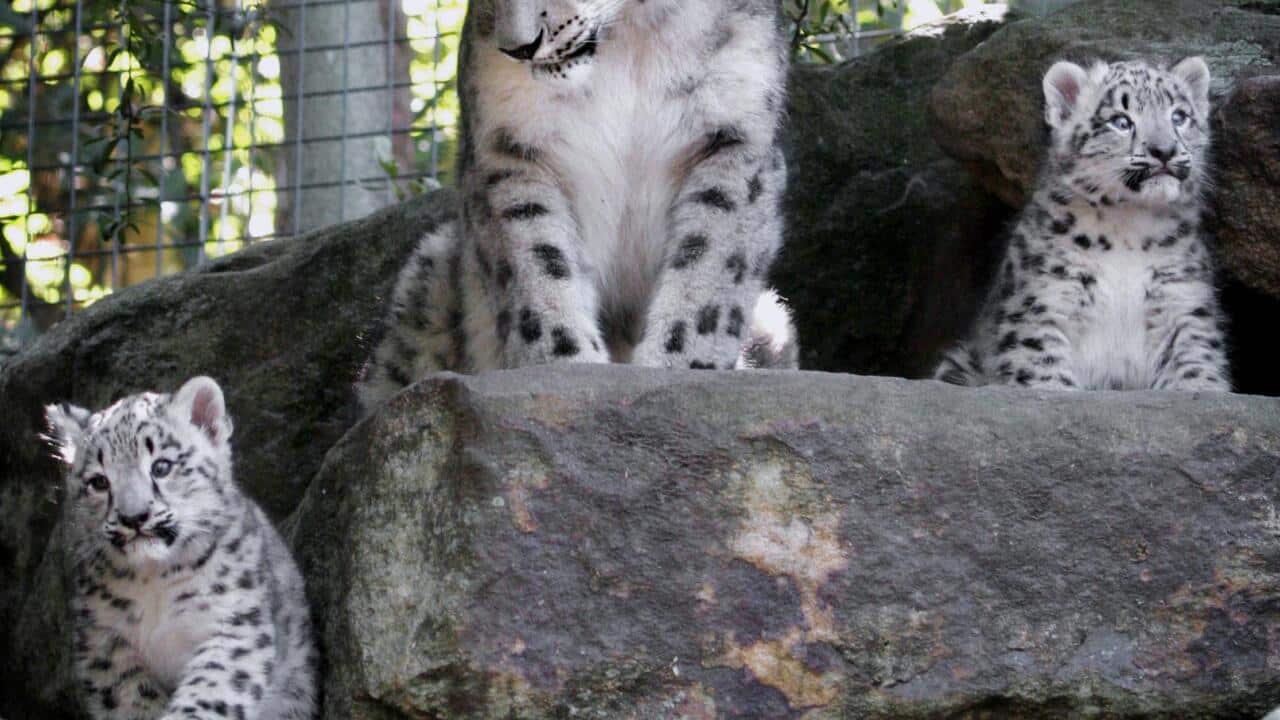
This finding is important because the relatively ancient geologic age of the fossils fill the gap in the existing fossil record of big cats, which is extremely fragmentary. Examining the family tree of living big cats and several extinct species indicates that Panthera blytheae is a sister to the snow leopard, two species that constitute a lineage of high altitude big cats that survived in the Himalayas for millions of years. Based on anatomical information, DNA samples and geographical distribution of big cat species, we found evidence that supported the idea that big cats originated in Asia.

Gary Takeuchi (in blue) works carefully to extract the rock containing the fossil cat skull from the ground. Jack Tseng
Despite the existing species of big cats, we know relatively little about their early evolutionary history. And they are not the only species that present a scientific conundrum due to missing fossils. Other mammals such as bats and lineages of certain apes (including anatomically modern humans) also have significant gaps in the fossil record that prevent a fuller understanding of exactly how they evolved.
One carnivore family dear to my heart, the hyenas, also presents some special issues for understanding living species. Three of the four living hyena species are specialised bone crushers, but the fourth species, aardwolf (Proteles cristata), is a specialised termite feeder with no functioning teeth for bone crushing or for pretty much any kind of chewing. The fossil record of aardwolves is essentially nonexistent, so there is much debate as to when and how these peculiar hyenas evolved.
Big cats receive extra attention partly because several living species are seriously endangered, and all are on the IUCN Red List of threatened species. They are also the earliest-branching lineage among all living cats. Unlike the evolutionary dead-ends elsewhere in the cat family, for example the sabre-toothed cats that roamed the world until the Ice Age brought their demise, feline and pantherine cats diversified sometime in the later Miocene epoch, and successfully dispersed throughout the world into modern times. A more complete understanding of how all living cats came to be so diverse, widespread, and intertwined with human civilisation will come from understanding how the various species first diversified.
Big cats fit in that early place in the evolution of living cats, and continued fossil discoveries will no doubt enlighten us to the history of the earliest of feline predators. As for our research team, we intend to return to the Zanda Basin to continue our search for fossil clues on the “Roof of the World” – the Tibetan Plateau, which rose to its present height within the evolutionary time frame of many living mammals – hopefully to reveal not only more about these early big cats, but also the connection between environmental change over time and its effects on the extinct ecosystems found there.
Z. Jack Tseng receives funding from the National Science Foundation (U.S.) and American Museum of Natural History.