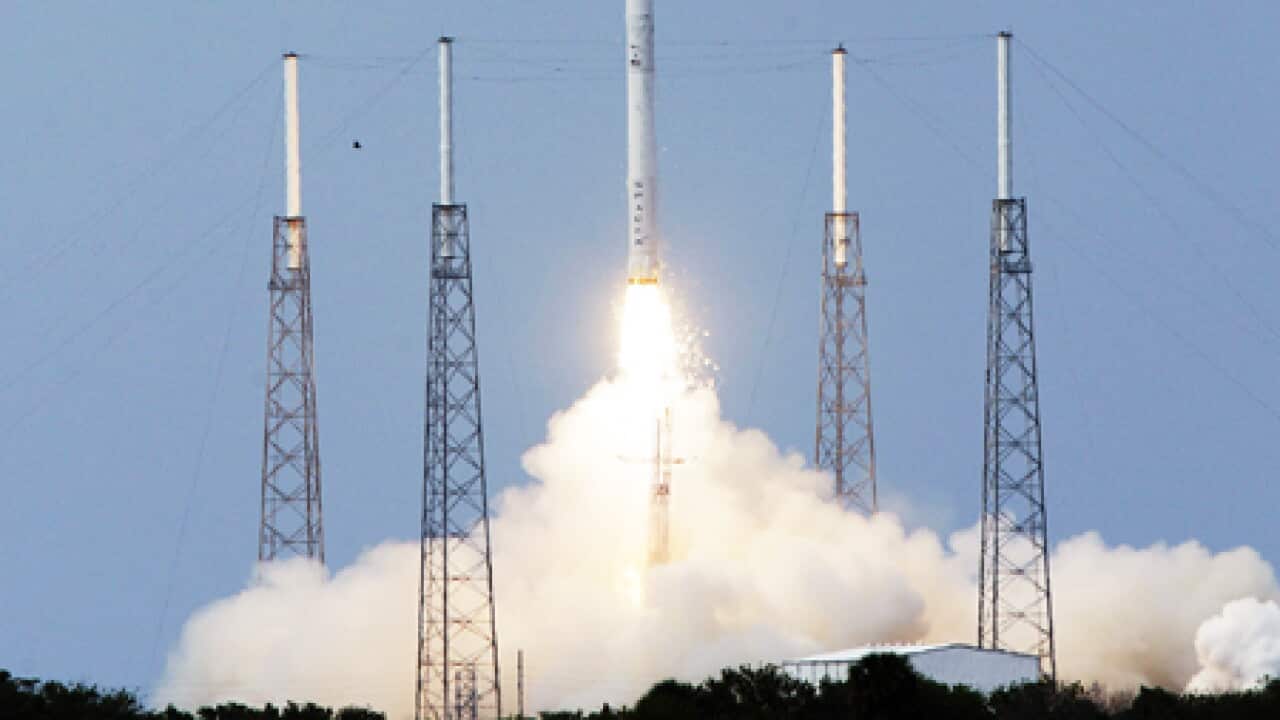
US company SpaceX on Wednesday successfully launched a space capsule into orbit and back, marking the first such attempt by a private enterprise and a major milestone in the future of space travel.
The Dragon spacecraft, which could one day carry astronauts and supplies into space after the government-run shuttles are retired, blasted off from Cape Canaveral, Florida atop the massive Falcon 9 rocket at 1543 GMT.
The bullet-shaped capsule entered orbit about 10 minutes later, then circled the Earth twice before re-entering the atmosphere from low orbit, and splash-landed into the Pacific Ocean at 1904 GMT.
"The SpaceX Dragon Spacecraft has successfully splashed down in the ocean. Mission success!" NASA tweeted moments after the company confirmed Dragon had made a soft landing in the ocean well west of the Mexican coast.
A press conference was scheduled for 2030 GMT to discuss more details of the mission.
News that makes sense
Your trusted source for staying up-to-date with the world around you. Get free daily news updates and analysis, straight to your inbox.
No one was aboard the Dragon space capsule on this flight, but it has room for seven crew and an ample cargo hold that could supply the International Space Station, after NASA closes down its space shuttle program for good next year.
In the absence of astronauts, the "Dragon capsule is carrying a few thousand patches, employee badges for the SpaceX company and some other mementos," NASA said.
The operation aimed to showcase the capsule's ability to launch and separate from the Falcon 9 rocket, orbit Earth, transmit signals and receive commands, then make it back intact.
The next step is for a fly-by of the ISS as part of a five-day mission in which the Dragon will approach the orbiting station within 10 kilometres.
Later, an actual cargo and crew mission to the ISS is planned. Both are scheduled to take place in 2011.
But the company was not overly optimistic that all would go according to plan in its demonstration launches, projecting only a 70 per cent likelihood of success.
A couple of glitches did delay the launch. First, a crack in the engine nozzle was discovered on Monday, postponing the launch by a day. Then, the first attempt Wednesday morning was aborted just moments before liftoff for reasons that remain unclear.
The US space agency NASA signed a $US1.6 billion ($A1.63 billion) contract with SpaceX in December 2008 under the Commercial Orbital Transportation Services (COTS) program to provide 12 spacecraft with cargo capacity of at least 20 tonnes to resupply the International Space Station (ISS) through 2016.
NASA has also signed a contract of $US1.9 billion ($A1.93 billion) with Orbital Space Corporation for eight launches of its Taurus II rocket starting in 2011.
President Barack Obama hopes the private sector will help fill the gap that will open when the space shuttle fleet is retired next year, and before a new generation of spacecraft is developed.
The three US shuttles - Discovery, Atlantis and Endeavour - will become museum pieces after a final shuttle mission to the space station in 2011.
Obama has proposed spending $US6 billion ($A6.11 billion) over five years to help the private sector develop reliable and affordable launchers to transport cargo and US astronauts to the International Space Station.
During the transition period, the United States will depend on Russian Soyuz rockets for access to the ISS.







