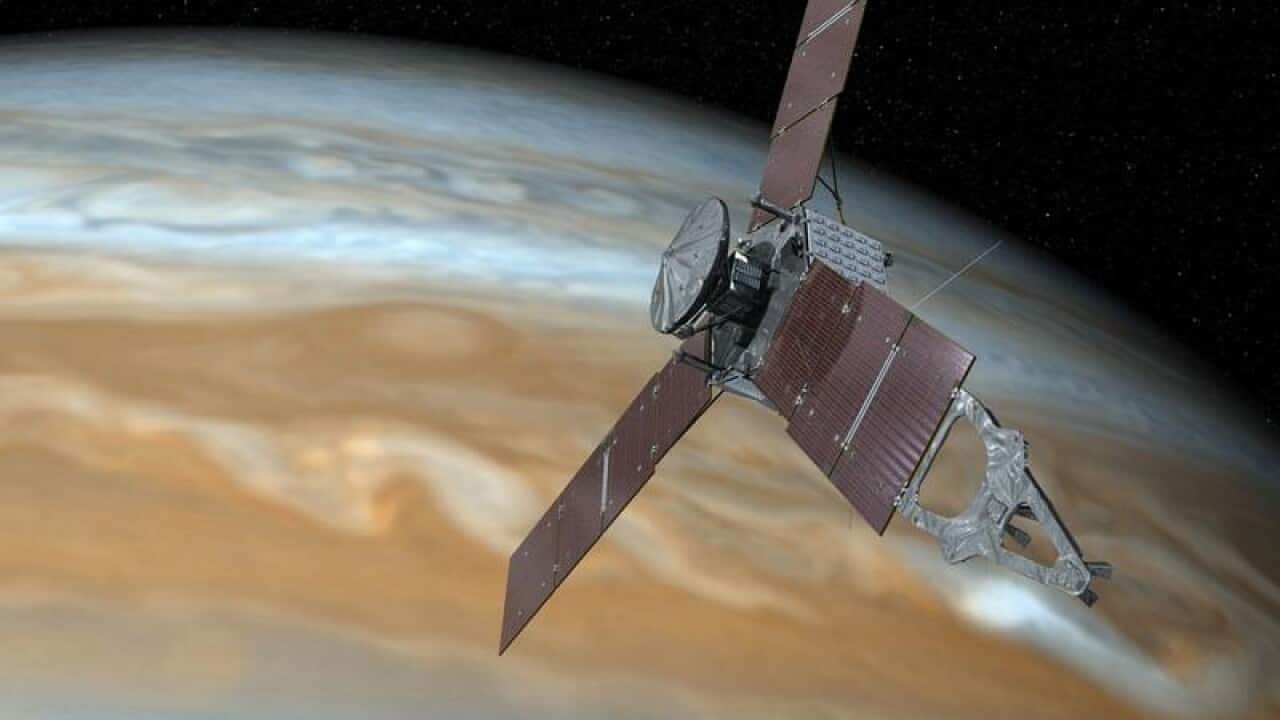
A NASA spacecraft in orbit around Jupiter has begun transmitting data from humanity's closest brush with the Great Red Spot, a flyby of the colossal storm that has fascinated observers for centuries.
The Juno probe logged its close encounter with the gas giant's most distinctive feature on Tuesday afternoon as it passed about 9000km above the clouds of the mammoth cyclone.
But it will take days for readings captured by Juno's array of cameras and other instruments to be delivered to scientists at the Jet Propulsion Laboratory in California, and much longer still for the data to be analysed.
Scientists hope the exercise will help unlock such mysteries as what forces are driving the storm, how long it has existed, how deeply it penetrates the planet's lower atmosphere and why it appears to be gradually dissipating.
Steve Levin, the lead project scientist for the Juno mission, said the storm was believed to be powered by energy oozing from Jupiter's interior combined with rotation of the planet, but its precise workings are unknown.
News that makes sense
Your trusted source for staying up-to-date with the world around you. Get free daily news updates and analysis, straight to your inbox.
The churning cyclone ranks as the largest known storm in the solar system, measuring about 16,000km in diameter with winds clocked at hundreds of kilometres an hour around its outer edges.
The spot has been monitored from Earth since about 1830, though observations believed to have been of the same feature date more than 350 years.







