(Transcript from SBS World News Radio)
Questions are being asked over Federal Government plans to give the Immigration Minister power to revoke a person's citizenship for alleged links to terrorism-related activity.
The Prime Minister says changes are needed to confront the terrorist threat facing Australia as some Australians appear to be travelling to join conflicts in the Middle East.
Kristina Kukolja reports.
(Click on the audio tab above to hear the full report)
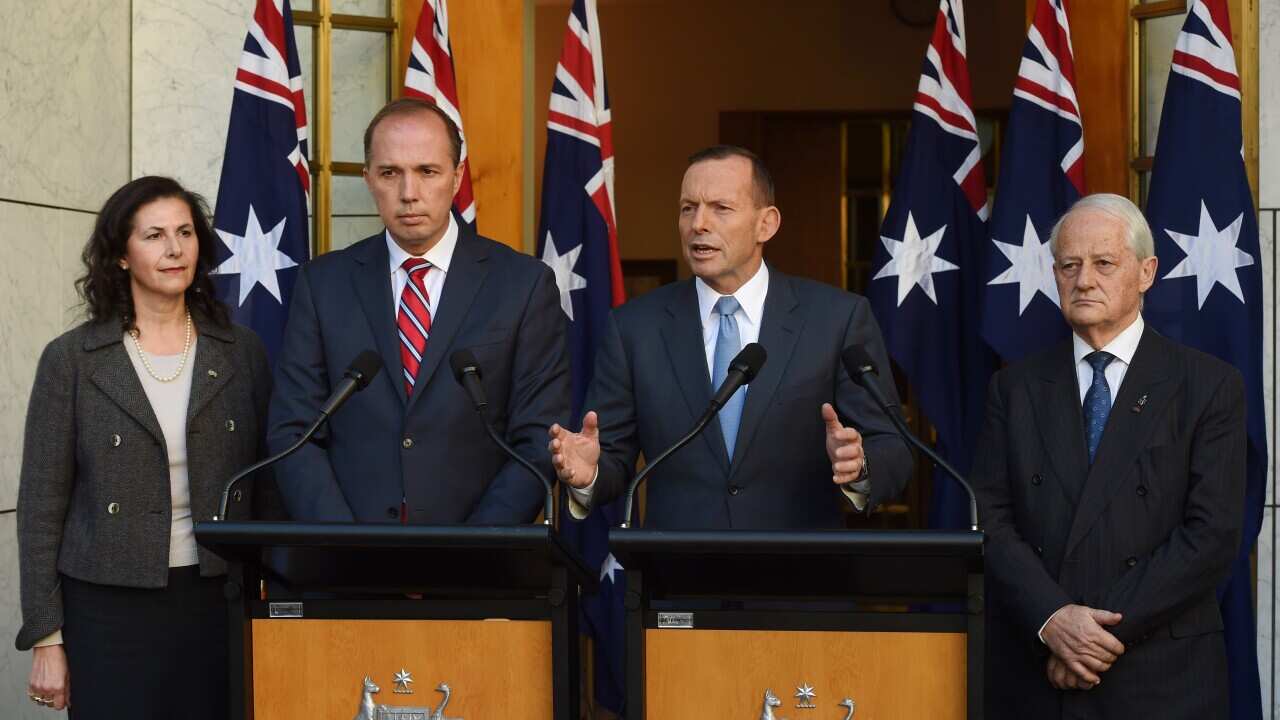
Tony Abbott has reaffirmed plans to introduce legislation giving the Immigration Minister power to revoke certain people's citizenship over suspected terrorism-related acts.
He says giving the Minister the ability to exercise the power would be in the national interest if the citizen, as he puts it, betrays Australia by participating in such activities.
The Prime Minister says it could apply to dual citizens who fight or support groups such as the self-proclaimed Islamic State, or IS, including so-called lone wolves.
He says the changes remain consistent with Australia's international legal obligations not to leave a person stateless.
Mr Abbott reportedly faced significant opposition in Cabinet, though, when he and Immigration Minister Peter Dutton proposed extending the idea further.
They want the measures to also apply to Australians who are not citizens of any other country but might qualify for citizenship elsewhere.
The Prime Minister says the treatment of sole nationals will be open for public input by way of a citizenship discussion paper.
"There are obviously some circumstances in which Australian citizens already can lose some of the privileges of citizenship. For instance, Australian citizens who are serving lengthy jail sentences lose the right to vote. In the United Kingdom, as I understand it, there are some provisions for action to be taken in the citizenship area even against UK citizens, and that's the kind of thing that we will be open to community debate on."
The Prime Minister says safeguards are in place to balance the powers that would be granted to the Immigration Minister.
He says they include the option of a judicial review.
However, that appears to leave open the question of access for those Australians who could have their citizenship withdrawn while still overseas.
Peter Dutton says the decision would be made following consultation.
"Like when we receive advice now through the intelligence agencies, we form judgments, based on that advice. The difficulty, of course, is, if someone is off fighting in Syria, they may be involved in a terrorist act there, they may -- as we're learning from the death cult over there -- be involving themselves in rape or blowing up buildings and other treacherous acts -- it is very difficult, of course, to gather sufficient evidence to satisfy an Australian court beyond reasonable doubt that that person had committed that offence in that part of the world. Right now, I rely on security assessments from ASIO in relation to people who come to our country, and, if there is an adverse security assessment, I make a judgment about whether or not that person can be released into the community, and a similar process would follow."
University of New South Wales professor George Williams is a constitutional lawyer.
He says the powers proposed to be granted to Peter Dutton are concerning.
"It would mean that ministers could determine, themselves, who is a member of the community, particularly if they can do it without a court finding of guilt. It might be used in circumstances where perhaps the evidence isn't strong enough to actually determine that they are a terrorist. And it introduces a scheme into the law that would give great power to the government of the day without, I think, clear justification."
Professor Williams says the withdrawal of citizenship will not be effective in deterring young Australians from joining groups such as IS.
And he says the Government's proposal lacks detail.
"Well, the idea of stripping citizenship has been announced many times, but we haven't actually seen any detail yet, and, of course, here, it's the detail that matters. For example, will someone have their citizenship stripped only for the most serious crimes, perhaps acts of terrorism involving life imprisonment, or will it apply to more minor crimes of terrorism, perhaps to speech offences? Is it possible that someone could stop being an Australian merely because of words they say, for example? That's the sort of thing we need to look at carefully. And until we see that, it's not possible to see just how far this scheme might go."
It is a view shared by Eddie Micallef, chairman of the Ethnic Communities' Council of Victoria, a group representing migrant and refugee communities.
"The clarity is not there. I mean, it's advice they get. Sometimes, people, for all sorts of reasons ... they may have family over there, they may have close relatives who are linked, they may go for a whole range of reasons, and they may not necessarily be absolutely committed to a radical position that's detrimental to Australia's well-being. So these are issues, and I think there has to be some sort of open and transparent process. People can be locked up without any reasons or rationale. A lot of our civil liberties are going out of the door, and I'm just concerned that this may be another one of those actions that whittle away at our civil liberties."
Eddie Micallef says the Government's intentions appear heavy-handed and could be seen as unfairly targeting members of some communities.
"Whether that's the reality or not, the perception will be that that would be the case, and that's another issue that forces some of the young people into taking up radical causes, when they feel as though they're being victimised."
Share


