
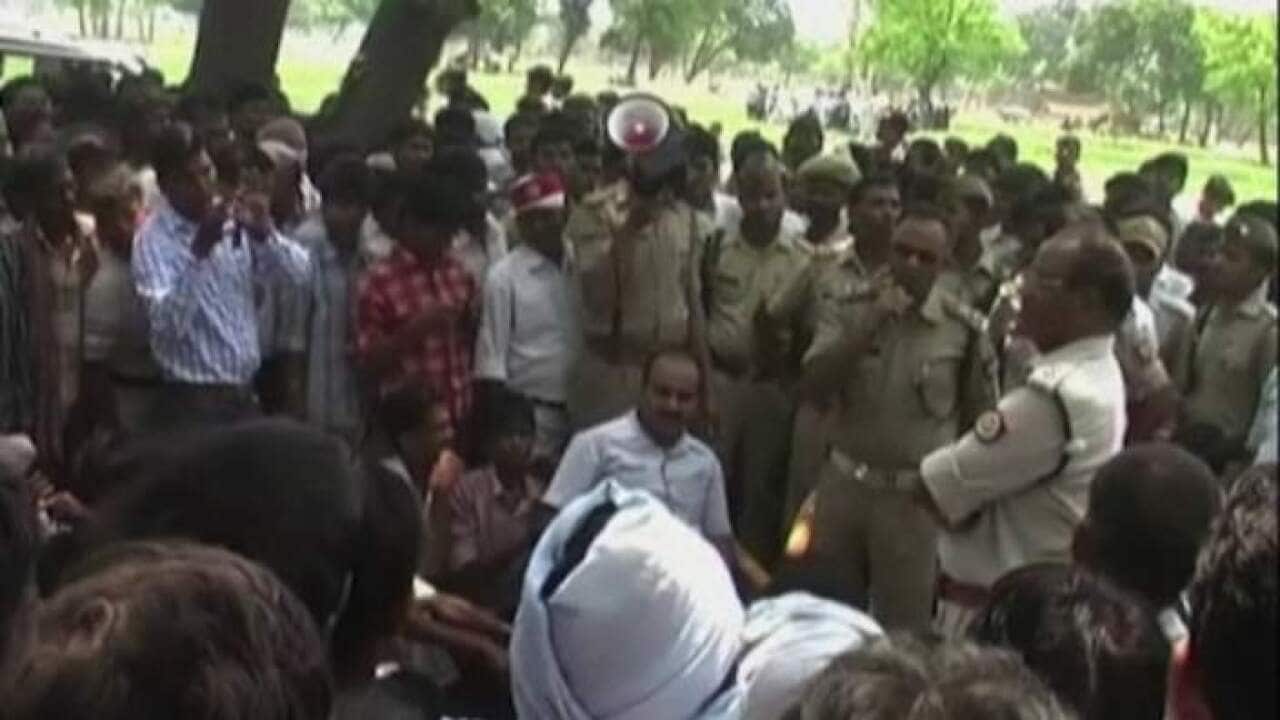
The tree has become the scene of a silent protest by villagers angry about alleged police inaction over the case.
Two of the four men arrested so far are police officers, while authorities are searching for three more suspects.
Villagers found the girls' bodies hanging from the tree early on Wednesday, hours after they disappeared from fields near their home in Katra village in Uttar Pradesh state, police Superintendent Atul Saxena said.
The girls, aged 14 and 15, had gone into the fields because there was no toilet in their home.
Hundreds of angry villagers stayed next to the tree throughout Wednesday, silently protesting the inadequate police response.
Indian TV footage showed the villagers sitting under the girls' bodies as they swung in the wind, and preventing authorities from taking them down until the suspects were arrested.
Police arrested two police officers and two men from the village later on Wednesday and were searching for three more suspects.
Autopsies confirmed the girls had been raped and strangled before being hung, Saxena said.
The villagers accused the chief of the local police station of ignoring a report by the girls' father on Tuesday night that the girls were missing. The station chief in Katra, 300km southwest of the state capital, Lucknow, has since been suspended.
The family belongs to the Dalit community, also called "untouchables" and considered the lowest rung in India's age-old caste system.
Records show a rape is committed every 22 minutes in India, a nation of 1.2 billion people.
Activists say that number is low because of an entrenched culture of tolerance for sexual violence, which leads many cases to go unreported. Women are often pressed by family or police to stay quiet about sexual assault, and those who do report it are often subjected to public ridicule or social stigma.
India tightened its anti-rape laws last year, making gang rape punishable by the death penalty, even when the victim survives. The new laws came after the fatal gang rape of a 23-year-old woman on a bus in New Delhi that triggered nationwide protests.
Health workers, police and women's rights activists say women and girls face the risk of rape and harassment when they go out into fields or bushes due to the lack of toilets in their homes.
More than half a billion Indians lack access to toilets.
* Readers seeking support and information about suicide prevention can contact Lifeline on 13 11 14 or Suicide Call Back Service on 1300 659 467.





