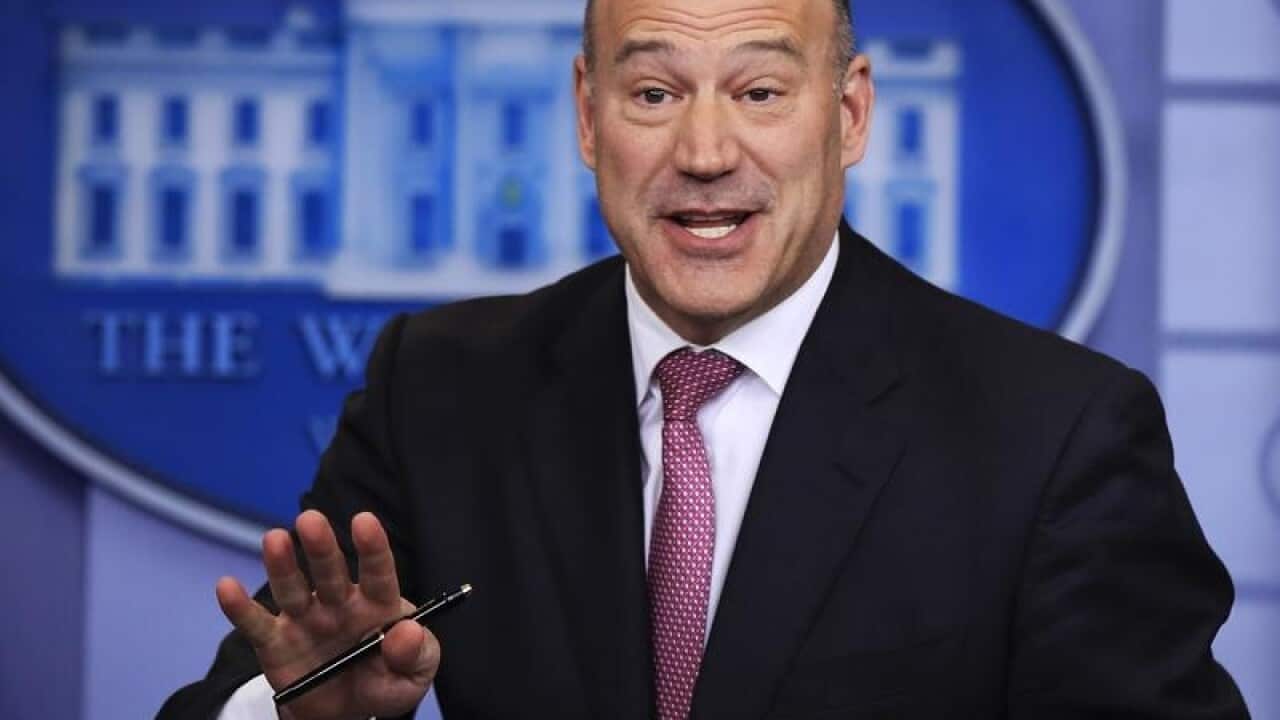
Donald Trump's top economic adviser Gary Cohn has resigned after the US president said he would push ahead with punitive tariffs on steel and aluminum imports, which some critics have dubbed the first shot in a global trade war.
Cohn did not spell out the reasons for his resignation, although he was regarded as a bulwark of economic orthodoxy in an administration whose protectionist policies have sparked alarm among US legislators and in governments across the world.
Despite a rising tide of criticism from Republican lawmakers about the proposed 25 per cent tariffs on steel and 10 per cent on aluminium imports, Trump said he would stick to his guns, and again lashed out at what he described as a rigged trading system that has bled American companies and jobs.
Given the size of America's trade deficit, Trump said the country would not be a loser in any fight.
"When we're behind on every single country, trade wars aren't so bad," he told reporters at the White House on Tuesday.
News that makes sense
Your trusted source for staying up-to-date with the world around you. Get free daily news updates and analysis, straight to your inbox.
Critics worry that the measures risk igniting a trade war and damaging the US economy.
A prominent Republican critic of the proposal, House of Representatives Speaker Paul Ryan, returned to the attack on Tuesday, saying the proposed duties were too broad.
Although the measure is designed to hit China, its main impact will be on US allies like Canada.
Ryan, whose home state of Wisconsin could be hit by proposed counter-tariffs from the European Union, has consistently opposed the tariffs and called for "more surgical and more targeted measures".
The White House has said the measures will protect industries and jobs from unfair competition, and that across-the-board tariffs are needed because countries like China use third countries for shipping steel to the United States, disguising its origin.
Opponents charge that the tariffs could destroy more jobs than they create and risk alienating US allies, while American consumers will end up paying more for a range of products from cans of beer to cars.
Financial markets have rallied off their lows on expectations the measures may be watered down in the face of an intense lobbying effort from leading Republicans.
Trump had been presented with three options by the Commerce Department. The broad tariffs that he announced last week were one.
He also had the option of imposing a much higher duty of 53 per cent on steel imports from on a narrower group of 12 countries that did not include Canada, Mexico and the European Union, although all countries would be subject to quotas.
For aluminium, China, Hong Kong, Russia, Venezuela and Vietnam would be subject to direct tariffs and others to quotas.







