

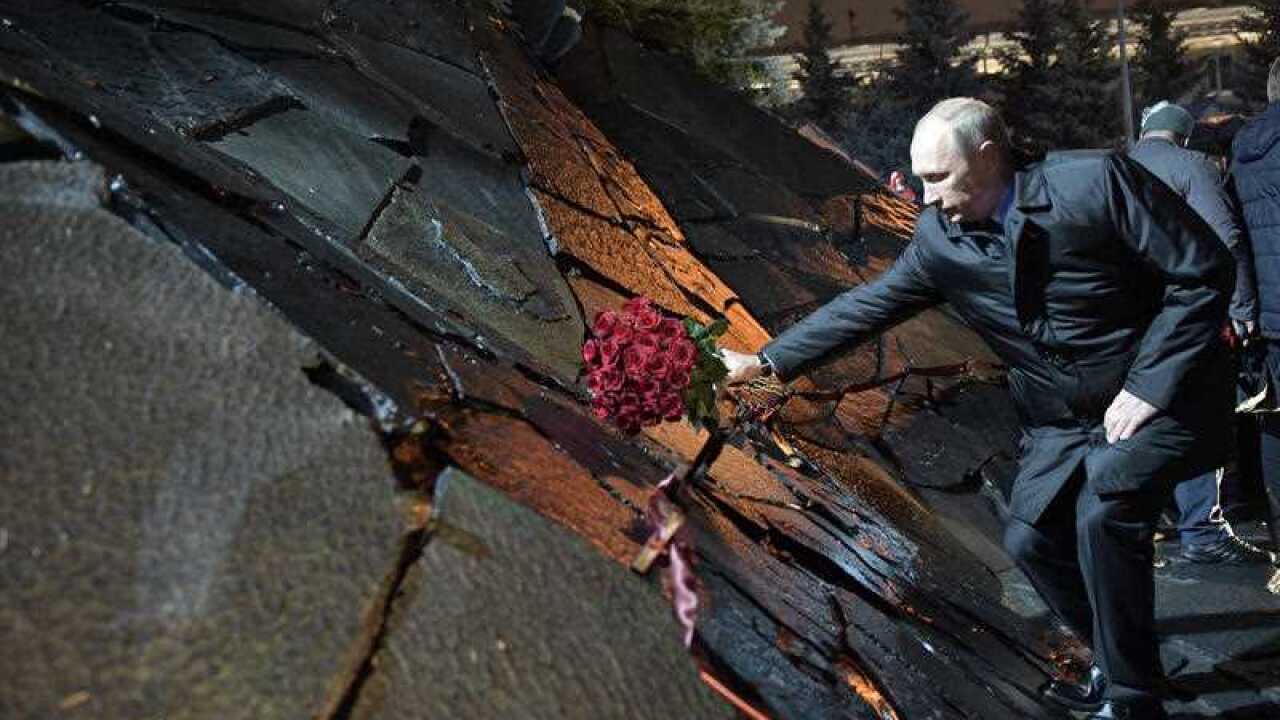
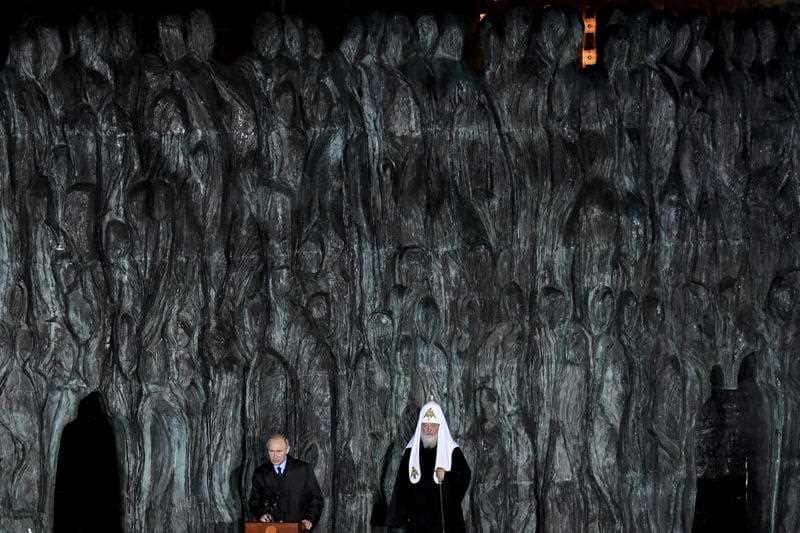
"The Wall of Grief", a large bronze relief of human figures in central Moscow, opened following decades of efforts to create such a memorial starting under dictator Joseph Stalin's successor Nikita Khrushchev.
"For all of us, including future generations, it is important to remember this tragic period of our history," Putin said at a ceremony that was also attended by Russian Orthodox Patriarch Kirill.
"Political repressions became a tragedy for our nation and society and a cruel blow to the roots, culture and identity of our nation. We feel their consequences until this day," Putin said of the purges under Stalin that saw millions of people executed and sent to labour camps.
He ended his speech with a quote from Natalya Solzhenitsyn, widow of the "Gulag Archipelago" author Alexander Solzhenitsyn, whose foundation supported the creation of the monument: "To know, to remember, to condemn and only then to forgive."
But an open letter signed by about 40 former political prisoners ahead of the ceremony called the unveiling "untimely and cynical".
"A memorial is a tribute to the past, but political repression in Russia is not only continuing but growing," said the letter, whose signatories included the Soviet-era dissident Vladimir Bukovsky and Crimean Tatar leader Mustafa Dzhemilev.
"Those currently in power in Russia, who back the opening of this monument, want to make it seem as if political repression is a thing of the distant past... (but) Russian political prisoners today deserve our help and attention just as much as victims of the Soviet regime deserve our remembrance and respect."
Mixed signals
After the ceremony dozens of people, many of whom had lost family members during the repressions, left flowers and walked around walls inscribed with the word "remember".
With tears in her eyes, 78-year-old Zoya Puchkina described how her father was arrested in 1943 after a colleague at the factory where he worked reported him for saying the country had not been ready for war.
By the time he was released ten years later, under Khrushchev’s thaws, Puchkina was a teenager and knew her father only through the letters he had sent.
"I'm crying but at the same time thank God they opened this memorial," she told AFP.
Alexei Baranov came from Saint Petersburg to remember the three members of his family who were shot by the Soviet secret police at the height of the purges in the 1930s.
"The opening of this memorial gives us a place to remember them. It's a sort of compensation for us, though of course a very small one, for what happened in the years of the Great Terror," he told AFP.
The Kremlin has sent mixed signals on Stalin-era crimes in recent years, with authorities playing down the horrors of the purges and reviving some of the Soviet Union's ideology and traditions.
Last month a bronze bust of the dictator was unveiled outside a Moscow military history museum during a ceremony attended by lawmakers, alongside statues of other Soviet leaders including Khrushchev and Vladimir Lenin.
Since Putin took power in 2000, there has been a growing number of Russians who take a positive view of the Soviet tyrant's role in history.
Sculptor Georgy Frangulyan, who created a monument to the first Russian president Boris Yeltsin, won a competition to design the monument at the junction of Moscow's central ring road and an avenue named after the dissident Nobel Peace Prize-winner Andrei Sakharov.
The project has received state backing and been supported by groups including the Solzhenitsyn Foundation and Memorial, a prominent organisation that works with Stalin-era archives but also campaigns against human rights violations under Putin.