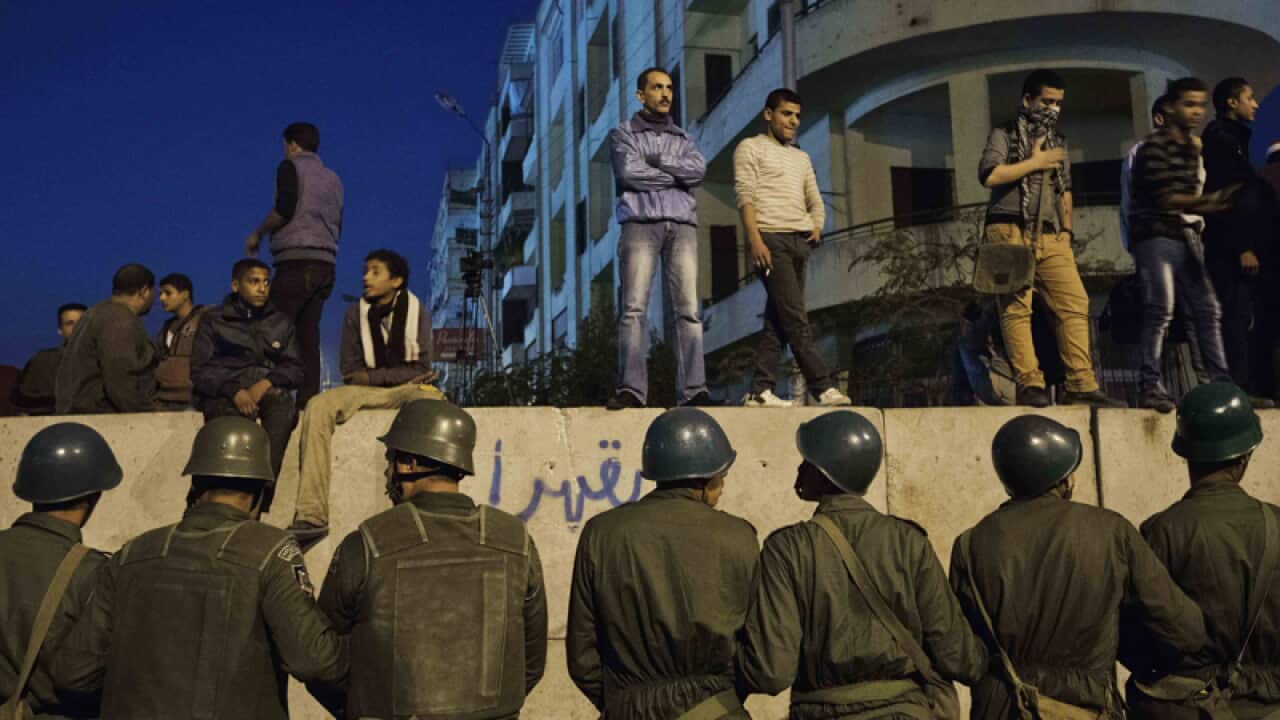
As Egypt prepares to vote on a controversial draft Constitution on December 15, the population, including many of the nation's political leaders, remains divided on the issue.
Professor Amin Saikal from the Centre for Arab & Islamic Studies at Australian National University tells SBS reporter Rhiannon Elston that despite some very vocal opposition, it's likely the vote will pass.
Rhiannon Elston: Thousands of protestors have already voiced their opposition to this referendum in a series of street demonstrations. It has also been firmly rejected by opposition groups. Who particularly is concerned about these potential changes, and what are the major fears?
Professor Amin Saikal: I think it's mainly the liberalists, also many elements of the Christian minority in Egypt. They are very concerned that the draft constitution contains many Islamist provisions which could easily enable the ruling Muslim Brotherhood to lead Egypt down the path of 'Islamisation' and therefore away from the democratic transformation of the country for which the revolution started in the first place.
RE: What are some of the big changes that could emerge if this draft constitution is accepted?
News that makes sense
Your trusted source for staying up-to-date with the world around you. Get free daily news updates and analysis, straight to your inbox.
AS: The Islamist content of the constitution could enable the government to shape Egyptian policy more along Islamist lines. Of course, President Morsi has said he wants to be very inclusive and consensual, but the opposition headed by people like the former head of the International Atomic Energy Agency Dr Mohamed ElBaradei, and the former Egyptian Foreign Minister and head of the Arab League Amr Moussa, they fear the constitution will provide legitimacy for the Muslim Brotherhood to engage in the Islamisation of politics and Egyptian society.
RE: Those who are protesting on the streets and in Tahrir Square, are they concerned about the same thing?
AS: These are the people who have been very concerned about this issue and of course it all started with their opposition to President Morsi assuming extra powers about three weeks ago. One must remember that the draft constitution very much was rushed through by a constituent assembly which had been dominated by the Muslim Brotherhood and that is what the fear of the opposition is, perhaps there should have been a lot more consultations. Perhaps the constituent assembly that drafted the constitution should have been far more inclusive and containing a range of voices and forces in the country, because one of the things that has really transpired since the overthrow of the former dictatorship of Hosni Mubarak in the country is that Egyptian politics has become very pluralist.
RE: Islamists say this constitution will restore political stability. Is this a realistic outcome if the referendum is passed?
AS: I think it's going to be very difficult. President Morsi, in many ways, is placed between a rock and a hard place in the sense that whatever he does, he still needs to carry his main constituency of support with him, and that is the Muslim Brotherhood, and perhaps also elements of the hardline Salafists in the country. On the other hand, he will also need to accommodate to whatever extent possible the demands of the liberalists and secularists.
RE: Many have called the outcome of Saturday's vote unpredictable. You mentioned earlier you think it's likely it will pass.
AS: I think it's possible because it's likely Morsi's supporters may well come out in large numbers to vote, and many segments of the opposition say they are going to boycott the vote.
RE: You made an interesting point earlier, saying that even if this constitution is passed, it won't be a healing process for the majority of Egyptians. How do you overcome that, is there any way that Morsi could lead this healing process forward?
AS: Well, I think it's going to be pretty difficult for him. But I think also that he will have to become a lot more inclusive than he has been, particularly in the last few weeks. I think he'll have to assure the Egyptian public that while there is Islamist content in the constitution – and of course, there should be room for some Islamist content in the constitution because the majority of Egypt is made up of Muslims, and many of them really devout Muslims – but at the same time he has to reassure them that while Islam is going to be respected, Sharia law, Islamic law is not necessarily going to form the basis of the legal system.







