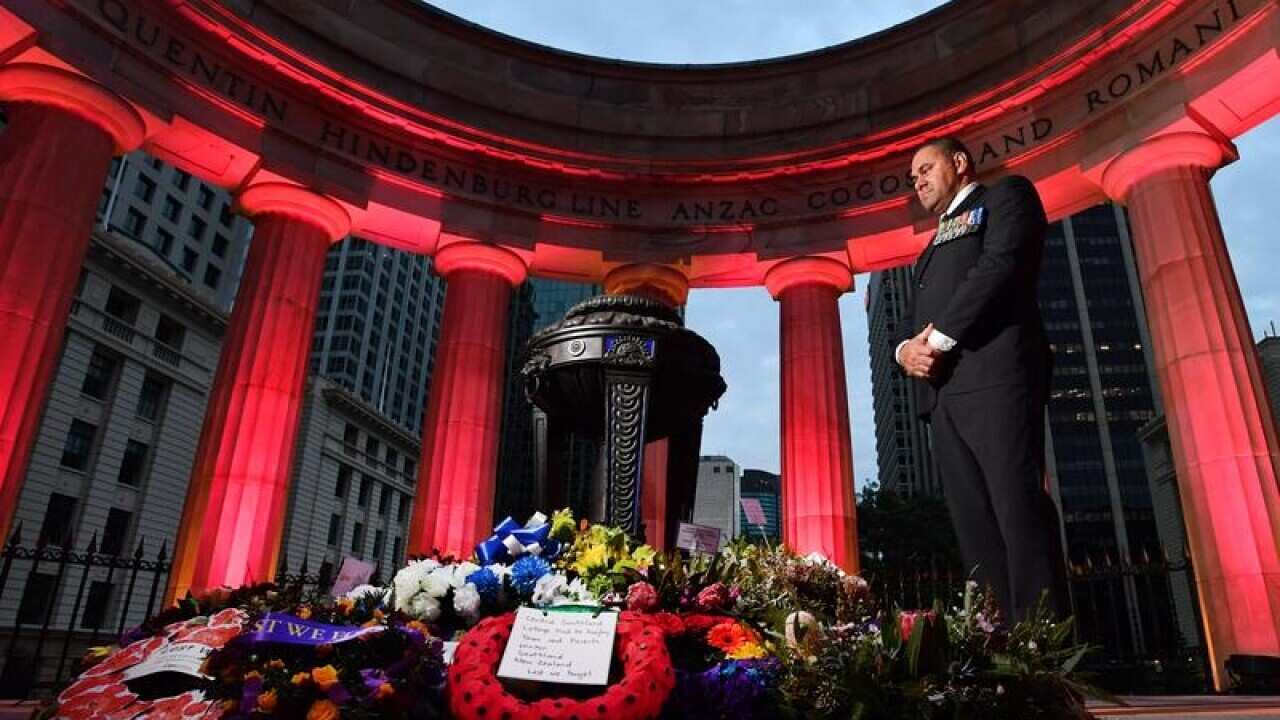
A new way to "ease into the boots of the first Anzacs" was shared with a crowd of about 20,000 in Brisbane's pre-dawn Anzac Day quiet.
Queensland Governor Paul de Jersey said there was a direct way of making a connection with them 104 years on from the landing at Gallipoli.
"We can see their faces," he said, as the crowd was shown a handful of the State Library's almost 27,000 newly-digitised photos of First World War veterans.
He said while they appeared ordinary, they displayed incredible courage.
"More than a century later, when we can scan the faces of the men and their most extraordinary feature is that there is nothing extraordinary about them at all," he said.
"They are faces of everyday Queenslanders who had hitherto lived everyday lives."
"But we know that these men are the same men that displayed such extraordinary daring and courage at Gallipoli in the Middle East and in the killing fields of the Western Front."
As thousands reflected on veterans from decades ago, many in the crowd fought in recent conflicts like veteran Peter Rabula, 49, who retired from the army three years ago.
He said dawn services were always emotional.
"I prefer the dawn services - I've lost some mates overseas so obviously it's pretty emotional," he said.
"Today really highlights a lot of the sacrifices a lot of our forefathers made."
Veteran Anthony Griffiths, 65, said the reverence Australians and New Zealanders felt towards Anzac Day ceremonies had not diminished.
As if to prove his point, cousins Lexxie Desmond, 10 and Zachary Keatin, 7, said their thoughts were with their great grandfather who served in World War II.
"Our great grandad Eric (Stewart) was in the war," Zachary said.
"We're remembering that they died for us," Lexxie added. "I remember that they fought for us and were brave."
South of Brisbane, at the Gold Coast's Elephant Rock, Currumbin RSL president Michael Humphreys highlighted that more needed to be done to support service men and women.
"No one can underestimate the price that has been paid by individuals and families ... because there are hundreds, if not thousands, carrying the physical and psychological injuries and will do for years to come."
He said from 2001 to 2016 there were 373 recorded suicides in the ADF community.
"We must do more to help the individuals and families who suffer."
Lifeline 13 11 14
beyondblue 1300 22 4636





