
Israeli Prime Minister Benjamin Netanyahu accused Hamas of responsibility for the kidnapping, and then began a harsh crackdown that led to the worst Palestinian-Israeli violence in years.
Hundreds of suspected Hamas operatives were arrested in the sweep, which led to a flare-up of hostilities across the Gaza-Israel border that in turn escalated into the war that was ended by a cease-fire a month ago.
The conflict killed more than 2,100 Palestinians, 72 Israelis and a foreign worker.
Now it's questionable that Hamas as an organization had anything to do with the original kidnapping.
An Israeli indictment submitted this month against the alleged ringleader of the kidnappers suggests the abduction plot was hatched by a local cell in the West Bank city of Hebron.
The indictment describes the kidnappers as acting on their own, not on orders from the Hamas leadership.
Statements by Hamas political chief Khaled Mashal also indicate the leadership of the organization was not party to the abduction plot.
The kidnapping on June 12 came at an awkward time for Hamas. Only days before it had agreed to form a unity government with the more moderate Fatah movement of Palestinian Authority President Mahmoud Abbas. Netanyahu objected to the unity government - Israel sees Hamas as a terrorist organization that refused to recognize Israel's right to exist - seized upon it as proof that Abbas's deal with Hamas had buried hopes for peace.
The alleged organizer of the attack, who is in Israeli custody, and one of the suspected kidnappers belong to the Qawasmeh clan in Hebron, some of whose members were known to be Hamas activists involved in attacks on Israelis. Yet the indictment describes the kidnappers as acting on their own, not on orders from the Hamas leadership.
The charges
According to the charges submitted to an Israeli military court on September 4, the idea for the abduction emerged from a meeting between the alleged organizer, Husam Qawasmeh, and Marwan Qawasmeh, one of the suspected kidnappers, who said he wanted to "take action" to free Palestinian prisoners held in Israel.
Marwan Qawasmeh had been arrested previously for Hamas activities, confessing under interrogation that he had been recruited by the armed wing of the organization in the Hebron area, according to Israeli security officials.
"Marwan offered (Husam) to join him in abducting a Jew in order to bring about the release of the Palestinian prisoners jailed in Israel," the indictment says.
"The defendant agreed."
According to the charges, Husam Qawasmeh was in charge of logistics.
Statements by Hamas political chief Khaled Mashal indicate the leadership of the organization was not party to the abduction plot.
He contacted his brother, a Hamas operative and former prisoner expelled to the Gaza Strip, to get money to buy cars and weapons to be used in the abduction.
The brother, who works for the Nur Association, a Hamas group that provides financial aid to families of prisoners and others killed in the conflict with Israel, transferred the requested funds to the West Bank, the indictment said.
Marwan Qawasmeh recruited Amer Abu Aisheh as an accomplice in the kidnapping. Abu Aisheh was a former prisoner whose brother was killed in 2005 while trying to hurl an explosive device at soldiers, according to the Israeli security officials.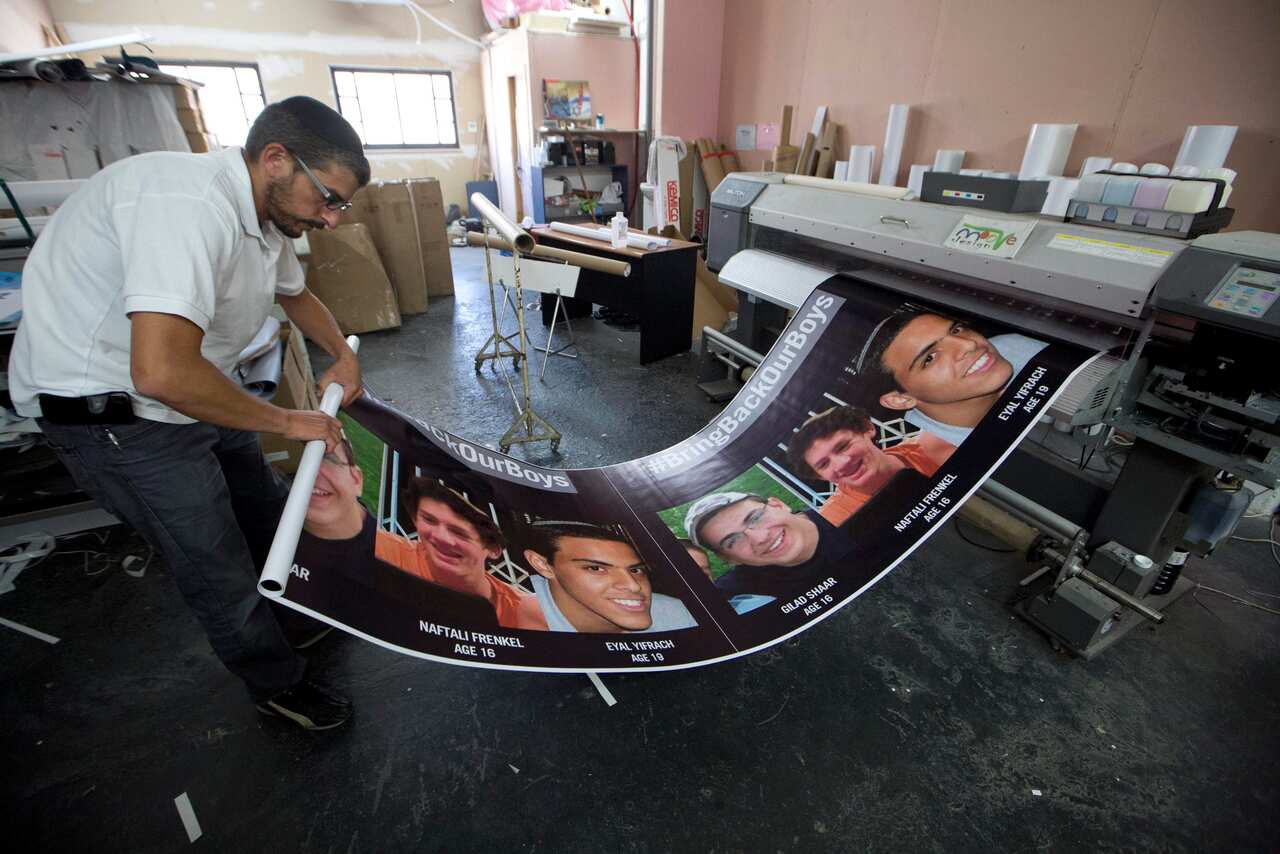 After picking up the Israeli teenagers, who were hitchhiking home from their schools in the West Bank, the kidnappers decided to kill them when they resisted orders to keep silent, shooting them in the back seat of the Palestinians' car, the indictment said.
The bodies of the three - Eyal Yifrah, 19, Gil-Ad Shaer, 16, and Naftali Fraenkel, 16 - were later buried and concealed in a plot of land owned by Husam Qawasmeh.
Was Hamas responsible for the killings?
In his initial statement assigning blame for the kidnapping, Netanyahu said it was carried out by "members of Hamas."
Later Netanyahu pointed a finger at Hamas as a whole.
"Hamas is responsible, and Hamas will pay," he said after the bodies of the three youths were found on June 30 as violence escalated across the Gaza frontier.
Khaled Mashal, the political leader of Hamas, initially refused to confirm or deny his group's responsibility for the kidnapping. But in an interview with Yahoo News on August 22, he described the abduction as a locally organized initiative of Hamas operatives.
"As a Hamas leadership, we were not aware of this action taken by this group of Hamas members in advance," he said. "We learned about these confessions from the Israeli investigation. The Hamas political leadership was not aware of all these details. We learned about it later on."
Another Hamas leader in exile, Saleh al-Arouri, said days earlier that the abduction had been carried out by members of Hamas's armed wing, the Qassam Brigades, but he did not comment on whether the action was coordinated with the group's leadership.
Lt. Col. Peter Lerner, an Israeli army spokesman, said it did not matter whether the kidnappers had acted on specific orders from Hamas leaders, because the leadership has consistently called for the kidnapping of Israelis to trade them for Palestinian prisoners.
Israel freed more than 1,000 Palestinian prisoners in 2011 in exchange for Gilad Shalit, an Israeli soldier seized by Hamas and held captive in the Gaza Strip for more than five years.
"This is the spirit of Hamas," he said. "There is no need for a specific order."
© 2014 Tribune Content Agency News Service
Share


