(Transcript from SBS World News Radio)
An unprecedented court ruling in The Netherlands is raising questions about the legal responsibility of United Nations peacekeepers in war zones and their immunity from prosecution.
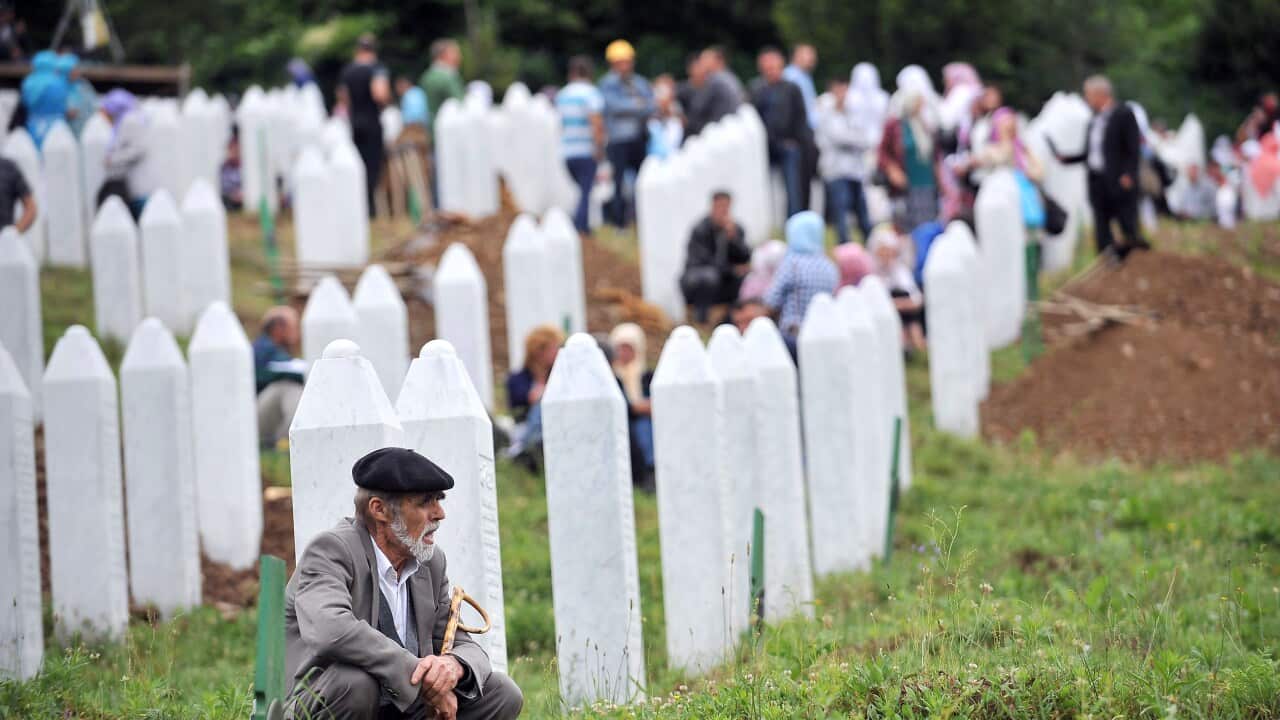
Almost 20 years after the massacre of thousands of Bosnian Muslim men and boys in the town of Srebrenica, a Dutch court has decided the state must pay compensation for some of the victims who had -- at the time -- sought protection from its soldiers, but were sent away.
Kristina Kukolja has the story.
(Click the audio tab above to hear the full report)
"Do not send your soldiers if they will not act appropriate to the mandate they've got. What's the purpose of such a mandate? Just to be there? Or to protect? To fulfil aims or goals of the mandate?"
With these words lawyer Semir Guzin lays out what he sees as the indisputable significance of a Dutch court ruling that The Netherlands can be held liable for the deaths of hundreds of Bosnian Muslims killed in a wartime massacre.
For 14 years he's represented the relatives of some of the 8,000 men and boys killed by Serb forces after the fall of the town of Srebrenica in July 1995.
Their bodies were buried in mass graves.
The area had been declared a safe zone by the United Nations and was manned by Dutch peacekeepers.
Now, a District Court in The Hague says the state was partially responsible for the deaths of over 300 of them, who'd sought refuge in the UN base in nearby Potocari, but were sent away even as killings went on in the surrounding Serb-held territory.
The court said the Dutch soldiers must have known they would be executed.
Mr Guzin describes the ruling as historic.
"For the first time [a] court found responsibility of one state for the [actions] of their soldiers in a UN mandated operation. We think the ruling definitely has an historical importance and that it is the first step on our path to final justice for all victims."
Semir Guzin says lawyers for the Srebrenica families will appeal the court decision in the hope it could extend to all of the victims.
It's an outcome that would certainly be welcomed by survivors in Bosnia and around the world who still live with the memory of those days.
26 year old Melbourne man Salmir Suljagic is from Bratunac, outside of Srebrenica.
His father, uncle and two grandfathers were killed in Potocari.
Salmir says although the ruling won't bring them back, it could help heal divisions.
"The people who still do not recognise the genocide in Srebrenica it will be a historical fact. It will help in the healing process in the sense that the children of the perpetrators and the bystanders will be able to ask, 'How could this have happened?' Just like my children and the children of the victims will be asking that question."
The Netherlands can still appeal to the Constitutional Court, but Salmir hopes that won't happen.
"It would be trying to absolve themselves of their international responsibility and it will be a stab to the victims who actually survived Srebrenica and the families of those who lost loved ones in Srebrenica because we know for a fact that the Dutch did nothing and by demilitarising the area they actually gave people a false sense of hope of survival and that led to a lot of people naively going to the UN Dutch base only to be handed over to the place of torture and execution."
In 2001 the UN Tribunal for the former Yugoslavia in The Hague judged the events in Srebrenica as genocide.
The following year the Dutch government, and the army chief, resigned over the failure of troops to protect those killed.
No court has ever successfully prosecuted UN peacekeepers because of legal immunity granted to them by the world body.
But the first breakthrough came just last year when the Dutch Supreme Court found The Netherlands could be held responsible for the deaths of three Srebrenica men.
Human rights lawyer Geoffrey Robertson says countries should think about how they contribute to international peacekeeping missions.
"It shows countries that if they're going to go out on a limb for peace that they've got to not only send soldiers in sufficient numbers, but they've also got to send soldiers who are prepared to fight to protect the innocent rather than to make this empty but fashionable gesture. So, I think that's a lesson and it's also a lesson for the United Nations that you cannot send simply token troops in a pre-genocide situation."
The Bosnian Serb army commander Ratko Mladic and former political leader Radovan Karadzic are on trial for war crimes, including in relation to Srebrenica, at the International Criminal Tribunal for the former Yugoslavia in The Hague.
Around 2,000 of the Bosnian Muslims killed in Srebrenica still haven't been accounted for.
Share


