(Transcript from SBS World News Radio)
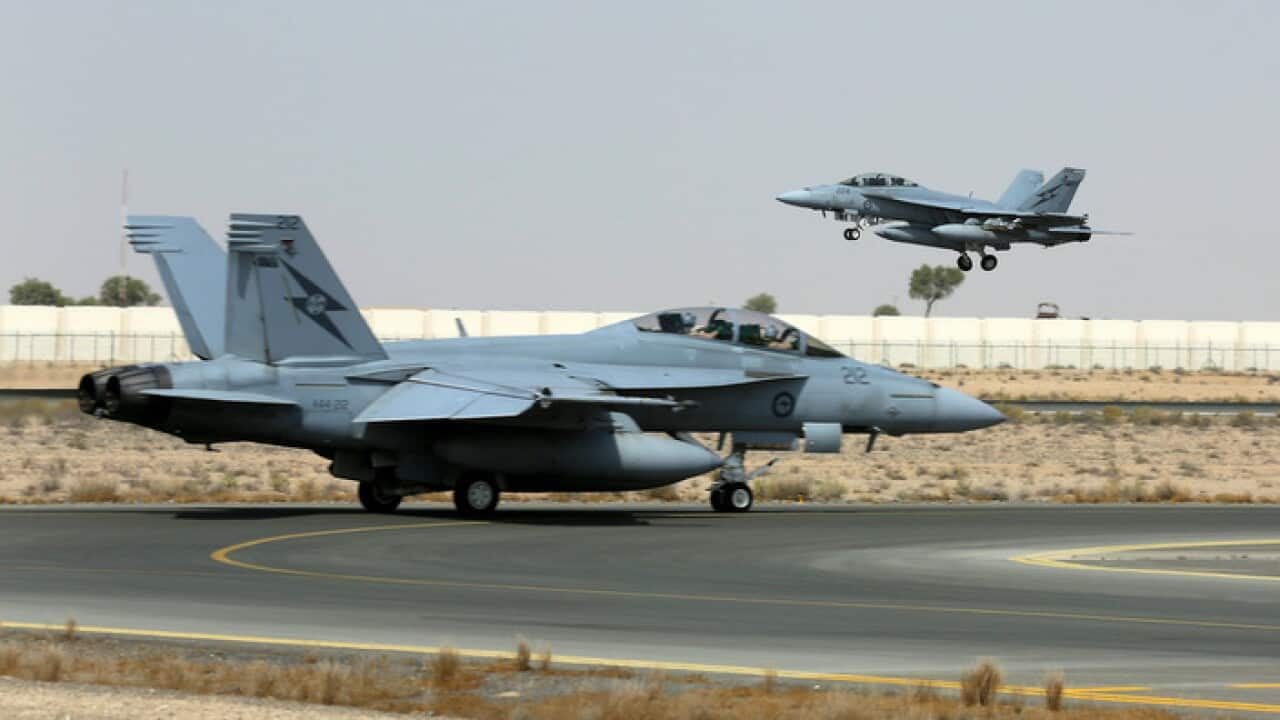
Australian aircraft have conducted their first combat mission over Iraq - without actually attacking any target.
This follows a decision last week by federal cabinet to give the go ahead for combat missions to proceed.
Amanda Cavill has the details.
(Click on the audio tab above to hear the full report)
News that makes sense
Your trusted source for staying up-to-date with the world around you. Get free daily news updates and analysis, straight to your inbox.
Two RAAF Super Hornets took off from the Australian base in the United Arab Emirates shortly after nine o'clock on Sunday night.
A refuelling aircraft also took off to support the mission together with the RAAF's Wedgetail airborne early warning and control aircraft.
The Wedgetail wasn't specifically supporting the Australian aircraft but directing coalition aircraft in what appears to be increasingly crowded air space.
The Australian Super Hornets have joined aircraft from the US, Britain, France, the UAE, Jordan, Saudi Arabia, Qatar and Bahrain which have all conducted attacks against Islamic State forces inside Iraq.
The aircraft were assigned to a combat air patrol, to be called on if needed.
As it turned out, they were not needed and no missiles were fired.
Defence Minister David Johnston has told the ABC it's not unusual for planes to take off but not take part in combat action.
"To the best of my knowledge what our operational parameters are is that we deploy our aircraft into the air off the tankers and wait to be assigned various target packages and things of that nature. There's a very large number of aircraft, a number of Coalition partners. It may be that from day to day, time to time, no such targeting is specified and in that instance our aircraft come home."
Labor frontbencher Chris Bowen says the mission has the support of the government, the opposition and the Australian people.
"It's a mission in defence of the defenceless. And it's a responsibility on all nations of good conscience to ability. But of course as nations of good conscience act, it's individuals who take the risks. Individual members of the Australian Defence Forces. Our thoughts, our hopes are with them and with the quest for freedom of the people of Iraq. We wish them the best as this combat mission begins and is the first of more to come."
Prime Minister Tony Abbott continues to warn of a long battle ahead.
Mr Abbott says the mission could take months rather than weeks.
Peter Jennings, from the Australian Security Policy Institute, says how long Australian forces will be in Iraq depends on whether time and effort is put into training the Iraqi army to properly fight the insurgents.
"If we continue with the current strategy which frankly is a rather half-hearted attempt. Where the Americans don't wish to become more involved there will be no political resolution. On the other hand if the US decides to more seriously invest in order to give the Iraqi military the capability it needs we are still talking about months to possibly years in order for them to be trained up to retake the territory that's been taken from them."
Australia is also planning the deployment of about 200 Special Forces into Iraq to advise and assist Iraqi forces.
However, Australia is still waiting for final rules of engagement and mission tasks to be established for the commandos.
The government continues to stress they will be in Iraq in an advisory role only.
But Peter Jennings believes Iraqi forces will need more help than that.
"The thing that I am struck by is just how sophisticated ISIL is in its thinking about both the strategy and the tactics of its operations. They have heavy weapons. They have large numbers of people. And they've really got the freedom to choose between heavy weaponry attacks or terrorist type operations. I think they are turning into the worst of all possible worlds. Well funded, well armed, smart, well trained. This is not an easy enemy by any stretch of the imagination."
The cost of Australian involvement is being estimated at at least $500,000 a year.
The government says it will look at how best to find the money and release the details in its Mid Year Economic Fiscal Outlook due later in the year.
The opposition says the money should not be found by raising taxes or cutting foreign aid or services.







