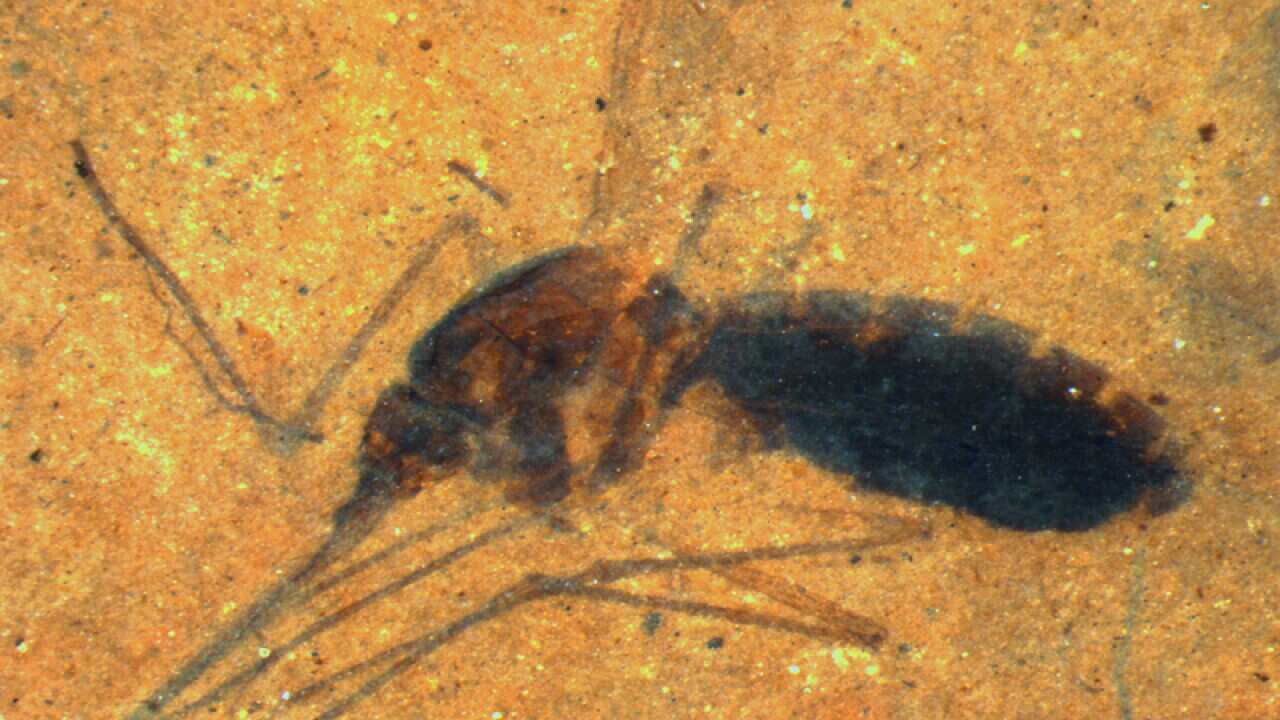
A unique 46-million-year-old mosquito fossil with a belly full of dried blood has been found in a Montana riverbed, US researchers say.
"It is an extremely rare fossil, the only one of its kind in the world," said Dale Greenwalt, lead author of the study in the Proceedings of the National Academy of Sciences, on Monday.
Cutting-edge instruments detected the unmistakable traces of iron in her engorged abdomen, but just what creature that blood came from is a mystery since DNA cannot be extracted from a fossil that old.
Greenwalt said it might have been blood from a bird, since the ancient mosquito resembles a modern one from the genus Culicidae, which likes to feed on our feathered friends.
"But that would be pure speculation," said Greenwalt, a retired biochemist who volunteers at the Smithsonian Museum of Natural History in Washington.
News that makes sense
Your trusted source for staying up-to-date with the world around you. Get free daily news updates and analysis, straight to your inbox.
Greenwalt said he became fascinated with fossilised insects several years ago.
He learned about Master's student Kurt Constenius, who described his discoveries of fossilised insects along a remote Montana riverbed in an obscure geological journal more than two decades ago.
Greenwalt and Constenius discussed the fossil grounds, which lie near the Flathead River along the western boundary of Glacier National Park.
The fossil described in PNAS came from a collection of fossilised insects languishing in Constenius's basement since the 1980s, and which he and his family had donated to the Smithsonian museum.
"As soon as I saw it, I knew it was different," Greenwalt told AFP.
The mosquito itself is only about 0.5cm in size. Somehow, the fragile creature ate its last meal, filling its abdomen until it was nearly ready to burst like a balloon.
Then, perhaps as the mosquito was flying over an algae-coated lake, it became caught in that mucus, enveloped in microbes that protected it from degrading, and eventually sank deep into the sediment of the lake.
Despite its impressive age it is far from the oldest known mosquito fossil. That honour goes to a 95-million-year-old mosquito in amber in Myanmar.







