
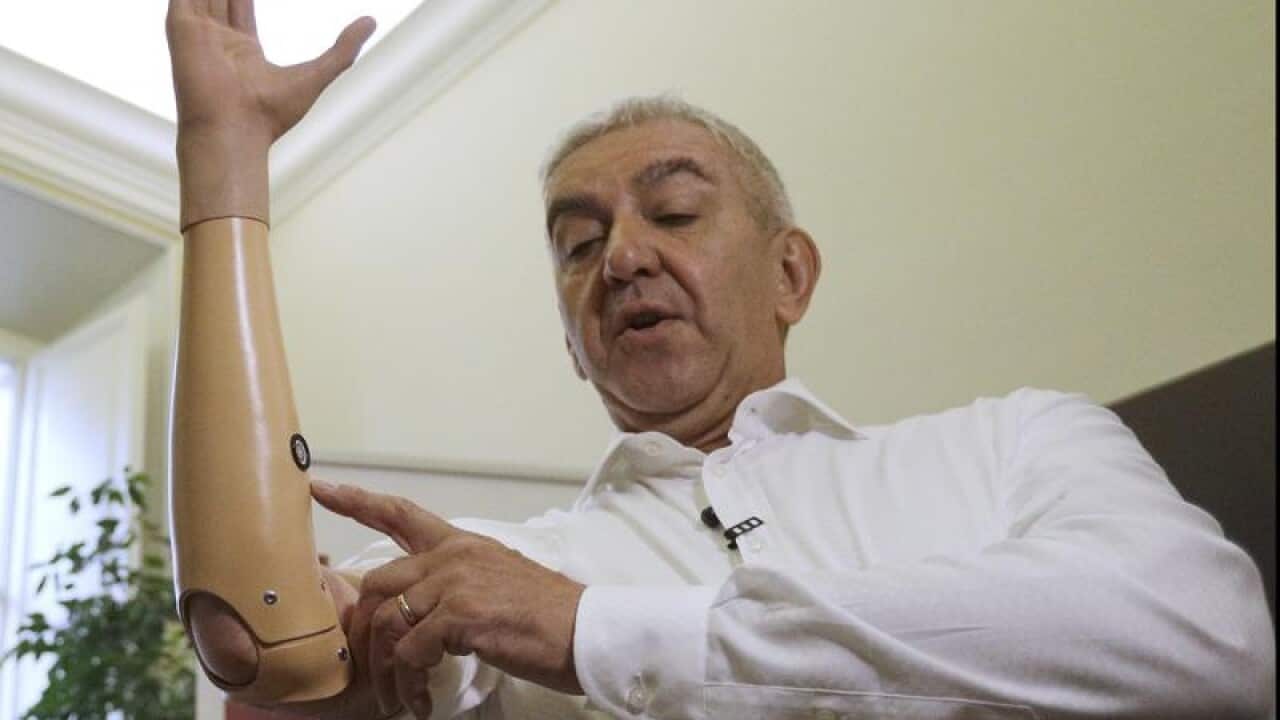
Italian researchers have unveiled a new robotic hand they say allows users to grip objects more naturally and features a design that will lower the price significantly.
The Hennes robotic hand has a simpler mechanical design compared with other such myoelectric prosthetics, characterised by sensors that react to electrical signals from the brain to the muscles, said researcher Lorenzo De Michieli, who helped develop the hand.
The Hennes has only one motor that controls all five fingers, making it lighter, cheaper and more able to adapt to the shape of objects.
"This can be considered low-cost because we reduce to the minimum the mechanical complexity to achieve, at the same time, a very effective grasp, and a very effective behaviour of the prosthesis," De Michieli said.
They plan to bring it to market in Europe next year with a target price of around 10,000 euros ($A15,823), about 30 per cent below current market prices.
Arun Jayaraman, a robotic prosthetic researcher at the Shirley Ryan AbilityLab in Chicago, said the lighter design could help overcome some resistance in users to the myoelectric hands, which to date have been too heavy for some.
Italian researchers say the Hennes weighs about the same as a human hand.
In the US, many amputees prefer the much simpler hook prosthetic, which attaches by a shoulder harness, because it allows them to continue to operate heavy equipment, Jayaraman said.
Cost remains a barrier for advanced prosthetic limbs, as well as the fact that the more complex motorised systems tend to be "heavy and fragile. They also get hard to control," said Robert Gaunt, an assistant professor of rehabilitation at the University of Pittsburgh.
Limitations remain such as the inability to control individual fingers for tasks like playing the piano or typing on a computer.
"But the vast majority of what many of us do with our hands every day is simply grasp objects," Gaunt said.





