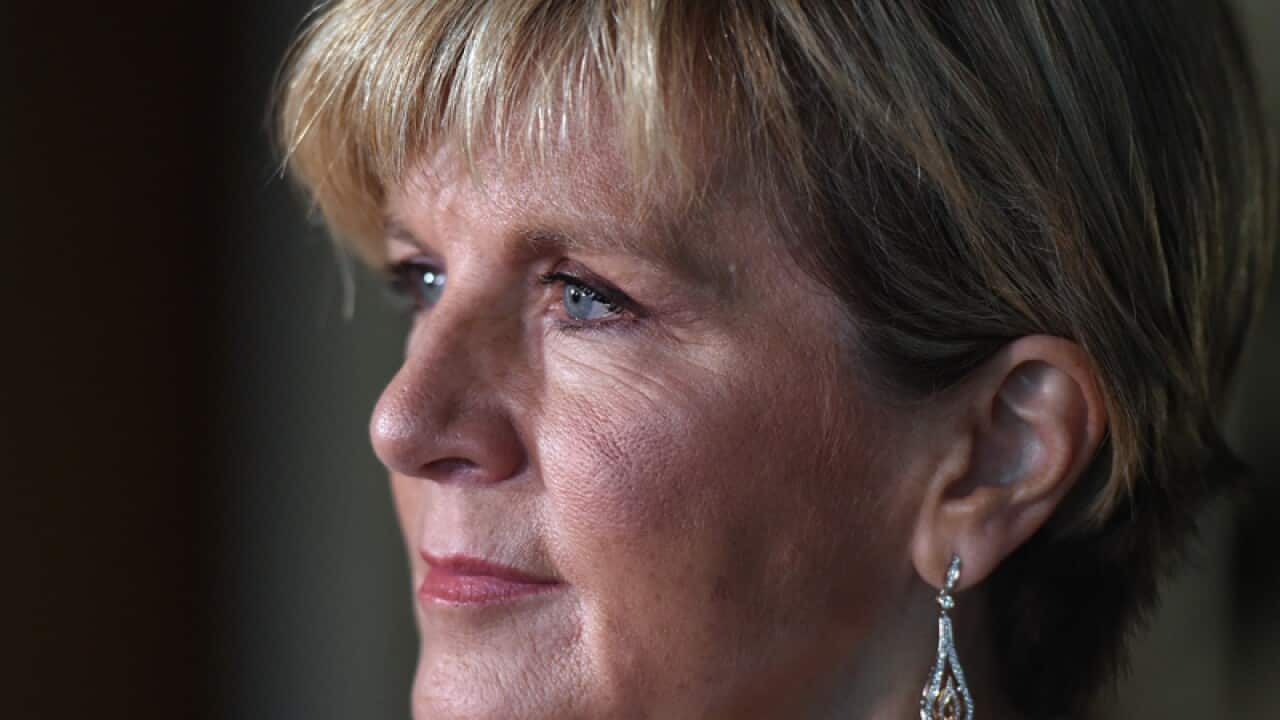
China and Australia have agreed to disagree on the South China Sea territorial dispute during a "candid exchange of views" by their foreign ministers.
Foreign Minister Julie Bishop and her Chinese counterpart Wang Yi held official talks on Wednesday in Beijing, canvassing bilateral relations, economic ties, people-to-people links and strategic issues, including the maritime dispute and North Korea.
Ms Bishop emphasised their discussions were conducted "as friends, forthrightly but with mutual respect" on areas of disagreement and common interests.
The press conference was delayed after reports emerged that China had deployed an advanced surface-to-air missile system on Woody Island, one of the disputed islands it controls in the South China Sea.
But Mr Wang dismissed the claims.
News that makes sense
Your trusted source for staying up-to-date with the world around you. Get free daily news updates and analysis, straight to your inbox.
"This is an attempt by certain western media to create new stories," Mr Wang told reporters through an interpreter in Beijing on Wednesday.
Ahead of her arrival, Ms Bishop had sparked a terse reaction from Chinese officials after she flagged quizzing China about purpose of its reclamation work on artificial islands and inquiring whether other countries would be granted access.
Mr Wang pointed to lighthouses China had built on the reclaimed islands to ensure the safety of passing ships in those waters.
He also hailed the meteorological forecast resources and rescue facilities that were in the pipeline.
"China, as the biggest littoral state in the South China Sea, has undertaken to provide more public goods and services to the international community," Mr Wang said.
China had a self-preservation right under international law to have limited self-defence facilities on the islands and reefs, he said.
The pair disagreed on the merits of a Philippines move to seek arbitration.
Mr Wang signalled Beijing would not be spooked by Australia's potential purchase of a new submarine fleet from Japan.
Asked if he saw the move as efforts to contain China's rise, Mr Wang replied he didn't think that was the intention.
"I actually don't think any country or force in the world can stop that rise," he said.
He said Australia and China would continue to enhance military-to-military exchanges and co-operation.
Ms Bishop responded that Australia was looking for a submarine fleet that met capability and technological requirements, and that would drive the evaluation process.
Australia also recognised China's right to take a strategic leadership role in the region commensurate with its extraordinary economic growth.
Meanwhile, the two countries will set up a working group to bring together officials involved in developing Northern Australia, and in China's belt and road initiative - a reference to the historic Silk Road from China to central Asia and maritime trade routes.
The working group will look at issues such as early harvests.
Mr Wang praised efforts to streamline visa processing for Chinese tourists to Australia.
Prime Minister Malcolm Turnbull is expected to make his first official visit to China later this year and Chinese Premier Li Keqiang will travel to Australia.







