
Note: Readers seeking support can contact the Sexual Assault & Domestic Violence National Help Line on 1800 737 732 or Lifeline on 13 11 14.
Rolling Stone magazine retracted its controversial story about an alleged gang rape at the University of Virginia after an independent review deemed it a “failure of journalism,” the magazine’s managing editor said Sunday.
“The report was painful reading, to me personally and to all of us at Rolling Stone,” Rolling Stone managing editor Will Dana said in an editor’s note appended to the outside review published on Rolling Stone’s website, and cross-published on the website of the Columbia Journalism Review magazine.
“It is also, in its own way, a fascinating document — a piece of journalism … about a failure of journalism.”
The authors of Columbia University’s investigation called Rolling Stone’s article and what happened after its publication “a story of journalistic failure that was avoidable.”
“The failure encompassed reporting, editing, editorial supervision and fact-checking,” Columbia’s authors wrote. “The magazine set aside or rationalized as unnecessary essential practices of reporting that, if pursued, would likely have led the magazine’s editors to reconsider publishing Jackie’s narrative so prominently, if at all.”
The report’s authors were Sheila Coronel, dean of academic affairs at Columbia Journalism School; Steve Coll, dean of the Columbia Journalism School; and Derek Kravitz, a postgraduate research scholar at Columbia Journalism School.
Rolling Stone requested the probe after news reports raised doubts about the accuracy of writer Sabrina Rubin Erdely’s explosive Nov. 19 article, “A Rape on Campus: A Brutal Assault and Struggle for Justice at UVA.”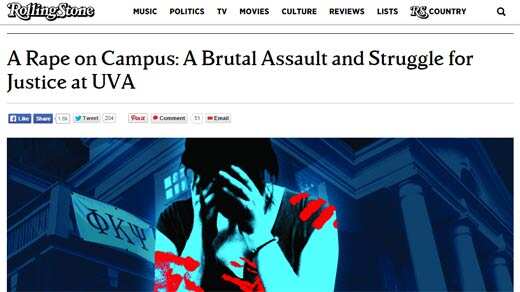 The story shook the University of Virginia, where officials swiftly suspended fraternity activities and asked local police to investigate the allegations.
Screenshot of 'A Rape on Campus: A Brutal Assault and Struggle for Justice at UVA.' Source: Rolling Stone
Erdely issued an apology Sunday, calling the past few months “among the most painful of my life. Reading the Columbia account of the mistakes and misjudgments in my reporting was a brutal and humbling experience.”
She apologized “to Rolling Stone’s readers, to my Rolling Stone editors and colleagues, to the UVA community, and to any victims of sexual assault who may feel fearful as a result of my article.”
The original Rolling Stone narrative told the story of a freshman named “Jackie” who said she was gang raped during a social function at a fraternity.
The Columbia investigators concluded that “If Jackie was attacked and, if so, by whom, cannot be established definitively from the evidence available.”
Earlier, police and the media had raised questions about several significant discrepancies in Jackie’s story.
The original Rolling Stone story was published at a time of rising national concern over the prevalence of sexual assaults on college campuses, and the initial public reaction was one of revulsion and outrage, not skepticism.
The magazine’s dramatic narrative relied heavily on the account of Jackie, a freshman and “a chatty, straight-A achiever from a rural Virginia town” who said she was invited to a fraternity party by a fellow lifeguard at the university pool named “Drew.”
The original story said Jackie was gang-raped for hours at that party by seven men as Drew and another man cheered Jackie’s attackers on.
Ensuing news reports and a Charlottesville, Va., police investigation found serious flaws in the Rolling Stone feature. The magazine’s dramatic narrative relied heavily on the account of “Jackie,” who reportedly asked the magazine not to contact her alleged attackers for their side of the story.
Reporters and investigators could not corroborate details in the articles. Most notably, there was no fraternity function on the night of the alleged rape.
In December, Rolling Stone publisher and editor Jann S. Wenner enlisted Columbia University, which has one of the most respected journalism schools in the country, to reinvestigate the story. Rolling Stone said Sunday that the magazine did not pay Columbia University to report and produce the inquiry. Rolling Stone promised to produce the final report in full on its website, and will run a condensed version in print.
Dana acknowledged Sunday that the magazine had botched the story by not contacting Jackie’s alleged attackers.
“In trying to be sensitive to the unfair shame and humiliation many women feel after a sexual assault, we made a judgment — the kind of judgment reporters and editors make every day,” Dana wrote. “We should have not made this agreement with Jackie and we should have worked harder to convince her that the truth would have been better served by getting the other side of the story.”
On March 23, Charlottesville police announced they had suspended their investigation after they could find no evidence that the alleged rape had taken place.
“Unfortunately, we’re not able to conclude to any substantive degree that an incident consistent with the facts in that article (occurred at the fraternity house named in the Rolling Stone story) or any other fraternity house, for that matter,” Charlottesville Police Chief Timothy Longo said in a televised news conference. “That doesn’t mean that something terrible did not happen to Jackie. … I can’t prove that something didn’t happen.”
Through an attorney, Jackie declined to comment to the Los Angeles Times after the police announcement in March.
Police said the article’s author, Erdely, who has stayed out of the public spotlight since the controversy began, had cooperated with their investigation as much as she could without compromising sources.
Share


