Prime Minister Kevin Rudd says he has spoken with US President Barack Obama about the situation in Syria.
Mr Rudd says history will judge the international community poorly if it does not stop the slaughter, likening it to the 1995 massacre in Srebrenica and the 1994 genocide in Rwanda.
Mr Rudd says it's becoming increasingly clear that the regime of Bashar al-Assad carried out last week's strike on a civilian community near Damascus and he's condemned snipers trying to disrupt the work of UN experts inspecting the site.
The Prime Minister says he and President Obama have had a detailed discussion about the situation in Syria.
"The situation in Syria is a grave one and the President is consulting allies about two things: where the evidence points in terms of who is responsible for what is now patently clear to have been a chemical weapons attack and secondly what now must be done across the international community. We also had a detailed conversation about the future of Syria and where it goes to from here given the enormously complex politics on the ground."
News that makes sense
Your trusted source for staying up-to-date with the world around you. Get free daily news updates and analysis, straight to your inbox.
Washington has warned Syria that it would face action over the "moral obscenity" of a chemical weapons attack following sniper attacks against UN inspectors gathering evidence in Syria.
Speaking amid reports that Washington and its allies are preparing to launch a punitive cruise missile strike on Syrian targets, US Secretary of State John Kerry accused Bashar al-Assad's regime of engaging in a cover-up.
"Let me be clear. The indiscriminate slaughter of civilians, the killing of women and children and innocent bystanders by chemical weapons is a moral obscenity," Kerry declared in a televised statement.
"By any standard it is inexcusable, and despite the excuses and equivocations that some have manufactured, it is undeniable."
But Syria's President Assad has rejected it had any role in the alleged chemical weapons attack.
Assad told pro-Kremlin daily newspaper Izvestia that Syria would never be a "puppet" of the West and warned the US against attacking his country.
In his remarks that appeared in the newspaper, he said Washington has never succeeded in reaching its political aims through war, citing US' previous military campaigns in recent years.
"The US faces failure just like in all the previous wars they waged, starting with Vietnam and up to our days," he said.
"America has taken part in many wars but could not once achieve its political goals for which the wars were started. Yes, it is true, the great powers can wage wars but can they win them?" he asked.
Senator Kerry said Washington would provide more evidence of who was behind the attack, and that US President Barack Obama was determined that the guilty would face consequences.
"We have additional information about this attack, and that information is being compiled and reviewed together with our partners, and we will provide that information in the days ahead," he warned.
"Make no mistake. President Obama believes there must be accountability for those who would use the world's most heinous weapons against the world's most vulnerable people. Nothing today is more serious."
Kerry was speaking as United Nations inspectors met survivors of last week's attack, which the independent medical agency Doctors Without Borders has said left at least 355 people dead from "neurotoxic symptoms."
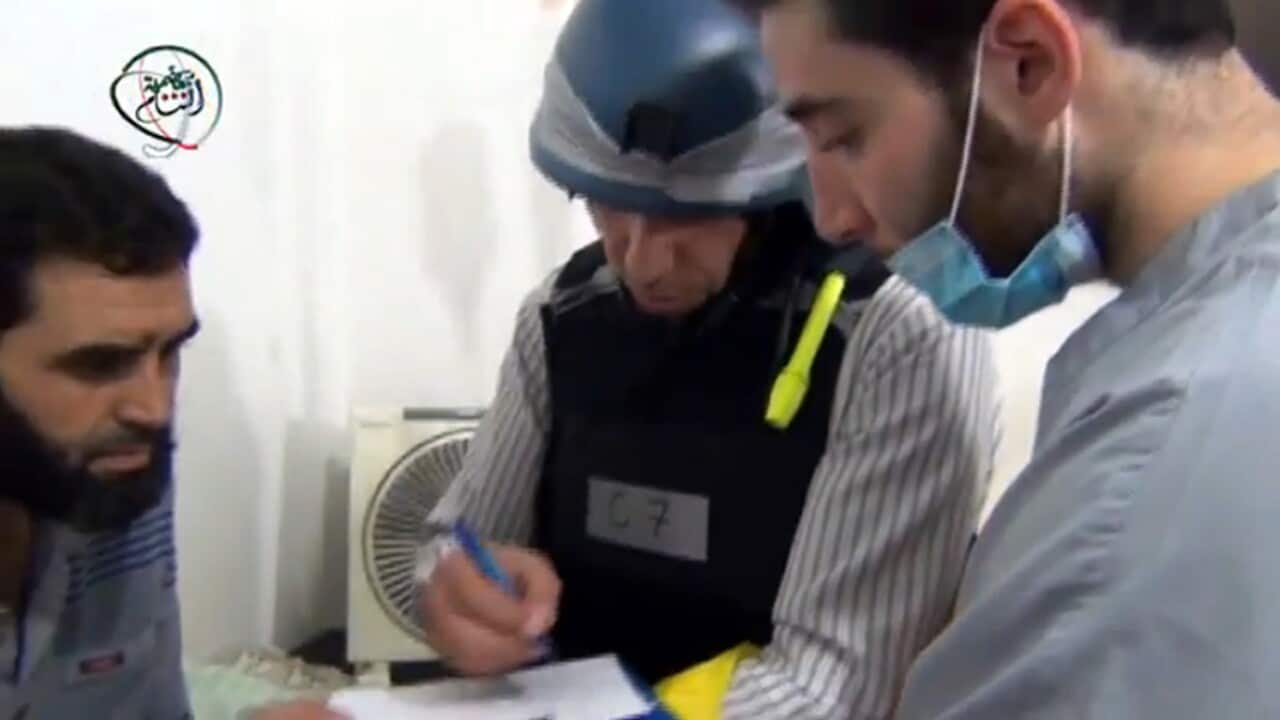
The UN convoy came under sniper fire as it tried to approach the Damascus suburb where the attack was reported, but the team nevertheless managed to visit victims receiving treatment in two nearby hospitals.
"It was a very productive day," UN spokesman Farhan Haq told reporters, adding that the team, led by Swedish expert Ake Sellstrom, is "already gathering valuable evidence."
UN leader Ban Ki-moon said that despite the "very dangerous circumstances" the investigators "visited two hospitals, they interviewed witnesses, survivors and doctors. They also collected some samples."
The UN team was in a buffer zone between government and opposition-held areas when it came under attack.
Ban said the United Nations had made a "strong complaint" to the Syrian government and opposition forces. The rebels and Assad's government traded blame for the sniper assault just as they did the chemical attack.
President Vladimir Putin of Russia -- a staunch Assad ally that provides the regime with diplomatic cover by blocking UN Security Council action -- remained unimpressed by the mounting evidence of an atrocity.
Putin on Monday told British Prime Minister David Cameron there was no proof Damascus had used chemical weapons, according to Cameron's office, which has said it has "little doubt" that there had been an attack.
Cameron cut short his holiday on Monday to return to London to plan a response. Britain, along with France, has been in the forefront of demands for tougher action against Assad's regime.
The Syrian opposition says more than 1,300 people died when toxic gases were unleashed on Eastern Ghouta and Moadamiyet al-Sham.
In Moadamiyet al-Sham, the UN team took samples and interviewed medical staff before returning to their hotel in Damascus.
Syria approved the UN inspection on Sunday but US officials said it was too little, too late, arguing that persistent shelling had "corrupted" the site.
The inspection came as the West appeared to be moving closer to launching a military response, after officials confirmed the US Navy has four warships armed with cruise missiles on standby in the eastern Mediterranean.
With China and Moscow expected to boycott any resolution backing a military strike, British Foreign Secretary William Hague said the West could act even without full UN Security Council backing.
The alleged poison gas attack is only the latest atrocity in a conflict that has claimed more than 100,000 lives since March 2011.
Russian Foreign Minister Sergei Lavrov meanwhile warned of the "extremely dangerous consequences of a possible new military intervention" and said intervening without a UN Security Council resolution would be illegal.
Experts believe the most likely US action would see sea-launched cruise missiles target Syrian military installations and artillery batteries deemed complicit in the chemical weapons attack.







