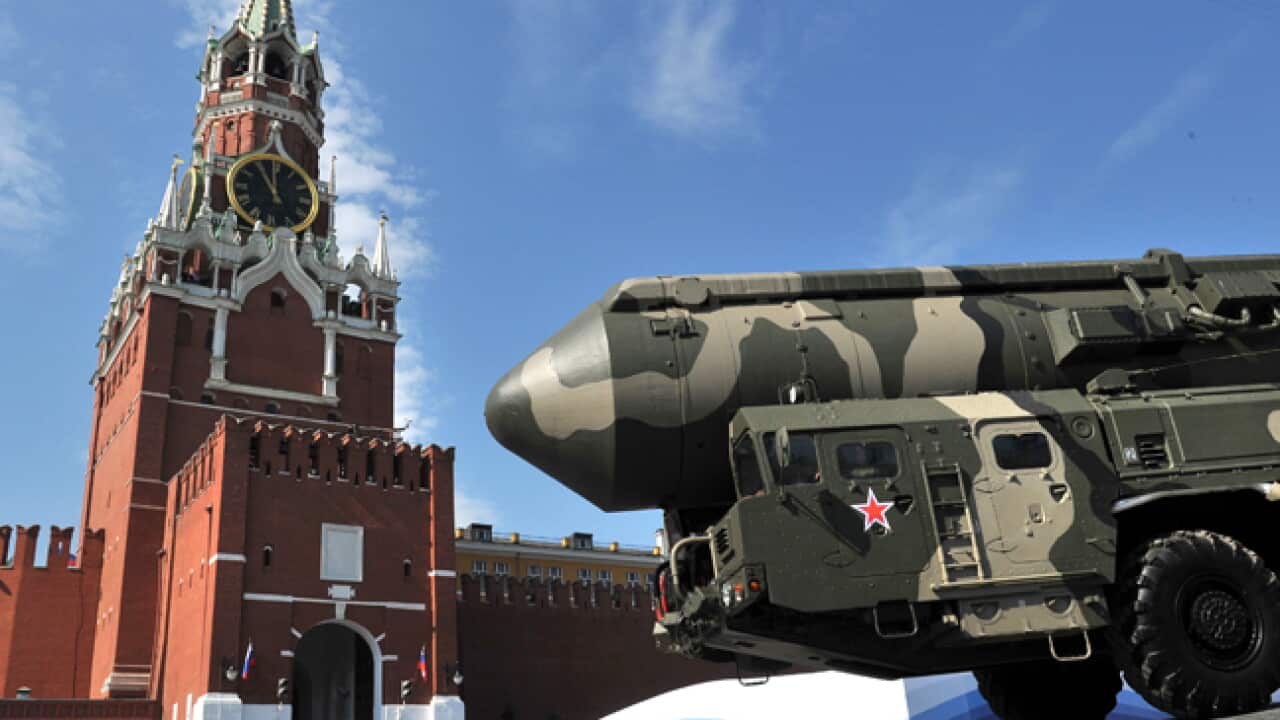
Russia launched a $650 billion rearmament plan to counter the West's military dominance by adding eight nuclear submarines and hundreds of warplanes to its creaking armed forces.
Details of the long-flagged Kremlin procurement plan through 2020 see Russia acquiring a total of 20 submarines and more than 600 warplanes in place of a outdated fleet of jets and vessels that have been losing international clients.
Analysts said the ambitious plan would in effect create a brand new Russian armed forces that finally cut links with its Soviet past.
News that makes sense
Your trusted source for staying up-to-date with the world around you. Get free daily news updates and analysis, straight to your inbox.
"Russia is so unprepared for conventional warfare that its nuclear threshold is quite low -- and the chances of it using nuclear weapons quite high," said military affairs columnist Pavel Felgenhauer.
"This lowers the threat of nuclear war breaking out."
The programme revealed by Deputy Defence Minister Vladimir Popovkin sees Russia building 100 new ships and acquiring 1,000 helicopters -- figures that would dramatically swell the number of modern and battle-ready craft.
"The main task is the modernisation of our armed forces. Nineteen trillion rubles ($653 billion) will be allocated for this," news agencies quoted Popovkin as saying.
The Kremlin has vowed repeatedly to boost spending on a dilapidated military whose 2009 exercises were scoffed at by the United States' mission to NATO in cables published by the WikiLeaks website.
A US official said the war games showed that Russia was only capable of engaging in a small to mid-sized local conflict that did not require the engagement of more than one branch of the armed forces.
The assessment added that Russia "continues to rely on aging and obsolete equipment" and further suffers from a "manpower shortage".
A Moscow newspaper reported in September that another in a series of poor army drafts brought the armed forces' total number to about 800,000 troops -- well short of the million-man army foreseen in planning.
The Kremlin has spent recent years trying to devise a military strategy that targets spending on high-profile weapons that enable Russia to compete with the West both on the battle field and the open arms market.
The strategy announced Thursday sees Russia funnelling much of its resources on nuclear submarines and next-generation anti-missiles defences to replace the already-popular S-300 system that has been sought by nations such as Iran.
It envisions the nuclear submarines equipped with a new generation of ballistic missiles and supported by highly manoeuvrable frigates and other small destroyers.
Yet Russia's strategy of regaining naval parity with the United States was hurt by confirmation that the military did not earmark any spending on new aircraft carriers.
That will leave Russia with just one carrier for the coming decade compared to the 11 in operations and six kept in reserve by the United States.
The air force also appears to be delaying plans to launch its next generation of strategic bombers -- a project that has been advertised through the media for much of the past decade.
Analysts said the plan was many years overdue.
"Only about 10 percent of Russia's armed forces may be really be described as modern," said independent military analyst Alexander Golts.
But he added that the plan threatened to get bogged in Russia's layered military industrial complex -- a Communist-era system that involves dozens of opaque state enterprises with murky spending practices.
"Without a radical reorganisation of our defence industry, this money will just go to waste," said Golts.







