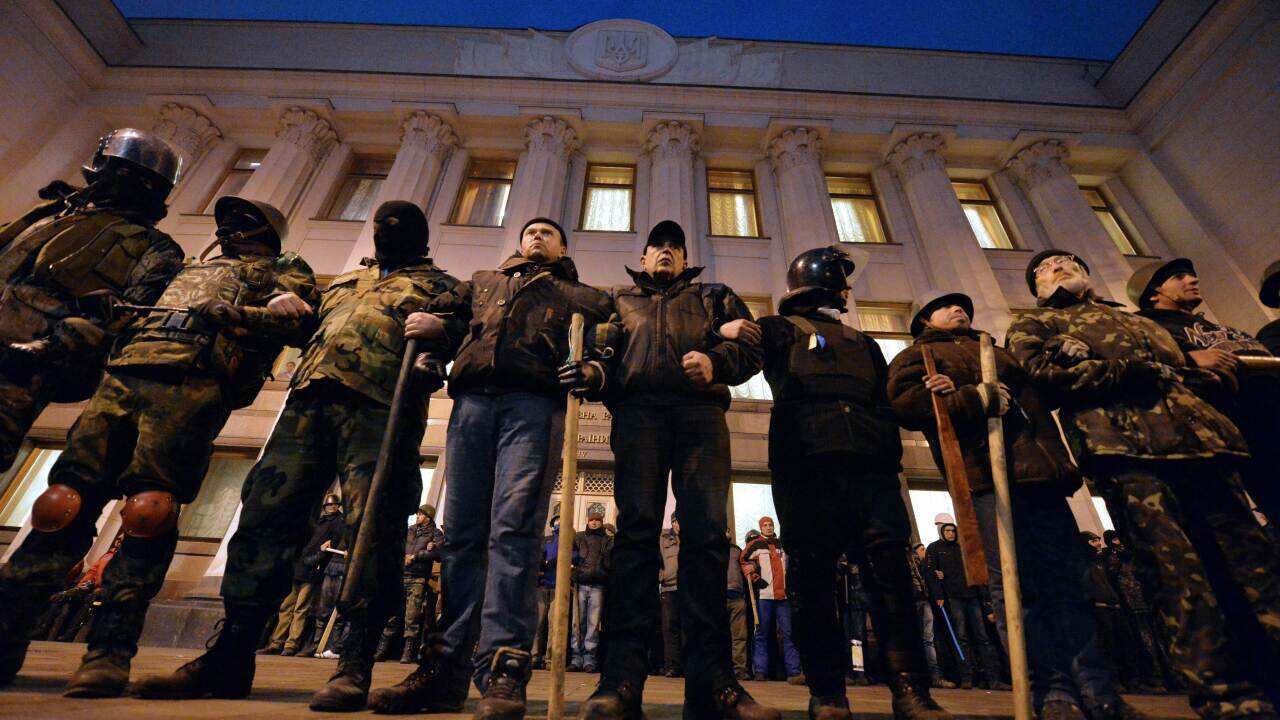
Moscow has questioned the legitimacy of Kiev's new leadership, accusing them of leading an 'armed mutiny' in Ukraine.
In the strongest reaction yet from Moscow to the transfer of power from Ukraine's disappeared President Viktor Yanukovych to the overwhelmingly pro-European opposition, Prime Minister Dmitry Medvedev said Moscow cannot negotiate with rebels who "carry Kalashnikovs".
"Strictly speaking, there is no one for us to communicate with there today," he told Russian news agencies.
To think the new leadership has legitimacy is "some kind of an aberration of perception when people call legitimate what is essentially the result of an armed mutiny," he added.
The Russian foreign ministry issued an even more hostile statement, saying that the Ukrainian parliament has "set a course to suppress those who do not agree in various regions of Ukraine using dictatorial and sometimes even terrorist methods".
"Militants are not disarmed, they refuse to leave the streets that they de-facto control, to go out of administrative buildings, they continue acts of violence," the ministry said.
Moscow was especially irked by the decision at the weekend to repeal a law introduced under Yanukovych in 2012 that elevated the status of the Russian language in regions where the population uses it.
The Russian ministry statement said that by voting the law out, parliament was trying to "restrict the humanitarian rights of Russians".
Analysts said the current situation was a result of Russia's relying overly on Yanukovych, whose power base was eroded even in the eastern part of the country.
"Russia is at a loss and disappointed in Yanukovych, who was the horse it had bet on," said analyst Mark Urnov of the Higher School of Economics.
"It's a chain of mistakes by Kremlin analysts... which led to a loss on all fronts in Ukraine."