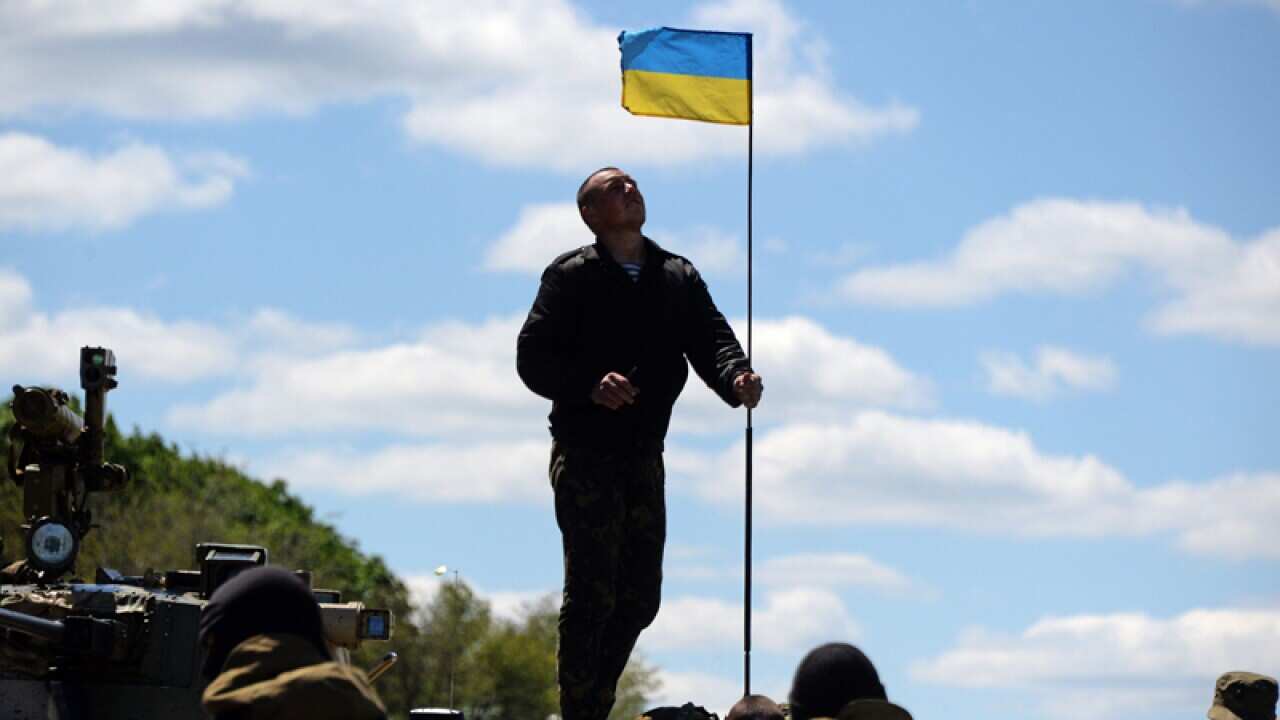
Russia has rejected a European push for fresh peace talks on Ukraine as fears of open war mount in the former Soviet republic.
French President Francois Hollande and German Foreign Minister Frank-Walter Steinmeier have added their voices to the chorus warning that deadly clashes between Ukraine's troops and pro-Moscow rebels in the east of the country could trigger a civil war.
Underlining the risk, Kiev has announced the death toll from an assault on a rebel-held flashpoint town has climbed to more than 34.
The West, which is threatening to broaden sanctions on Russia over the worsening crisis, sees a May 25 presidential poll in Ukraine as crucial to hauling the country back from the brink.
On Tuesday, the Swiss presidency, which chairs the Organisation for Security and Co-operation in Europe, urged a suspension of hostilities for the election to take place.
Ukraine's foreign minister Andriy Deshchytsia asked 30 of his counterparts assembled in Vienna to help "eliminate the external threats and provocations supported by Russia".
But Russian Foreign Minister Sergei Lavrov, also at the Vienna meeting of the Council of Europe, said holding the vote during the current violence would be "unusual".
President Vladimir Putin's spokesman has been more blunt, calling the idea "absurd".
Lavrov also dismissed a European push spearheaded by Germany to hold fresh peace talks on Ukraine after the collapse of an April 17 agreement that Moscow has already declared dead.
Any talks excluding the pro-Russian rebels active in Ukraine's east and southeast "would hardly add anything," he said.
The diplomatic impasse came as bloodshed soared in Ukraine.
Nearly 90 people have died in less than a week: half around the eastern town of Slavyansk, held by rebels since early April; and half in the southern port city of Odessa, where clashes culminated in a deadly inferno last Friday.
Most of those killed have been pro-Russian fighters and activists.
Putin has so far not ordered a threatened operation to "protect" Ukraine's Russian-speaking population, but he has kept an estimated 40,000 troops on the border for the past two months.
The US general commanding NATO's military operations, Philip Breedlove, said Russian special forces the West alleges are deployed covertly "may be able to accomplish his (Putin's) objectives in eastern Ukraine" without the need to invade.
Kiev and its Western backers see Moscow's main aims as making sure Ukraine's east holds a planned "referendum" for independence on Sunday, and sabotaging all possibility of the nationwide presidential election two weeks later.
US Secretary of State John Kerry slammed the efforts to hold a referendum in the eastern cities of Donetsk and Luhansk.
"We flatly reject this illegal effort to further divide Ukraine," he said, after meeting with EU foreign policy chief Catherine Ashton.
"We are not going to sit idly by while Russian elements fan the flames of instability instead of fulfilling the commitments that we made."
Share


