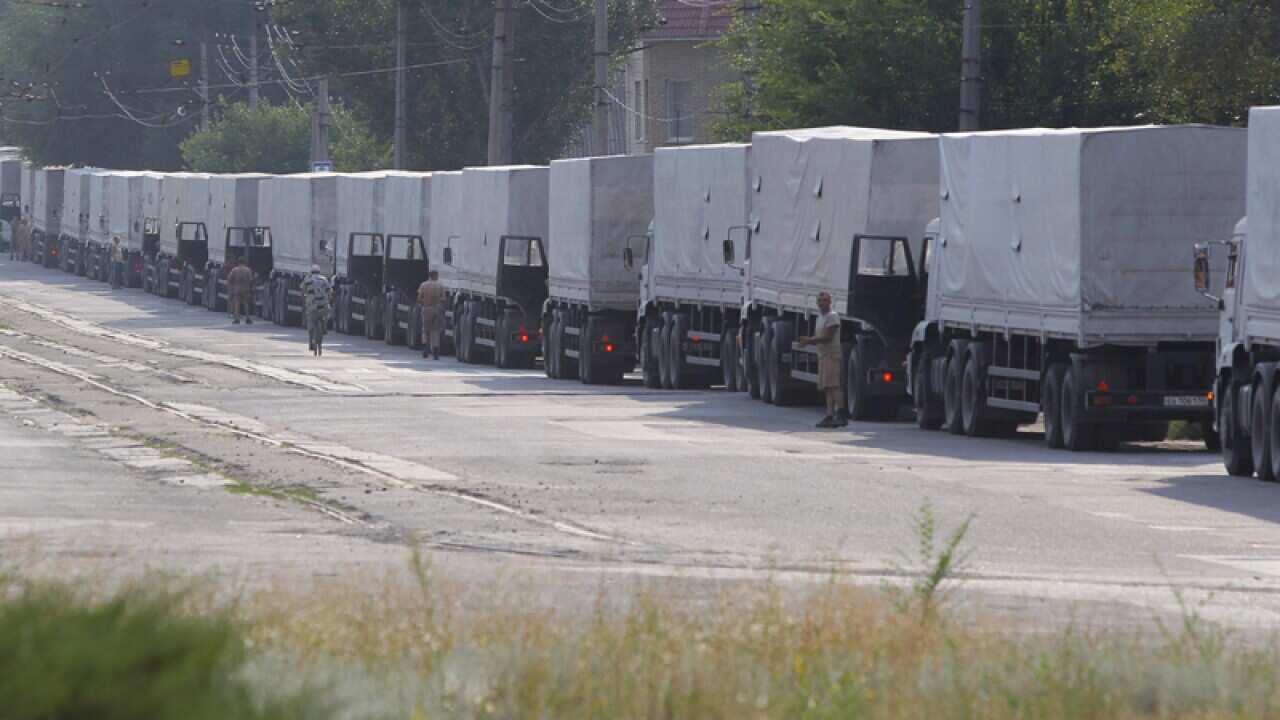
Parts of a large aid convoy from Moscow have crossed back from rebel-held east Ukraine to Russian territory, as German Chancellor Angela Merkel jetted into Kiev for crisis talks.
Russian news agencies reported that dozens of lorries had crossed back over the border after they were seen unloading their cargoes in the stricken rebel bastion of Lugansk, which has been without power or water for weeks.
The United States had demanded that Russia withdraw its disputed trucks after the Kremlin unilaterally sent them to the insurgent stronghold of Lugansk on Friday in a move Kiev decried as an "invasion".
An observer for the Organisation for Security and Cooperation in Europe (OSCE) at the border told AFP that some of the white lorries had returned to Russia but could not specify how many were still inside Ukraine.
US President Barack Obama and Merkel had warned following a telephone call that the Russian decision to send in the convoy marked a "dangerous escalation" of the four months of conflict in Ukraine with fears mounting that it could presage Moscow sending in troops.
The European Union and the United States both called for Moscow to pull out the trucks immediately or face further isolation as the manoeuvre drove cross-border tensions to a new high ahead of an already tricky visit to Kiev for the German leader.
Merkel will have to tread a fine line in Ukraine, showing firm support for Kiev's pro-EU leaders while also pushing for them to halt their increasingly successful - but brutal - offensive.
Merkel will hold talks with President Petro Poroshenko, three days ahead of the first meeting in months between Poroshenko and Russian President Vladimir Putin in Minsk alongside top EU officials.
Poroshenko has pledged to "talk peace" with Putin but insists that an end to the conflict that has cost more than 2200 lives can be achieved only if pro-Kremlin fighters are pulled out of Ukrainian territory.
Analysts said that the visit by Merkel needed "to consolidate the position of Kiev and the EU" in the run-up to the meeting with the Russian strongman or risk Moscow exploiting differences between the two sides.
"Putin will play on any contradictions between Kiev and Brussels and on Germany's objective economic interests," Oleksandr Sushko, the director of the Kiev-based Institute for Euro-Atlantic Co-operation, said.
The European Union and the United States have already slapped the toughest sanctions on Moscow since the Cold War over the crisis in Ukraine, a move that led Russia to ban agricultural products from the EU, the US, Australia, Canada and Norway.
There was no way to verify whether all of the roughly 250 trucks were pulling out or what exactly they transported into Ukraine as Kiev's officials managed to check only a handful of them.
An official from Lugansk's city council said on condition of anonymity that several dozen trucks were unloaded and that rebels had begun organising for aid to be handed out to local residents.
The official could not say how many trucks remained in the city.
Fighting has intensified ahead of the fresh round of diplomacy as Ukraine has pressed on with its punishing push into dwindling rebel-held territory in a bid to deal a knockout blow to the ailing insurgents.
Kiev has accused Russia of stepping up arms supplies to the flagging rebellion but Moscow has denied these claims and demanded that Ukrainian forces immediately cease fire.
In a reminder of the bloody toll the conflict is taking on ordinary people, AFP saw the bodies of two civilians killed by shelling sprawled on the pavements of the main rebel stronghold of Donetsk on Saturday.
Donetsk, which had a population of about one million before the conflict, has been pummelled by artillery bombardments as Ukraine forces have increased their pressure on rebels hunkered down there.
Insurgent-held areas are facing a humanitarian crisis with water cut off and food supplies dwindling.
More than 400,000 people are estimated to have fled the conflict in the east since April.
Share


