
Ukraine has reported a gradual withdrawal of Russian troops from its border that might be linked to Washington's latest push for a diplomatic solution to the worst East-West standoff since the Cold War.
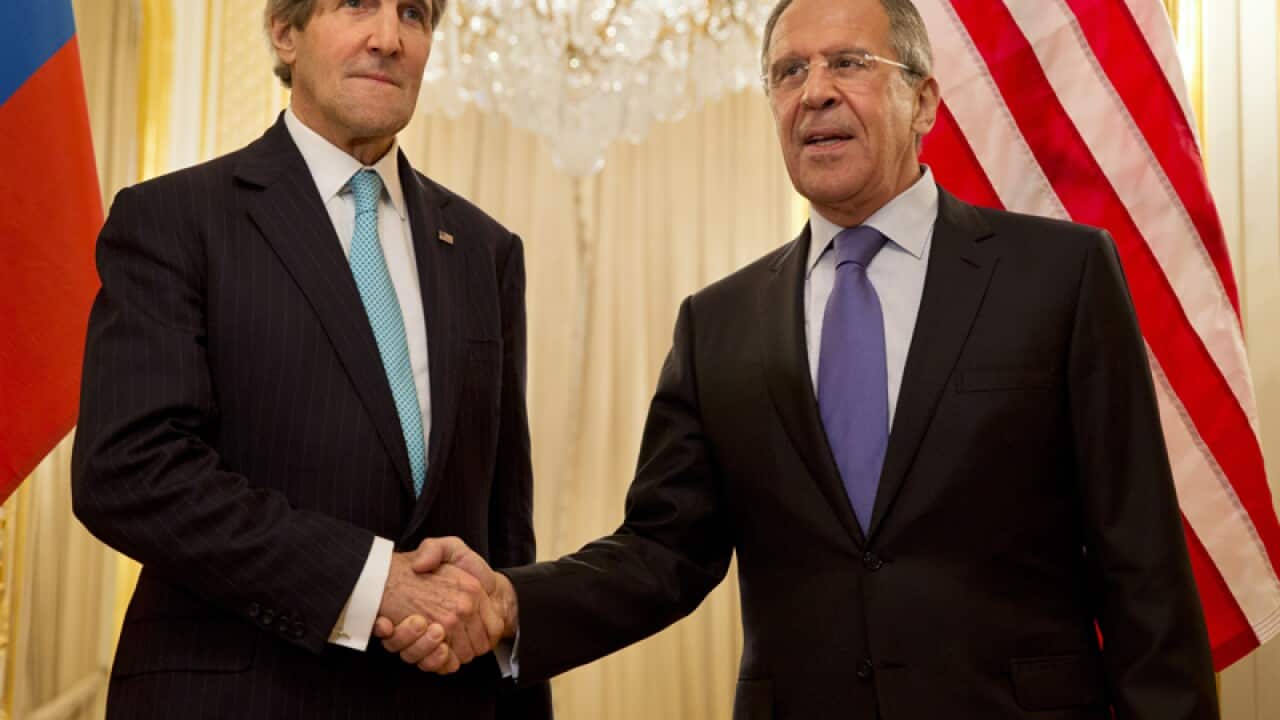
The announcement on Monday came after a four-hour meeting in Paris on Sunday between US Secretary of State John Kerry and Russia's Foreign Minister, Sergei Lavrov, that ended with an agreement to resolve the Ukrainian crisis through talks.
Western powers and the new pro-European interim leaders in Kiev have been increasingly worried that the Kremlin intended to seize heavily Russified southeastern parts of Ukraine after annexing its Crimea peninsula in response to the fall in February of the country's Moscow-backed president.
But any sign of an easing in Russia's position was countered by an unannounced visit to Crimea by Prime Minister Dmitry Medvedev.
The Ukrainian defence ministry said the start of the troop drawdown appeared to coincide with a phone call Russian President Vladimir Putin unexpectedly placed to US President Barack Obama about the crisis on Friday evening.
"In recent days, the Russian forces have been gradually withdrawing from the border," Ukrainian defence ministry spokesman Oleksiy Dmytrashkivskiy told AFP in a telephone interview.
He could not confirm how many soldiers were involved or the number of troops still stationed in the border region. US and EU officials had earlier estimated that Russia's sudden military build-up had reached 30,000 to 40,000 troops.
Kiev's Centre for Military and Political Studies analyst Dmytro Tymchuk said his sources had told him Russia had only 10,000 soldiers stationed near Ukraine by Monday morning.
Kerry's hastily arranged meeting with Lavrov concluded without any evident shift in either sides' stance.
Lavrov reiterated Moscow's demand that Ukraine be turned into a federation in which the regions enjoyed broader autonomy from Kiev and had the right to declare Russian as a second official language.
Washington is not against the idea of constitutional changes but remains wary that the Kremlin wants to use decentralisation as a tool for vetoing Kiev decisions in southeastern regions whose Russian speakers Putin has vowed to "protect".
Ukraine's new leaders have been willing to give more authority to local legislatures and allow the regions to elect their own governors.
But they also refuse to give regions the power to set up their own economic and social policies that could theoretically boost their reliance on Russia.
"Lavrov, Putin and Medvedev can suggest as many ideas as they want for resolving Russia's problems, but not for resolving our problems," Ukraine's acting president, Oleksandr Turchynov, told reporters on Monday.
Medvedev reasserted Russia's claim over Crimea on Monday by leading a major delegation of cabinet ministers to its main city of Simferopol and then planning a side trip to Sevastopol, a historic port that has housed tsarist and Kremlin navies since the 18th century.
He promised to modernise Crimea's crumbling infrastructure by turning the region into a "special economic zone" of Russia that attracted investments through lower tax rates.