This audio is voiced by AI and may occasionally mispronounce words.
Share your feedback and help us improve this feature. Read more about how we use AI at SBS here.
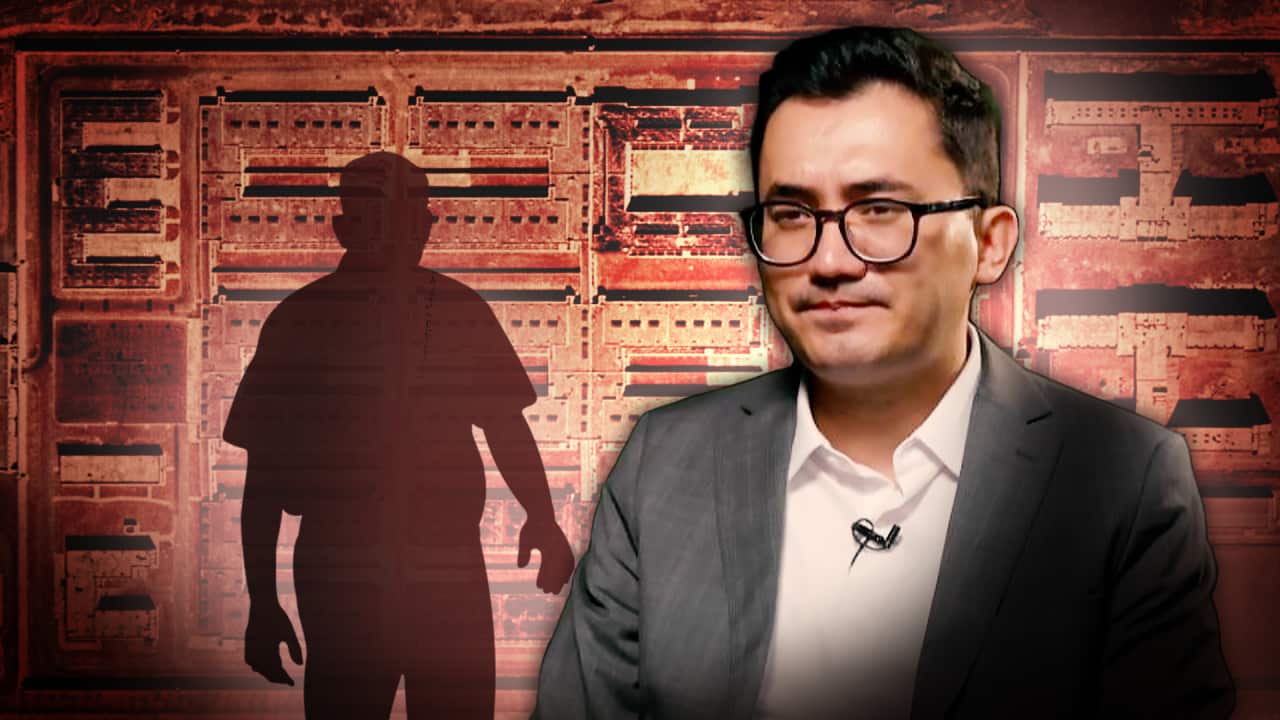
Yalkun Uluyol has dedicated years of his life to documenting and researching human rights abuses in the Xinjiang Uyghur Autonomous Region.
The north-west Chinese province is the ancestral homeland of the predominantly Muslim, Turkic-speaking Uyghur people.
It is also the site of expanding facilities where hundreds of thousands of Uyghurs and other mostly Muslim minorities are believed to be held in detention.
"Uyghurs have been subjected to restrictions of religious activities for a long time, but in 2016, the Chinese government started criminalising everyday peaceful religious activities," Uluyol tells SBS News.
"Uyghurs have been subjected to assimilationist policies, deprived from their language rights for a long time.
News that makes sense
Your trusted source for staying up-to-date with the world around you. Get free daily news updates and analysis, straight to your inbox.
"There has been a gradual shift from Uyghur language education to bilingual education and then to Han Chinese education."
Uluyol's dedication to tracking and documenting the plight of Uyghurs in China is deeply personal. Dozens of his family members, including his father, have been 'disappeared' over the past decade.
"The first person from my wider family got into a detention camp in September 2016," he says.
"And then gradually ... nearly 30 people from my wider family from different periods of time were detained or imprisoned. And that includes my father, who was forcibly disappeared in June 2018."
In 2022, the United Nations concluded in a landmark report that the Chinese Communist Party (CCP) had committed "serious human rights violations" against Uyghurs in the region, adding that these actions may constitute crimes against humanity.
China has always dismissed and denied these allegations — the state claiming in 2019 that "vocational education and training centres" in Xinjiang, as well as tight security measures, are necessary "to prevent the breeding and spread of terrorism and religious extremism".
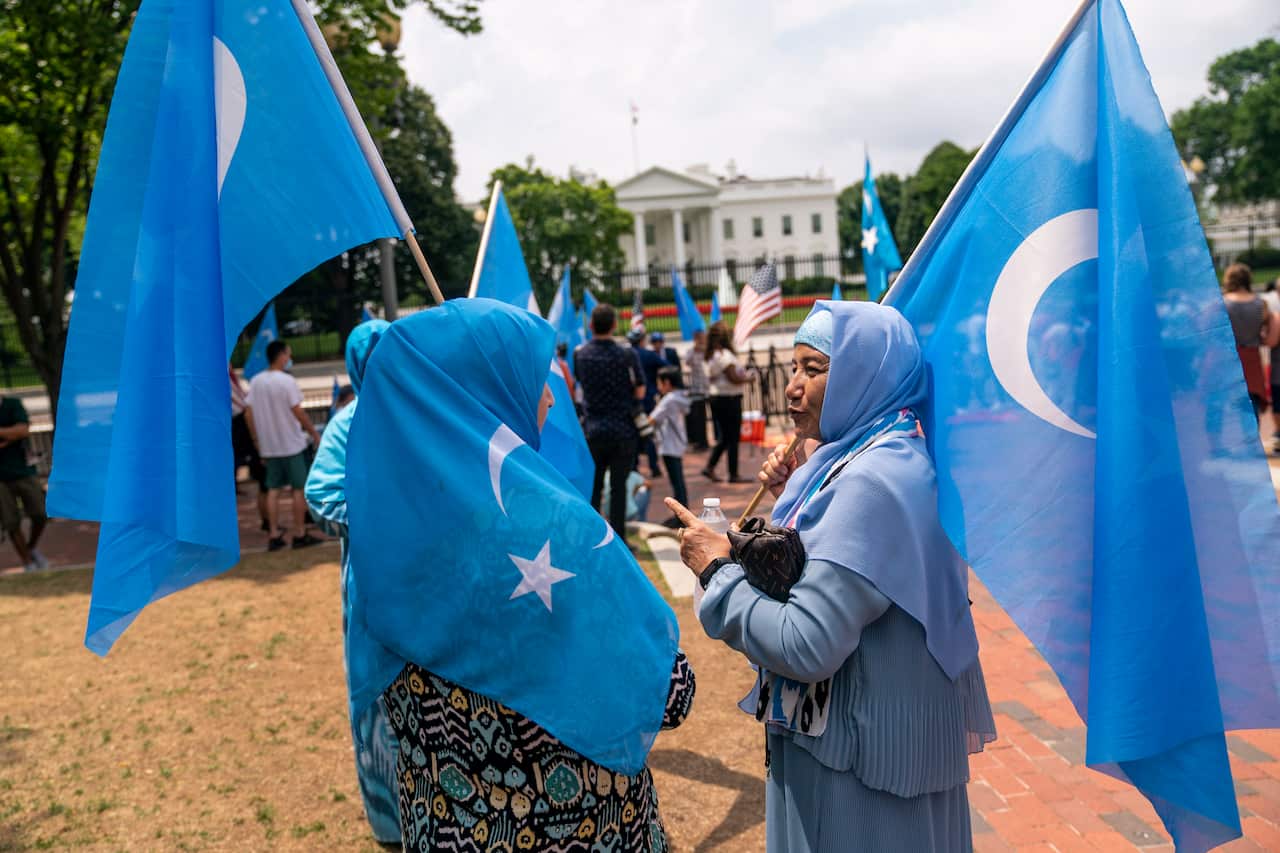
The United Nations and human rights groups estimated in 2022 that at least one million Uyghurs and other predominantly Muslim minorities had been detained in so-called 're-education' camps in China.
Years on, Uyghurs living in exile, including Uluyol, still haven't heard from their family members.
"I still have no communication with home. I still don't know where my father is, what are the allegations against him," Uluyol says.
I only know that he got 16 years imprisonment without due process, without a reason — nothing — but because he was a Uyghur.
In 2024, the Australian government delivered a joint statement at the UN General Assembly urging China to implement recommendations from the 2022 UN report.
In response, Beijing dismissed the statement, describing matters relating to Xinjiang and Xizang (Tibet) as "internal affairs" and accusing Australia of being "plagued by systemic racism and hate crimes".
Recent satellite imagery obtained by SBS News reveals that the CCP is continuing to expand and evolve its detention sites in Xinjiang.
'The most heavily detained part of the world'
In 2020 the Australian Strategic Policy Institute used satellite imagery to find evidence of more than 380 so-called 're-education' camps in Xinjiang. Nathan Ruser was part of that team and works as a geospatial analyst.
"What we set out to do was to look at as many of the facilities that had been confirmed as possible, learn this signature that they have — how they look, how they sit in the landscape — and then just apply that eye across the whole region to just try and find as many as we can," he says.
The satellite imagery compiled by Ruser's team reveals signs of surveillance and control at these sites.
"The biggest thing to tell is just imagine that you're in one of the buildings on that facility, how hard would it be to leave?
"You can sort of see fences around each building. You can see a single consolidated entrance and then exit points that have sort of blocked fencing, watch towers on the corners, just intense sort of surveillance and movement control."
Ruser's research also reveals how detention facilities have expanded over time, with sites popping up in the desert, as well as old government buildings, schools and industrial parks being converted.
Over the last five years, Ruser says there has been a change in the style of detention across Xinjiang. He says he can track how some centres have evolved, for example, to comprise low-security spaces or sit alongside labour facilities.
"Despite the heavy hand the Chinese government was using, I think there was a level of insecurity in that policy where they sort of saw everyone as a threat," he says.
"Now, they think they've tamed that threat, so the detention landscape has moved on to different coercive ways of population control, with this big contingent still of formal prison sentences.
There's probably room for more than half a million people in prison in Xinjiang, which would make that part of China the most heavily detained part of the world.
In 2019, Shohrat Zakir, chairman of China's Xinjiang Uyghur Autonomous Region, rejected estimates that more than a million Uyghurs and other mostly Muslim minorities are kept at the camps, describing detainees as "students".
"Students ... with the help of the government have realised stable employment [and] improved their quality of life," Zakir said at a press conference at the time.
Those in the centres have "all completed their courses", he said, adding that "there are people entering and exiting".
While Ruser says it appears the objectives of Beijing's 2014 'Strike Hard' campaign — a national campaign targeting Uyghurs, billed by the CCP as an anti-terrorism initiative — shifted post-2019, he says it has been replaced with a broader systemic approach to oppressing the Uyghur population.
"[Through satellite imagery], we're able to see people being moved from a facility onto a bus and those same buses appearing at a factory down the road," Ruser explains.
"As the detention centres closed, a lot of the people sort of transitioned very cleanly and very systematically into these organs of state-controlled work."
UN experts in January this year expressed deep concern regarding "persistent allegations" of forced labour within the Xinjiang Uyghur Autonomous Region and across other parts of China.
An 'eye' from above
Ruser says the benefit of using satellite imagery to "try and get an eye on places you can't visit on the ground" is that it can bolster testimony from inside Xinjiang, which is often hard to obtain and verify.
"We can sort of go back through this historical archive and get an idea of exactly when and what happened," he says.
"Bringing visibility to these issues is important … this is probably one of the largest detention campaigns since the Second World War and so much of it was happening behind closed doors."
To illustrate how China's crackdown is changing, Ruser points to the example of the Urumqi detention centre in Dabancheng. Pictured below, it is one of the largest in Xinjiang.
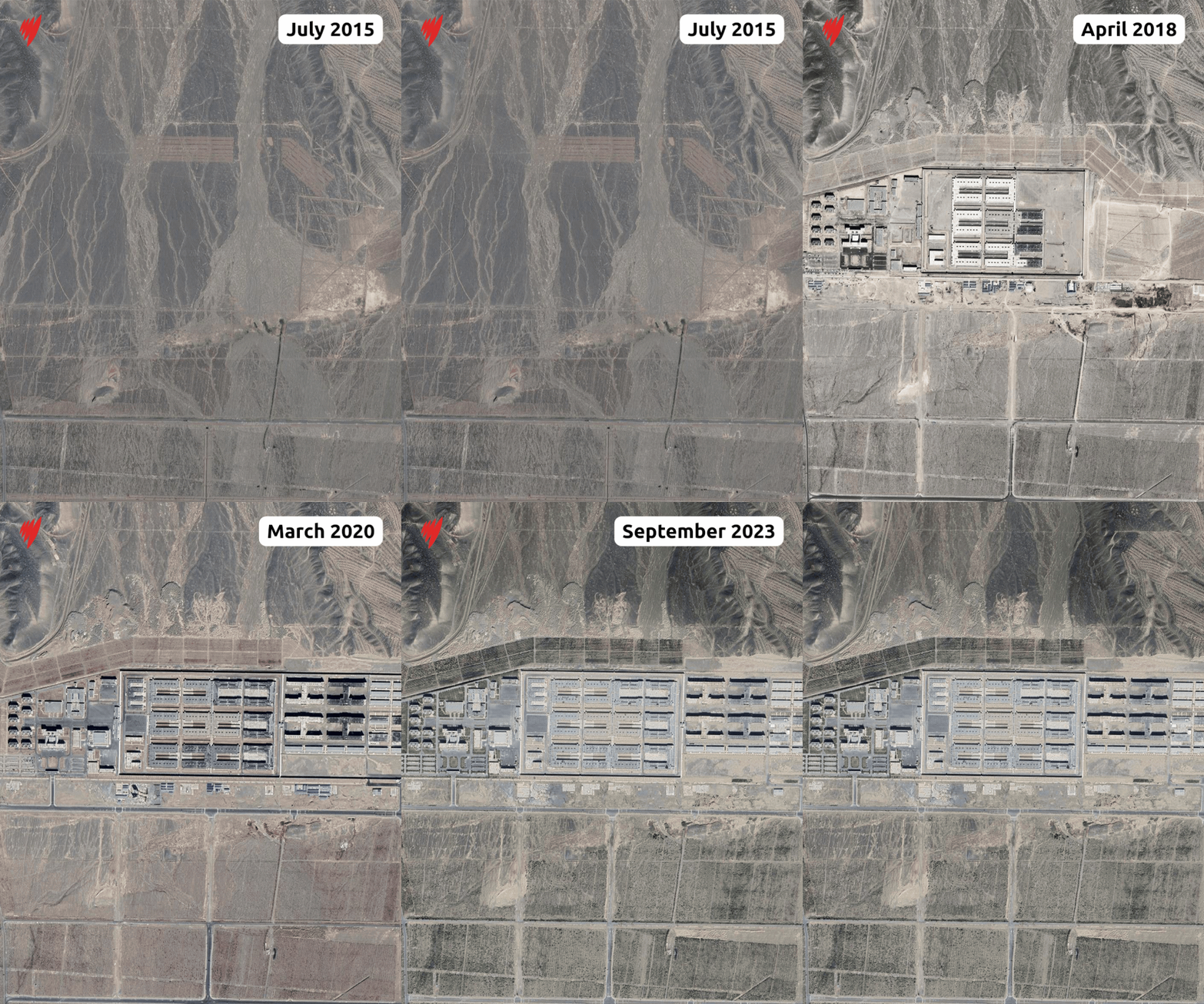
"This is one that very much, very rapidly appeared in 2017 and grew for the next sort of four or five years. Right now, it stretches about three kilometres across," he says.
Multiple satellite mapping programs are used in Ruser's research. When Google Earth is missing imagery, he turns to other providers, which at times show the area at a lower resolution.
"In the peak period of this campaign [around 2018], there actually was really good satellite imagery that was being purchased and made available over the region.
"But since media attention's gone away and since the architecture of this repression has become less obvious from a satellite picture, there's been a bit of a drawdown on the satellite monitoring of these areas and I think that basically gives a situation where if you look on Google Earth or Google Maps, a lot of these places are sort of frozen in 2022 or 2023.
"You deal with what you have access to, so in some ways, you can often use the lower resolution imagery to detect change."
Using this methodology, Ruser says in recent years, the Dabancheng site has grown to include different types of re-education and detention facilities.
"This is a fusion of a few of the facilities. You've got lower security [buildings], then you've got the prison facility, then you've got the pre-trial detention centre.
"When we look at more recent, lower resolution imagery, we can see this is now being fleshed out with more recreational [facilities].
"There's a sports field, there's a pond, but it's still very much this very obvious detention architecture."
Erasing cultural sites
Ruser's research also shows that sites of cultural and religious significance to Uyghur people have been destroyed over the past 10 years.
According to ASPI research, between 2017 and 2020, approximately 16,000 mosques — more than half of those in Xinjiang — have been destroyed or damaged because of government policies that restrict religious practices.
A further 30 per cent of important Islamic sacred sites, such as shrines, cemeteries and pilgrimage routes, including many protected under Chinese law, have been demolished across Xinjiang, and an additional 28 per cent have been damaged or altered in some way.
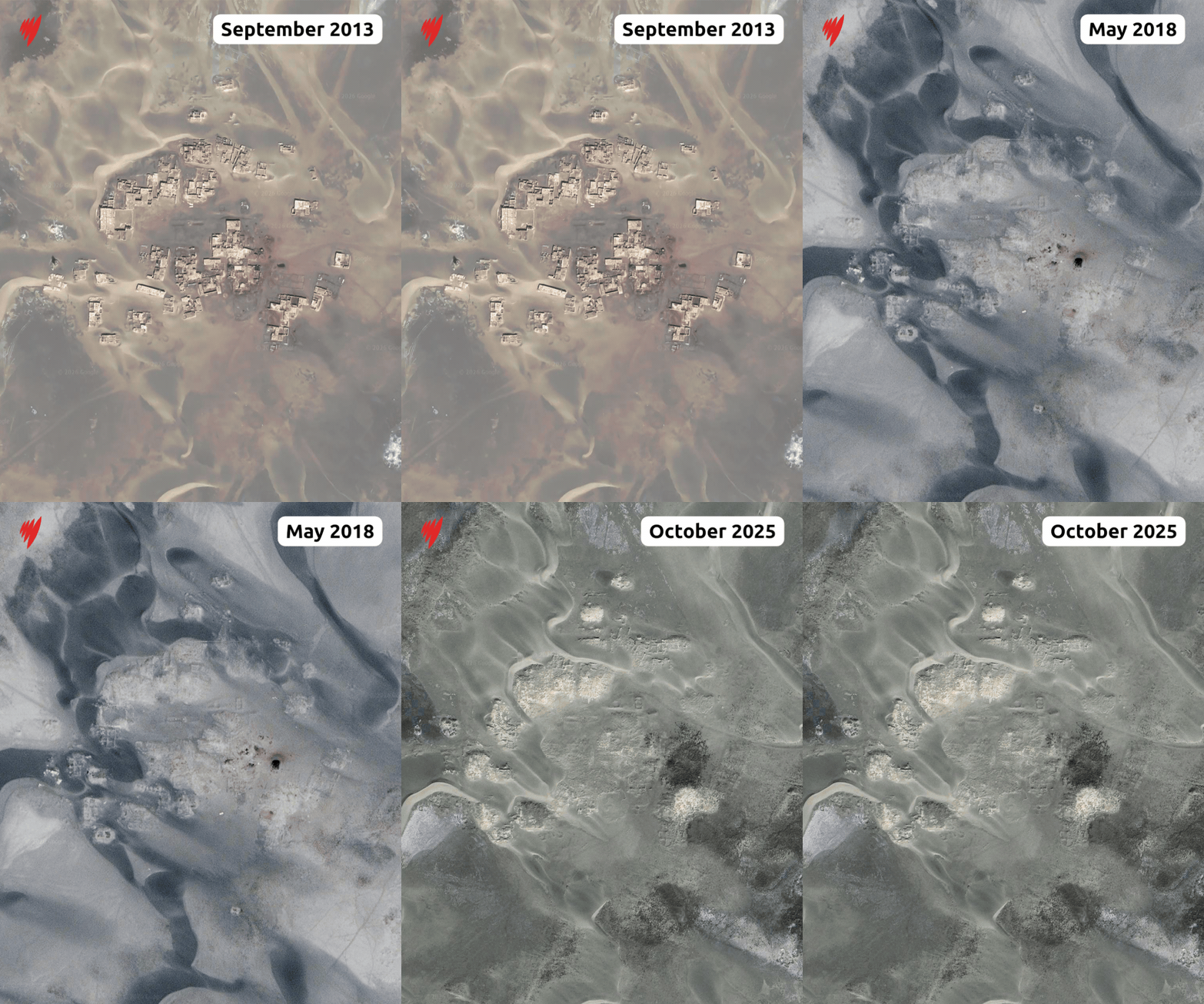
Located in a remote part of the Taklamakan Desert, Ordam Mazar was one of the most sacred and revered pilgrimage sites for the Uyghur people in Xinjiang. The Chinese government banned mass pilgrimages to Ordam Mazar in the 1990s.
A lead researcher of the site, Uyghur anthropologist Dr Rahile Dawut, was arrested by Chinese authorities in late 2017. She was teaching at Xinjiang University College of Humanities at the time, where she founded the Ethnic Minorities Research Centre in 2007.
According to the US-based Dui Hua Foundation human rights group, Dawut was convicted on charges of promoting 'splittism', which is used by the CCP to describe activities that threaten state security, and in 2018 she was sentenced to life in prison.
"She spent a lot of her life looking at Ordam Mazar and in the same month that she was detained, the Chinese government sent bulldozers through tens of miles of desert just to totally raze that structure," Ruser says.
"There's been this very consolidated campaign to erase normal expressions of culture, faith and history."
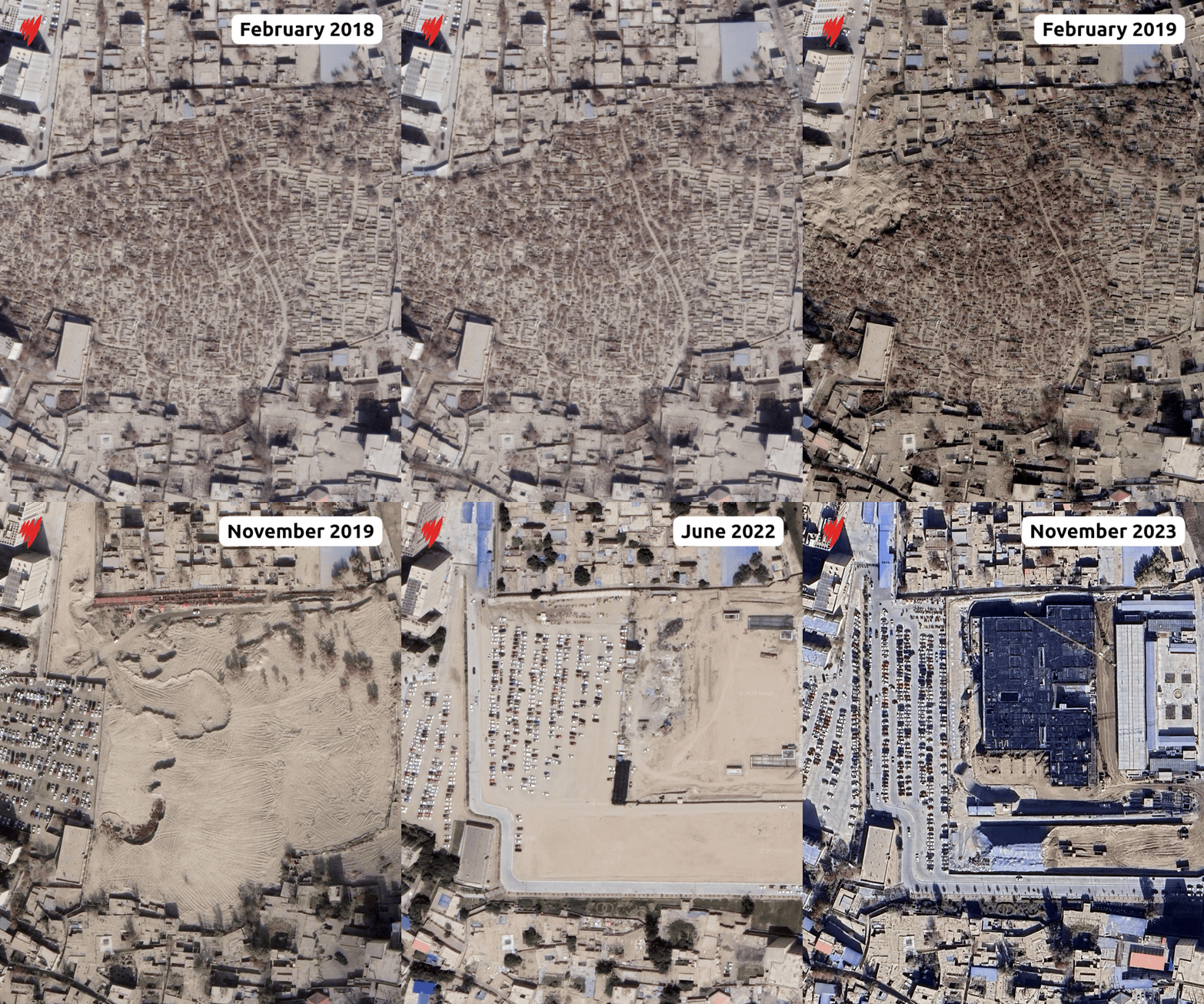
According to Ruser, the central cemetery in the city of Hotan, in southern Xinjiang, was razed to make way for a car park. A satellite data analysis shows bulldozers began clearing part of the cemetery in February 2019. By November of the same year, it was gone.
"[Hotan is] probably one of the largest, most Uyghur cities in all of Xinjiang. I think 99 per cent of the population before the crackdown was Uyghur," he says.
"This social re-engineering has happened again and again throughout different cities in the region."
Protection of culture
Nadira Yusuf is a prominent figure in Melbourne's Uyghur community.
She runs the MMH Charity, which supports orphaned children in Türkiye, which is home to one of the largest Uyghur diasporas.
Due to ethnic and cultural ties as well as a historic preferential immigration policy for Uyghurs, which has since been restricted, Türkiye has long been considered a safe haven. However, as the country strengthens its ties with China, these protections have also been weakened.
Yusuf says many Uyghur children in Türkiye have lost contact with their parents due to them travelling to Xinjiang to fill out paperwork or tend to other matters and never returning.
"Maybe their parents are in jail, maybe their parents are being killed, or now, most [re-education] camps have become forced labour factories, maybe their parents are in forced labour," Yusuf tells SBS News.

Through her charity, Yusuf attempts to provide financial support and promote educational pathways for Uyghur young people living in exile, while also instilling a sense of community.
"Language and the culture are the foundation for identity … and the way to connect their history," she says.
"Uyghur children in the diaspora, when they come together, for example, from Australia … from Sweden, Norway, Germany, they just can't communicate because everybody speaks their local languages."
There are a few schools teaching Uyghur language in Australia, including in Adelaide, Melbourne and Sydney. Australia's Uyghur diaspora is estimated to be around 5,000 people.
"I really believe we will be back soon and when we are going back, I want our children [to be able to] speak to their parents, their grandparents, uncles, aunties in their language," Yusuf says.
So, we try our best to keep our language and the culture safe for our next generation.
Meanwhile, others like Uluyol remain in limbo, hoping for a sign that their loved ones are still alive.
"It is a right thing to do for governments to continue to speak out for Uyghurs, for other people in China who are suffering from human rights violations, because it is contagious and our destinies are connected to one another," he says.
"It is a question of whether we want to live in a society where human rights is not respected, where some humans are less human than others, or we want to live in a world where we have equal rights."
For the full story, watch World News on SBS at 6.30pm tonight or catch up on SBS On Demand.
For the latest from SBS News, download our app and subscribe to our newsletter.







