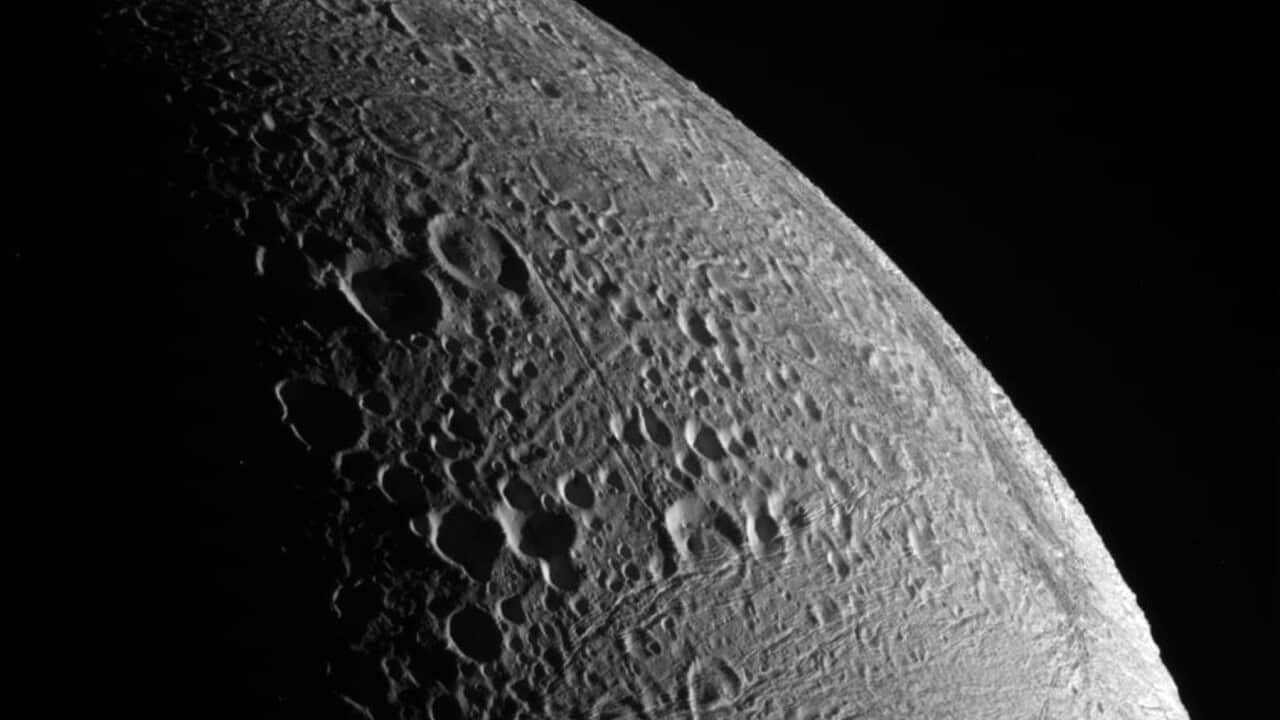
Only a drop of water will be collected during the 30,600 kph flyby.
Scientists say that will be enough to answer some key questions about Enceladus, which has a global ocean sealed beneath its icy surface.
"This is a very big step in a new era of exploring ocean worlds in our solar system bodies with great potential to provide oases for life," said Curt Niebur, program scientist for NASA's Cassini mission at Saturn.
News that makes sense
Your trusted source for staying up-to-date with the world around you. Get free daily news updates and analysis, straight to your inbox.
The spacecraft does not have instruments to directly detect life, but scientists hope to ferret out details about the underground ocean that is believed to be the source of Enceladus' geyser-like plumes. Scientists suspect tidal forces are keeping the ocean liquid.
Cassini discovered the plumes, which stretch hundreds of miles into space, in 2005, a year after reaching Saturn.
During repeat flybys of Enceladus, Saturn's sixth-largest moon and just 310 miles (500 km) in diameter, scientists confirmed that the moon holds a slightly salty, liquid ocean beneath its crust.
Saturn, a gaseous planet and the second-largest in the solar system, is about nine time the size of Earth and is the sixth farthest from the sun.
During Wednesday's flyby of Enceladus, which will take place just 30 miles (50 km) above the moon's active southern polar region, scientists hope to make chemical measurements of the plume that will allow them to determine if the moon has hydrothermal vents on its sea floor.
Similar superhot, perpetual-night deep ocean habitats on Earth support a wide variety of life.
Cassini, which is due to end its mission in 2017, will make a final flyby of Enceladus in December.







