(Transcript from SBS World News Radio)
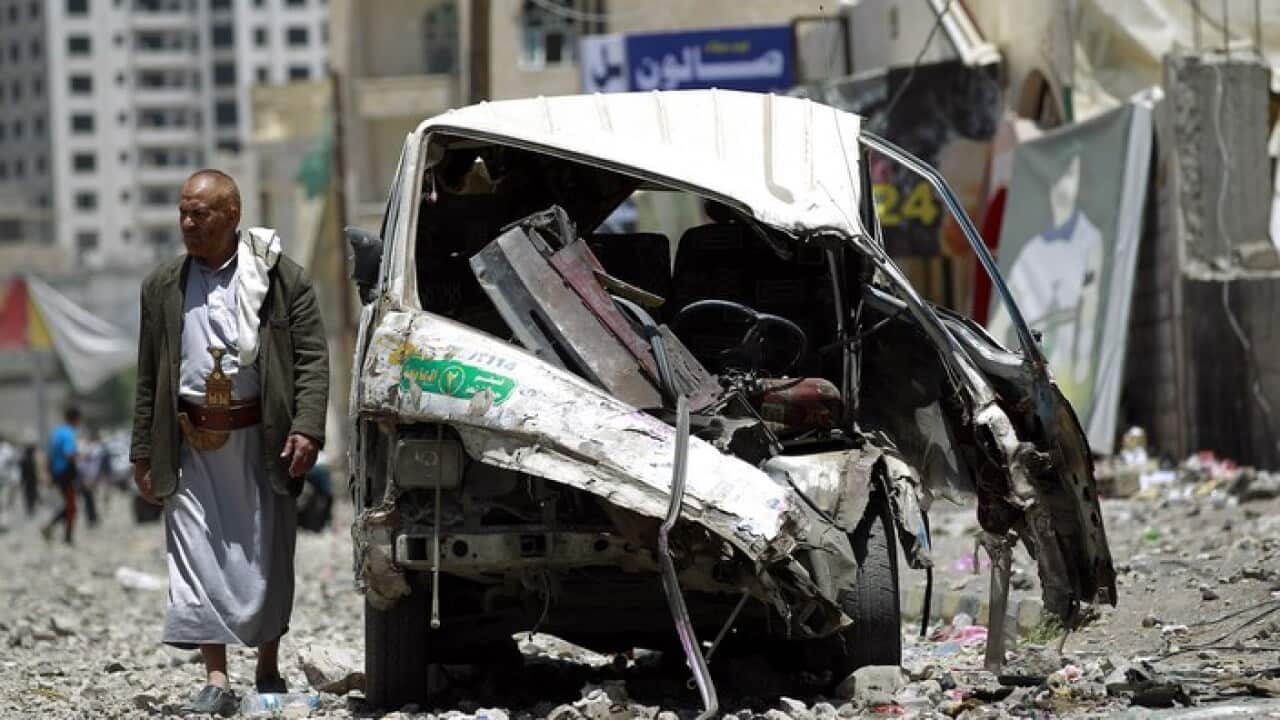
Saudi Arabia has resumed airstrikes against Yemeni rebels after declaring the offensive - briefly - over.
It says it is now moving into the next phase: protecting civilians and assisting humanitarian relief.
But the Iranian back Houthi rebels say they will fight on.
Simone Sutcliffe reports.
News that makes sense
Your trusted source for staying up-to-date with the world around you. Get free daily news updates and analysis, straight to your inbox.
(Click on the audio tab above to hear the full report)
It's the ceasefire you have when you don't have a ceasefire.
Houthi rebel supporters took to the streets in Yemen to protest the breach.
Just hours after Saudi Arabia annouced the end of Operation Decisive Storm, it was on again.
At least 12 more Saudi coalition airstrikes have been launched against Houthi rebel positions.
Saudi Arabia's Ambassador to the United States, Adel al-Jubeir, says they have achieved their initial objectives of cutting supply lines and destroying the Houthis' command and control.
"So now we enter a new phase where the objective is to protect the the civilians of Yemen from takeover by the Houthis - to counter any aggressive move by the Houthis and to work on enhancing the flow of humanitarian assistance to Yemen."
The Saudi military fires mortars into Yemen to push Houthi rebels from its southern border.
Iran - widely understood to back and arm the Houthis - says the Saudis have failed in all their objectives, instead causing death and misery across the country.
Iran's Parliamentary Speaker, Ali Larijani, says Saudi Arabia's actions have already pushed the impoverished country deeper into crisis.
(Translated) "Was killing Yemenis or destroying their infratsructure your operation's objective? Or did you want the revolutionary people of Yemen to take over the provinces of the country? This unwise behaviour is not consistant with the identity of the Islamic people."
Yemen's Health Ministry - now controlled by the Houthis - says nearly 1,600 hundred people have been killed and more than 2,300 others wounded in the Saudi-led airstrike campaign.
Dr Tamin al-Shami says hospitals and clinics are low on medical supplies and staff.
(Translated) "No doubt we undertsand that the threat of closure is a result of numerous factors and levels. The security situation, the health and medical situations and others. Also the health of the staff because many are absent - both foreigners and Yemenis."
In the Gulf of Aden international warships are gathering in one of the world's great trade routes.
The United States has moved two ships to protect commercial interests and serve as a warning to Iran.
US House Speaker John Boehner says he hopes United States involvement isn't needed.
"Clearly we are assisting our allies who are involved in a struggle to keep the radical Houthis from taking control of all of Yemen. They are clearly being supported by the Iranians. There is a lot of speculation about what may or may not be on this Iranian convoy, but I think having our ships in place is the right thing to do."
As the conflict continues, increasing numbers of people are being forced to flee.
Robert Mardini, of the International Red Cross, says the situation inside Yemen is dire.
"The humanitarian situation is worsening by the day and in some locations is really catastrophic. We urge all oarties to take every precaution to protect women, men and children. We call on them to facilitate desperately needed, impartial humanitarian action."
Yemeni Ahmed Abdullah and his family are displaced - he says waiting for a diplomatic solution seemed far too risky.
"We found our house is damaged. so again we thought of the idea to run away from all this - our country. It is not a peaceful place."







