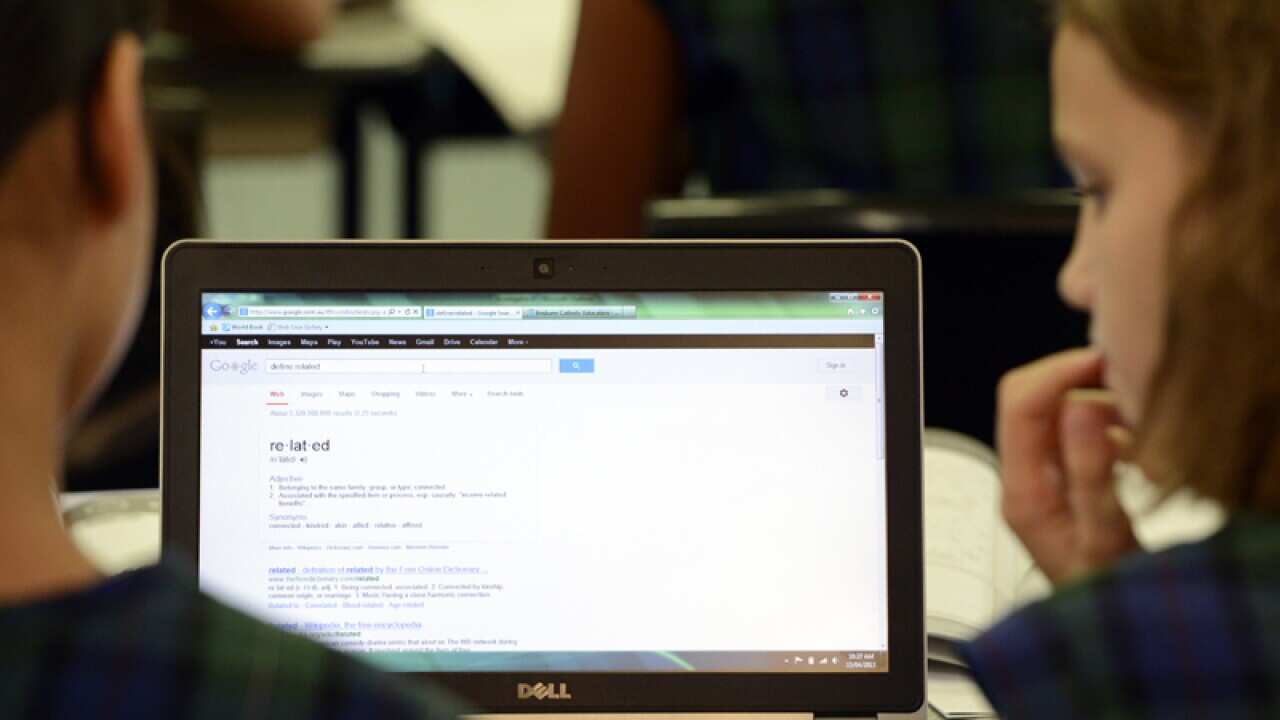
No more pencils, no more books.
Technology is invading classrooms around Australia and teachers and students in at least one school have heeded rocker Alice Cooper's call to throw away the textbooks.
The Buddhist Pal School in Sydney's southwest is set up to be completely paperless.
Students and teachers alike use tablets and computers for all schoolwork.
Principal Panha Pal says the aim wasn't to be paperless but rather to make schooling more relevant to his students.
"Students are actually getting bored in the classroom because classrooms are just way too behind what their daily lives are all about, which is technology," he told AAP.
"They're probably learning more out of school because of their iPad, their computers."
When the school took its first enrolments in 2013, teachers and parents had some doubts about the pervasion of technology.
But now, Mr Pal says, the students wouldn't go back to the "old ways" of learning.
Plus they don't have to carry heavy backpacks filled with books.
The school didn't have a whole lot of money so it has primarily used free software and systems.
Students film science experiments and annotate the videos to refer back to later. They read interactive textbooks, listen to recordings and can even take control of their teacher's computer to give answers.
"Because of the engagement ... how much they're stimulated by the content has probably increased three or four-fold at the minimum," Mr Pal says.
Across the city at elite girls' school Abbotsleigh, students are looking far beyond the pages of their textbooks.
The school uses video conferencing to let students quiz Holocaust survivors in New York, scientists in Antarctica and JFK experts at the book depository in Dallas.
Even four-year-olds in the early learning centre have video conferences, learning how to make slime from scientists in the US.
Staff use the video link-ups to complement existing curriculum not just for technology's sake, technology director Warwick Noble says.
"It's an extremely enriching addition to what they would normally do in the classroom," he told AAP.
But it's not all about connecting with people on the other side of the world: the school recently held a career session with female academics from nearby Macquarie University.
"To try and get seven scientists to visit the school and talk about their life experiences is a big impost," Mr Noble said.
But asking them to pop into a room at the uni and take questions via video was much easier.
Technology also lets the school effectively expand its staff.
Cleveland Institute of Music's Dr Keith Fitch is the school's virtual composer in residence, working with HSC music students on composition and giving them real-time feedback via video links.
That's the kind of experience that can't be found in a textbook.
Share


