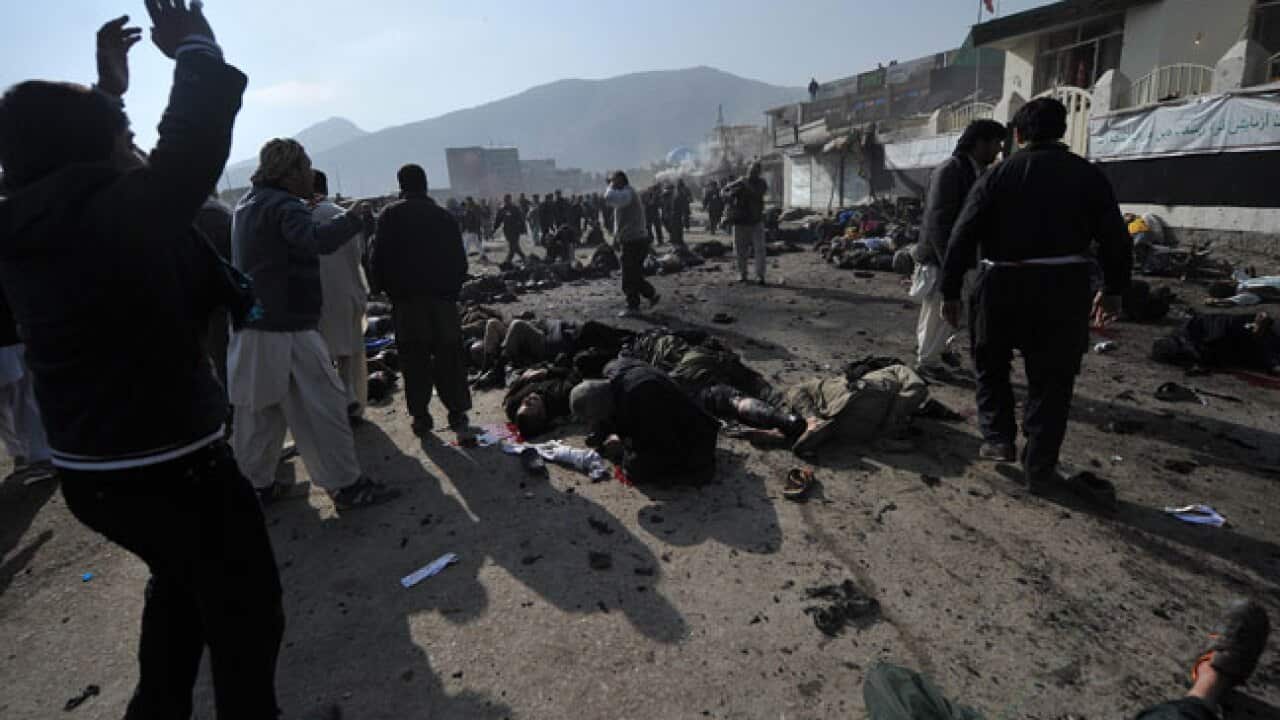
Twin blasts at Afghan shrines on the Shiite holy day of Ashura left at least 34 people dead with one massive suicide attack in Kabul ripping through a crowd of worshippers including children.
The attack in Kabul and another in the northern city of Mazar-i-Sharif came a day after an international meeting in Germany meant to further efforts to end the Afghan war, 10 years after US-led forces drove the Taliban from power.
At least 30 people including children were killed in the huge blast at the entrance to a riverside shrine in central Kabul, where hundreds of singing Shiite Muslims had gathered to mark Ashura, an AFP photographer saw.
A young girl, dressed in a green shalwar kameez that was smeared in blood, stood shrieking as she was surrounded by the crumpled, piled-up bodies of children.
"I was there watching people mourning (for Ashura) when there was suddenly a huge explosion," witness Ahmad Fawad said.
"Some people around me fell down injured. I wasn't hurt, so I got up and started running. It was horrible," he said.
Men and women at the scene sobbed as they surveyed the carnage, and screamed slogans denouncing Al-Qaeda and the Taliban.
There was no immediate claim of responsibility for either blast. Sectarian violence has been rare in Afghanistan but when the Sunni Taliban ruled in the 1990s, minority Shiites from the Hazara group suffered brutal persecution.
Shiites beat and whip themselves in religious fervour during the 10-day Ashura ceremonies, which began on November 27 but peak Tuesday. They mark the seventh-century killing of a grandson of the Prophet Mohammed.
Shiites were banned from marking Ashura in public under the Taliban. Sunnis oppose the public display of grief, but sectarian violence has not been common in Afghanistan since the Taliban were ousted in late 2001.
"A suicide bomber detonated his explosives in the Abu-Ul Fazil shrine," Kabul police said in a statement, without giving any death toll.
A security official speaking on condition of anonymity confirmed that more than 30 people had been killed.
The official said it was believed the bomber had arrived with a group of Shiite pilgrims from Logar province, south of Kabul.
Separately, four people were killed in Mazar-i-Sharif when another blast struck a shrine in the northern city as crowds gathered for Ashura. It was not immediately clear whether Shiites were the target.
Lal Mohammad Ahmadzai, a police spokesman for northern Afghanistan, said that the blast was caused by a bicycle bomb, adding that four other people had also been injured.
And police said that five people were wounded by a motorcycle bomb in the southern city of Kandahar, the Taliban's heartland. But the police said the attack was unconnected to Ashura.
The blasts came the day after delegates at a key international conference in Bonn agreed to extend international support for Afghanistan to 2024 following the scheduled withdrawal of all foreign combat troops by the end of 2014.
Pakistan and the Taliban -- both seen as pivotal to any end to the bloody strife in Afghanistan -- boycotted the talks, undermining already modest hopes for real progress.
There are around 140,000 international forces in Afghanistan, most from the United States, fighting the 10-year, Taliban-led insurgency.
Ashura marks the slaughter of Imam Hussein, the grandson of the Prophet Mohammed, near Karbala by armies of the caliph Yazid in 680 AD.
Tradition holds that the revered imam was decapitated and his body mutilated. His death was a formative event in Shiite Islam.
On Monday, at least 28 people were killed and 78 wounded in a wave of bomb attacks in central Iraq against Shiite pilgrims making their way to Karbala.
According to the UN, the number of civilians killed in violence in Afghanistan rose by 15 percent in the first six months of this year to 1,462, with insurgents blamed for 80 percent of the killings.
Share


