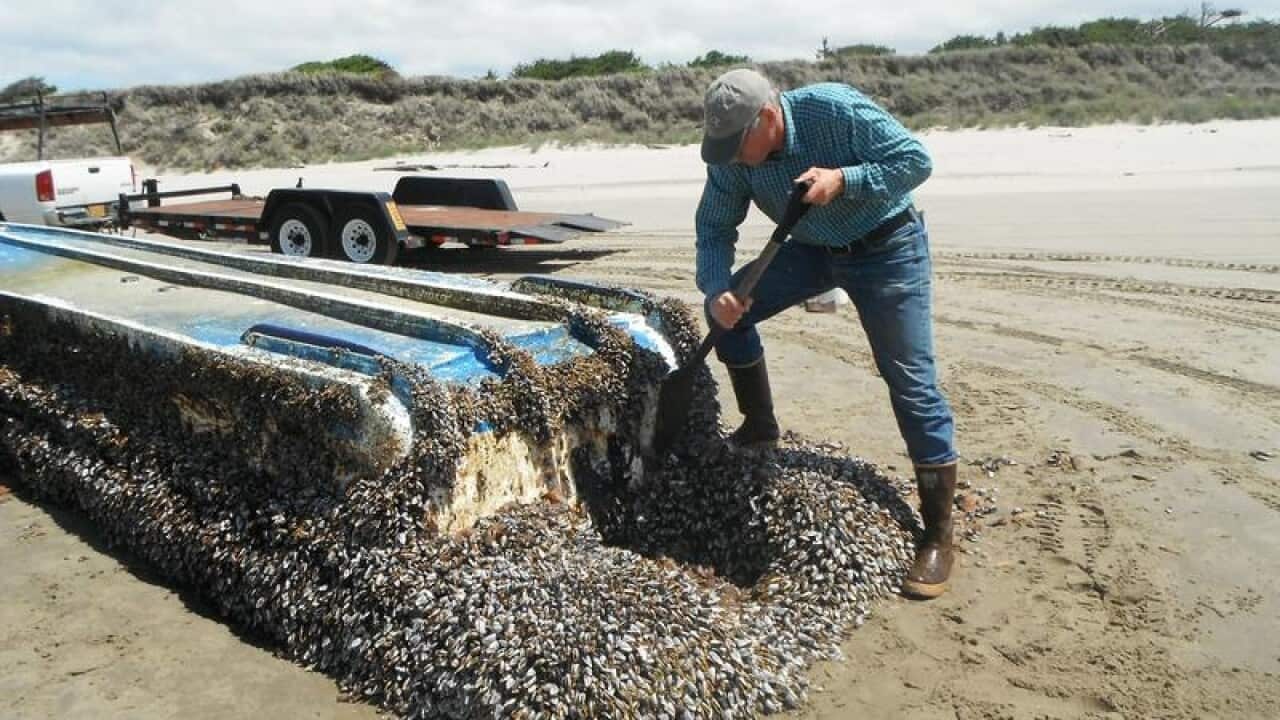
Nearly 300 species of fish, mussels and other sea critters hitchhiked across the Pacific Ocean on debris from the 2011 Japanese tsunami, washing ashore alive in the US.
It's the largest and longest marine migration ever documented, outside experts and the researchers said.
The scientists and colleagues combed the beaches of Washington, Oregon, California, British Columbia, Alaska and Hawaii and tracked the species to their Japanese origins. Their arrival could be a problem if the critters take root, pushing out native species, the study authors said in Thursday's journal Science.
"It's a bit of what we call ecological roulette," said lead author James Carlton, a marine sciences professor at Williams College, in Williamstown, Massachusetts.
It will be years before scientists know if the 289 Japanese species thrive in their new home and crowd out natives. The researchers roughly estimated that a million creatures travelled 7,725km across the Pacific Ocean to reach the West Coast, including hundreds of thousands of mussels.
News that makes sense
Your trusted source for staying up-to-date with the world around you. Get free daily news updates and analysis, straight to your inbox.
Invasive species is a major problem worldwide with plants and animals thriving in areas where they don't naturally live.
Marine invasions in the past have hurt native farmed shellfish, eroded the local ecosystem, caused economic losses and spread disease-carrying species, said Bella Galil, a marine biologist with the Steinhardt Museum of Natural History in Tel Aviv, Israel, who wasn't part of the study.
A magnitude 9 earthquake off the coast of Japan triggered a tsunami on March 11, 2011, that swept boats, docks, buoys and other man-made materials into the Pacific. The debris drifted east with an armada of living creatures, some that gave birth to new generations while at sea.
"The diversity was somewhat jaw-dropping," Carlton said.
"Mollusks, sea anemones, corals, crabs, just a wide variety of species, really a cross-section of Japanese fauna."
The researchers collected and analysed the debris that reached the West Coast and Hawaii over the last five years, with new pieces arriving Wednesday in Washington. The debris flowed across the North Pacific current, as other objects do from time to time, before it moved north with the Alaska current or south with the California current. Most hit Oregon and Washington.
Last year, a small boat from Japan reached Oregon with 20 good-sized fish inside, a kind of yellowtail jack native to the western Pacific, Carlton said.
Some of the fish are still alive in an Oregon aquarium. Earlier, an entire fishing ship - the Sai sho-Maru - arrived intact with five of the same 6-inch fish swimming around inside.
The researchers note another huge factor in this flotilla: plastics.
Decades ago, most of the debris would have been wood and that would have degraded over the long ocean trip, but now most of the debris - buoys, boats, crates and pallets - are made of plastic and that survives, Carlton said.







