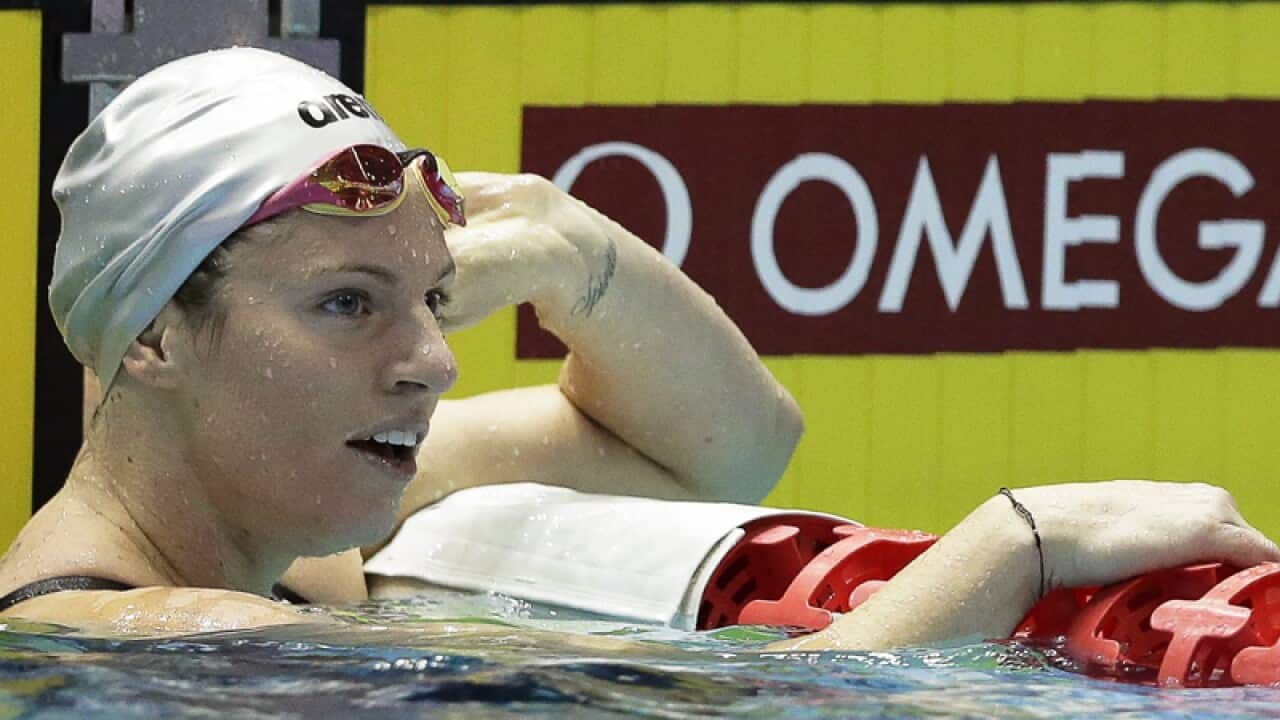
A rich vein of form has dual world champion backstroker Emily Seebohm in sight of a World Cup jackpot.
Australian teammate Mitch Larkin impressed with a record-breaking return to the pool at the two-day Tokyo World Cup round.
But Seebohm won more than admirers in Japan, setting up a potential record $150,000-plus pay day.
Seebohm completed the 50m-100m-200m backstroke treble on the final night in Tokyo, boosting her World Cup prize money to $94,000 from six rounds.
She is poised to strike it rich after November's final two World Cup rounds in Doha and Dubai.
News that makes sense
Your trusted source for staying up-to-date with the world around you. Get free daily news updates and analysis, straight to your inbox.
The best performed male and female swimmer in the World Cup's Tokyo-Doha-Dubai leg receives $50,000.
Second best earns $35,000, third $30,000 and so on down to sixth who receives $5000.
And after every final at each Cup round, the winner gets $1500, second $1000 and third $500.
It sets the stage for an in-form Seebohm to crack the $150,000 barrier in a World Cup series, believed to be the most by an Australian female swimmer.
Seebohm might find it hard to overtake the series earnings of prize money leader Katinka Hosszu, Hungary's "Iron Lady", who boasts $158,000.
Hosszu earned $9500 at Tokyo after medalling in eight events.
She had to settle for 100m backstroke silver behind Seebohm who clocked 58.37 seconds on the final night in Japan.
But instead of Hosszu, Seebohm said she had someone else in her sights at Tokyo - teammate Larkin.
Dual world champion Larkin broke his own national and Commonwealth 200m backstroke record to claim Tokyo World Cup gold on the final night.
In all, he claimed two gold and a silver in world-class times in Japan - his first meet since dominating August's world titles in Russia.
"I couldn't let Mitch outdo me - I have a thing about beating boys," Seebohm laughed.
Larkin clocked one minute, 53.34 seconds - 0.24 of a second faster than when he claimed 200m world titles gold in Kazan.
It is the third fastest non-supersuit 200m backstroke time in history.
Yet the Michael Bohl-coached Larkin baulked when asked what it meant for his Rio Olympic chances.
"I'll make sure the boxes are ticked and keep doing what I'm doing but it's a different challenge at the Olympics," he said.
Australia have only two Olympic 200m backstroke medallists - Matt Welsh (2000 bronze) and Mark Kerry (1980 bronze).







