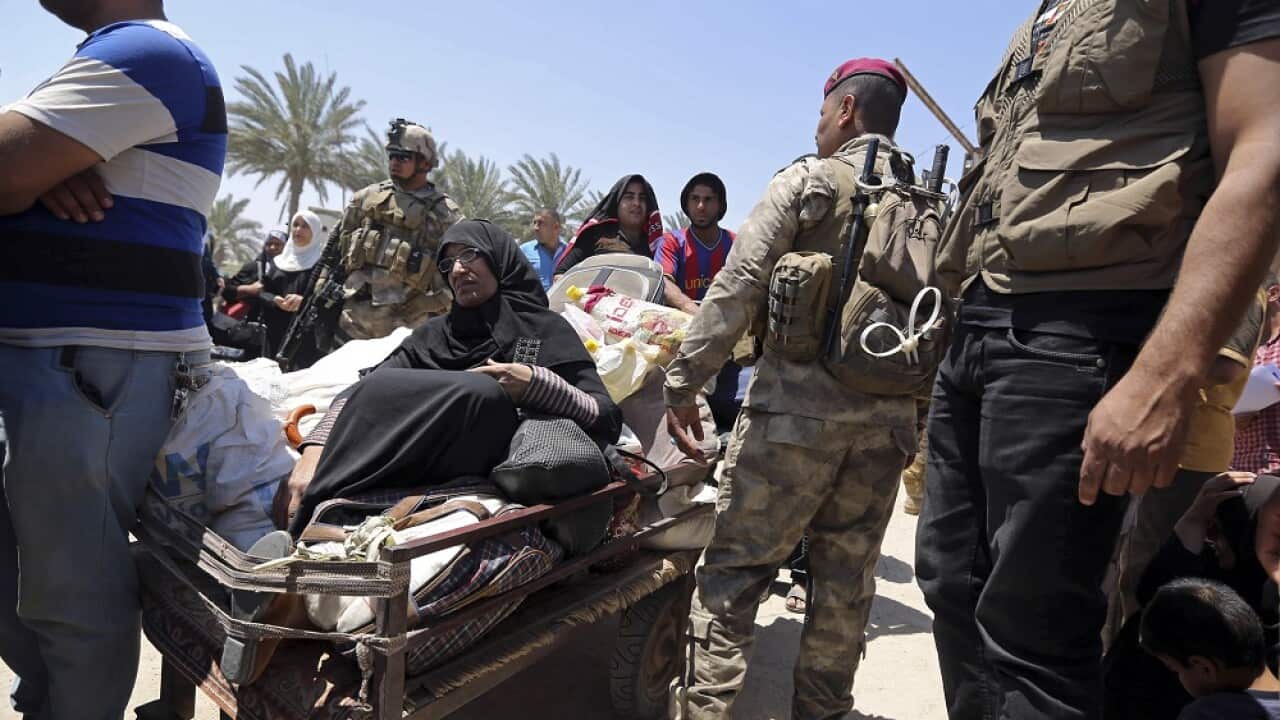
Setting the stage for renewed fighting over the city, Islamic State militants advanced in armored vehicles from Ramadi toward the base where the Shi'ite paramilitaries were massing for a counter-offensive, witnesses and a military officer said.
Warplanes in the US-led coalition stepped up raids against the Islamists, conducting 19 strikes near Ramadi over the past 72 hours at the request of the Iraqi security forces, a coalition spokesman said.
The United States, which has mounted air strikes on Islamic State positions since last August and sent advisers and arms to rebuild the shattered Iraqi army, acknowledged the fall of Ramadi was "a setback" but said its strategy would not change.
"To read too much into this single fight (over Ramadi) is simply a mistake," said Colonel Steve Warren, a Pentagon spokesman. "What this means for our strategy, what this means for today, is simply that we, meaning the coalition and our Iraqi partners, now have to go back and retake Ramadi," he said.
The Shi'ite militia, known as Hashid Shaabi or Popular Mobilization, was ordered to mobilize after the city, the capital of Anbar province, was overrun on Sunday.
News that makes sense
Your trusted source for staying up-to-date with the world around you. Get free daily news updates and analysis, straight to your inbox.
The militiamen give the government far more capability to launch a counterattack, but their arrival could add to sectarian animosity in one of the most violent parts of Iraq.
"Hashid Shaabi forces reached the Habbaniya base and are now on standby," said the head of the Anbar provincial council, Sabah Karhout.
Massing for a fight
An eyewitness described a long line of armored vehicles and trucks mounted with machine guns and rockets, flying the yellow flags of Kataib Hezbollah, one of the militia factions, heading toward the base about 30 km (20 miles) from Ramadi.
Spokesmen for militia groups said reconnaissance and planning were under way for the upcoming "battle of Anbar", the vast Euphrates River valley province bordered by Syria, Jordan and Saudi Arabia where Islamic State forces have taken key towns and roads.
Ramadi is dominated by Sunni Muslims. Prime Minister Haider al-Abadi, who is a Shi'ite, signed off on the deployment of Shi'ite militias to try to take back the area, a move he had resisted for fear of provoking a sectarian backlash.
About 500 people have been killed in the fighting for Ramadi in recent days and up to 8,000 have fled, a spokesman for the provincial governor said.
Islamic State said it had seized tanks and killed "dozens of apostates", its description for members of the Iraqi security forces. An eyewitness in Ramadi said bodies of policemen and soldiers lay in almost every street, with burnt-out military vehicles nearby.
The city's fall marked a major setback for the forces ranged against Islamic State: the U.S.-led coalition and the Iraqi security forces, which have been propped up by Iranian-backed Shi'ite militias
It was also a harsh return to reality for Washington, which at the weekend had mounted a special forces raid in Syria in which it said it killed an Islamic State leader in charge of the group's black market oil and gas sales, and captured his wife.
Limits of US-led strategy
The Iraqi government and Shi'ite paramilitaries recaptured Saddam Hussein's Tigris river home city of Tikrit from Islamic State six weeks ago, the biggest advance since the militants swept through northern Iraq last year. But government forces have had less success in the valley of Iraq's other great river, the Euphrates, west of Baghdad.
An army major who fought his way out of Ramadi said government forces in the area had been ordered to regroup, but soldiers were exhausted and morale was at rock bottom.
To some analysts, the fall of Ramadi shows the limits of the U.S. strategy of attacking from the air but leaving ground fighting to Iraq's military and its Iran-backed militia allies.
"The Americans said that they have carried out air strikes against ISIS but then the group went in and defeated the local forces," said Hassan Hassan, author of a book on Islamic State. "So they really need to come up with a whole new strategy ... and really take the fight to them."
U.S. officials said there would be no strategy change and Iraqi forces were ultimately responsible for defeating Islamic State. "We will retake (Ramadi) in the same way that we are slowly but surely retaking other parts of Iraq, and that is with Iraqi ground forces and coalition air power," Warren, the Pentagon spokesman, said.







