(Transcript from SBS World News Radio)
In full, in part or not at all.
That sums up how media outlets around the world are dealing with the question of whether to republish cartoons from the French satirical magazine, Charlie Hebdo.
Greg Dyett looks at the issue.
(Click on the audio tab above to hear the full report)
News that makes sense
Your trusted source for staying up-to-date with the world around you. Get free daily news updates and analysis, straight to your inbox.
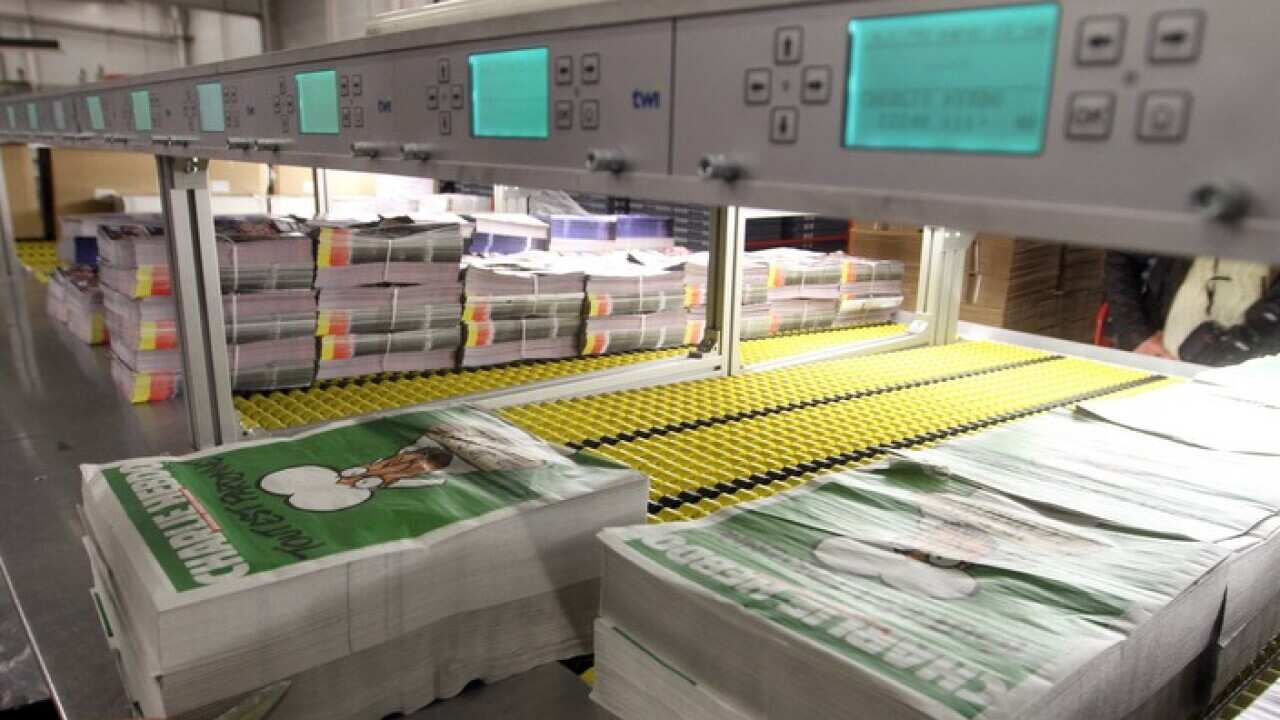
The magazine itself has just put out another edition with the Prophet Mohammed on its cover.
It features an image of the prophet, crying, with the headline "All is forgiven."
The cartoonist who drew it, Renald Luzier has defended the image.
(Translated) "It was not the front page the world wanted us to make. But it was the one we wanted to make. It was not the front page that the terrorists wanted us to make, because there isn't a terrorist in it. There is just a man crying, a character crying, it's Mohammed, I'm sorry, we drew him again, but the Mohammed we drew is a man crying above all."
Prime Minister Tony Abbott says he likes the cartoon with its promotion of forgiveness.
"I rather like that cartoon and I'm not sure I would have liked everything that Charlie Hebdo produced but this is a cartoon of the Prophet with a tear streaming down his face saying all is forgiven. That spirit of forgiveness is what we need more and more in this rancorous modern world."
Robert Drechsel is the Director of the Centre for Journalism Ethics at the Madison campus of the University of Wisconsin in the United States.
He says media outlets would be considering a range of questions about republication, including the safety of their staff.
"Contemplating the possible risk under these circumstances of republishing these images of in essence adding fuel to the fire, creating danger, to questions of almost the incident aside whether it is something that would be offensive to listeners and to readers, whether they should be warned that offensive material to them may be available all the way from that really to the question of should we be explaining ourselves in terms of what our decision was whether to publish, republish or not."
A front page in The Australian, a few seconds on SBS World News and, at National Public Radio in the United States, a decision not to reproduce the cartoons in any way.
The Supervising Editor for Standards and Practices at NPR, Mark Memmott, explained that rationale.
"We just in the end didn't feel we could do justice to what Charlie Ebdo has done over the years and give people a true picture of the kinds of cartoons it had put out if we didn't put out a lot that would really bust our standards not just bend our standards but bust them. (Interviewer) Is this self-censorship? (Memmott) No, we edit or we censor, if you want to use that word all the time. There are images, videos, sounds that we just don't think people want to hear, that will offend them, that will shock them and in this case many of the editorials, many of the cartoons that Charlie Hebdo has done over the years would do just that and we feel we can stand up for their right to publish them, we believe in their right to publish them, we don't necessarily have to republish them ourselves."
Mark Memmott says there are times when storytelling will end up offending.
"There are times we've put words on the air that we really shouldn't because it was imperative. There have been instances where it's got on because it was during war and a soldier accidentally slipped, things like that, but in this case do the people who are shocked and horrified by what happened in Paris need to also be shocked and horrified, as many might, by the cartoons that Charlie Ebdo ran over the years, probably not, I think you can hold both opinions, you can be offended by what they did and be horrified by what the killers did."
The President of the Islamic Council of Victoria, Ghaith Krayem says he'd prefer the images were not reproduced at all but if they are, media outlets need to understand what's at stake.
"In our religion we don't allow any imagery of any prophet whether it's Mohammed, Jesus, Moses, any of them so from a purely religious perspective our preference would be that they don't be republished. Having said that we understand the logic and the thinking in the current movement around wanting to show solidarity given what occurred in Paris and I guess, you know, our main advice is if media outlets do want to reproduce them in some way to do it in a way which is at least cogniscent of the feelings of essentially a quarter of the population of the world."
Robert Drechsel from the Centre for Journalism Ethics says on air or online warnings can sometimes be useful.
"If you are of a mind to caution people who might be offended by it then you do have to consider whether that's going to be effective, you want to consider whether that might actually attract more attention, not less attention and whether you're presenting it in a technological environment in which it's effective in the first place. But I think whenever you're deciding to do that sort of thing, caution people, you'd better have a very convincing reason for doing that."
Ghaith Krayem from the Islamic Council says the most important question to be asked about republication is a simple one.
"I know there's been a lot of conversation in the last few days around the legalities and you know what law allows and doesn't allow but ethically speaking we would say really what is republishing those images really achieving from an ethical perspective. We all absolutely agree around the condemnation of what occurred last week. There's no question about that. What does republishing those images which everybody knows Muslims are against, what is it really achieving is the question we would ask."