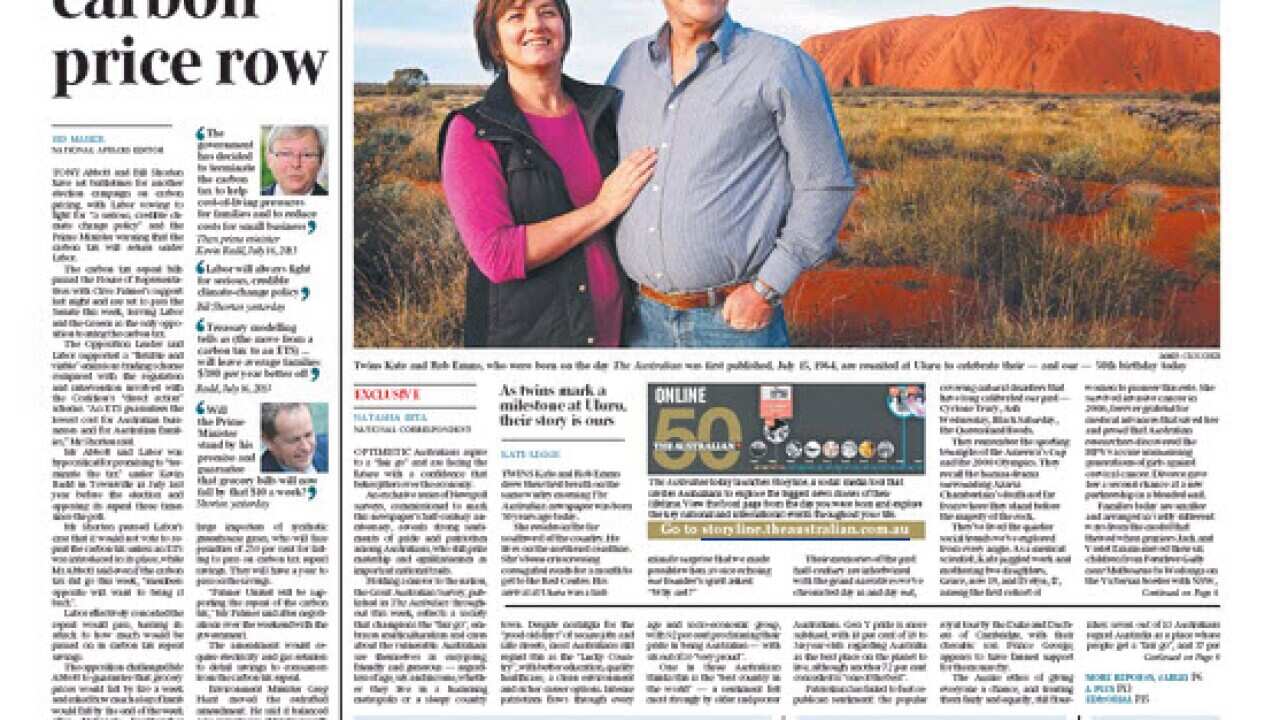
It's been 50 years since The Australian started bringing news to a national audience, with Rupert Murdoch launching his fledgling newspaper on July 15, 1964.
Mr Murdoch will attend a black-tie function in Sydney tonight, which will bring together some of the nation’s most influential people. Prime Minister Tony Abbott, Opposition Leader Bill Shorten, former Labor prime minister Paul Keating, former Liberal Prime Minister John Howard, Reserve Bank Governor Glenn Stevens and Treasurer Joe Hockey are all thought to be attending.
As the media market becomes more fractured, the future of the print newspaper in particular has been deemed 'terminal' by some observers. The Australian was one of the first adopters of “pay wall” technology that charges readers for access to stories online.
Reflecting on 50 years of publication Editor-in-chief Chris Mitchell told SBS he's confident the paper will "probably last longer than most."
"I would think because we've got a sort of wealthier and slightly older readership I would think they are quite comfortable with the print product and will be so for a while," said Mr Mitchell.
Others are advocating for digital newsrooms to adopt the traits of old-school, print journalism.
"The main challenge is to retain the good things that old style print newspapers had," media commentator David McKnight told SBS.
"Big newsrooms, resources given over to big stories, [we need to] retain that as we move into the digital age."
The Australian celebrates 50 years
Chris Mitchell said he doesn't consider "what Rupert [Murdoch] would think" at every turn.
"There will be times when Rupert is very interested in what is going on in Australia… and at other times he'll be very engaged in what is going on in Britain or elsewhere," said Mitchell.
"So you could go months without a phone call and then sometimes get called three or four times a week."
The Australian has been criticised for having an agenda, particularly when it covered the political turmoil surrounding Julia Gillard and Kevin Rudd.
"I don't have any real trouble with the agenda of the paper," said Mitchell.
"During the Rudd and Gillard years there were criticisms that the paper was too tough [on them].
"I think [the voters] probably thought that Rudd and Gillard got the treatment from us that they deserved."
Mr Mitchell said while other organisations like the ABC campaign strongly on environmental issues, The Oz remains committed to focusing on Indigenous Australia.
"We've had a pretty sort of clear position for 50 years that our judgement of political events and scientific events and events in Aboriginal affairs is all about the betterment of our country," he said.
When it comes to the durability of the print newspaper, David McKnight said The Oz won't die just yet.
"It will be a high end upmarket product, a bit like a beautiful artifact," he said.
Mitchell has also remained confident in its demand.
"I've heard people pronounce that 2023 will be the last newspaper in Australia," said Mitchell.
"I would think [in 25 years] we'll probably have some print products, particularly on weekends."
Share


