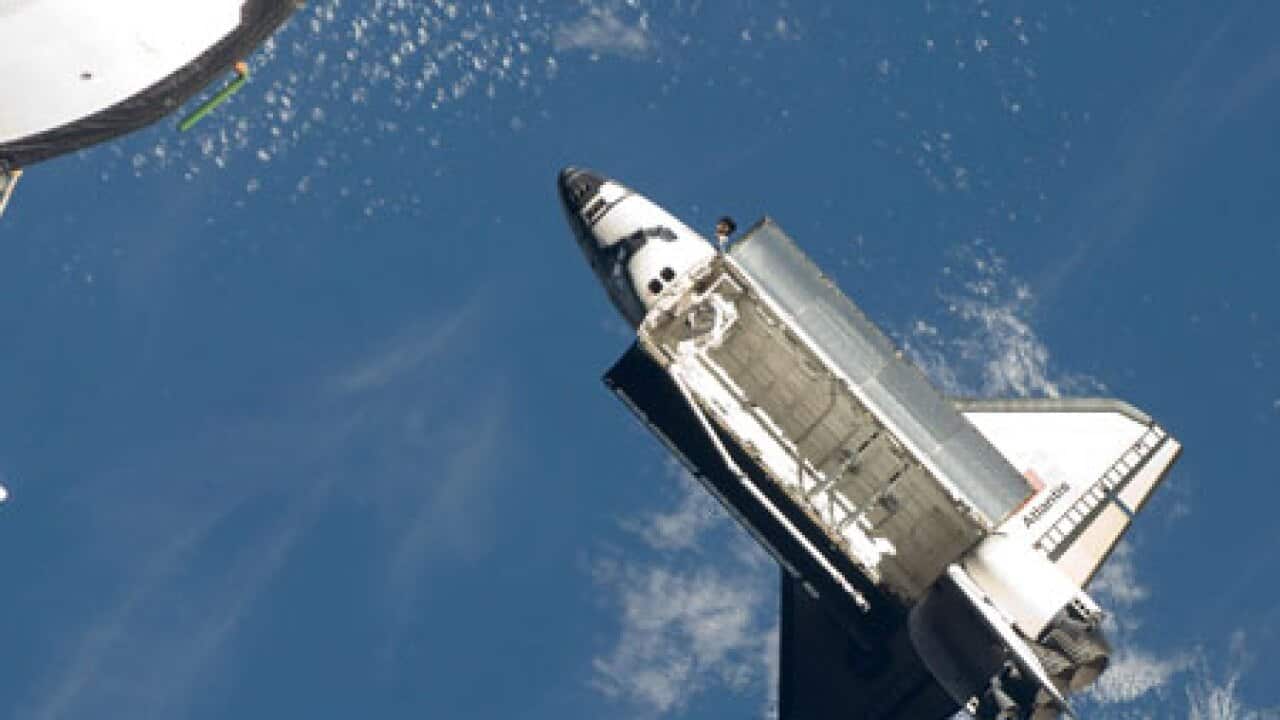
The space shuttle Atlantis has undocked from the International Space Stationto head back to Earth on its final mission, after successfully delivering tons of supplies.
The shuttle uncoupled from the orbiting space laboratory at 1522 GMT on Sunday, after its six-member crew unloaded the last equipment, which included a crucial communications antenna, power storage batteries and a radiator.
The biggest single element was the five-ton Rassvet research module, or MRM-1, which will provide additional storage space and a new docking port for Russian Soyuz and Progress spacecraft.
News that makes sense
Your trusted source for staying up-to-date with the world around you. Get free daily news updates and analysis, straight to your inbox.
The Rassvet - "Dawn" in Russian - was permanently attached to the bottom of the space station's Zarya module. It carries important hardware on its exterior including a radiator, airlock and a European robotic arm.
Astronauts completed the 12-day mission's final spacewalk on Friday, plugging a new ammonia jumper cable into the station, transferring a grapple fixture from the shuttle to the station and reconfiguring some tools.
Two shuttle missions to go
The trip back to Earth caps the 25-year career of one of NASA's iconic spacecrafts. The shuttle, which has logged some 185 million kilometers, is due back in Florida on Wednesday at 1244 GMT.
Only two more shuttle launches remain - one in September for Discovery and the final blast off for Endeavour in November - before the curtain falls on this era of human spaceflight.
The United States will then have to rely on Russia to take astronauts to the station aboard three-seater Soyuz spacecraft until a new fleet of commercial "space taxis" is operational.
The impending end of the mission is a bittersweet moment for NASA, which is preparing to retire the shuttle fleet.
President Barack Obama effectively abandoned in February plans laid down by his predecessor George W Bush to send astronauts back to the moon by 2020 and perhaps on to Mars with a new generation of rocket and spacecraft.
Constrained by soaring deficits, Obama submitted a budget to Congress that encouraged NASA to focus instead on developing commercial transport alternatives to ferry astronauts to the ISS after the shuttle program ends.
Shuttle fleet retirement
Nonetheless, Obama set a bold new course in April for the future of US space travel, laying out a vision to send American astronauts into Mars orbit within the next three decades.
He envisaged the design of a new spacecraft by 2025 for human travel deep into space and said he believed missions to asteroids and to orbit Mars by the mid-2030s were achievable.
By the time the final three missions are complete, the space shuttles - characterized by NASA as the most advanced machines ever built - will have flown 134 missions into orbit.
There is a chance, however, that the current mission may not be the final chapter for Atlantis.
NASA administrator Charles Bolden is considering flying Atlantis to the station once more time, with additional supplies, before mothballing the spacecraft for good.
The ISS, a joint project involving 16 countries, has cost around 100 billion dollars, mostly funded by the United States.







