
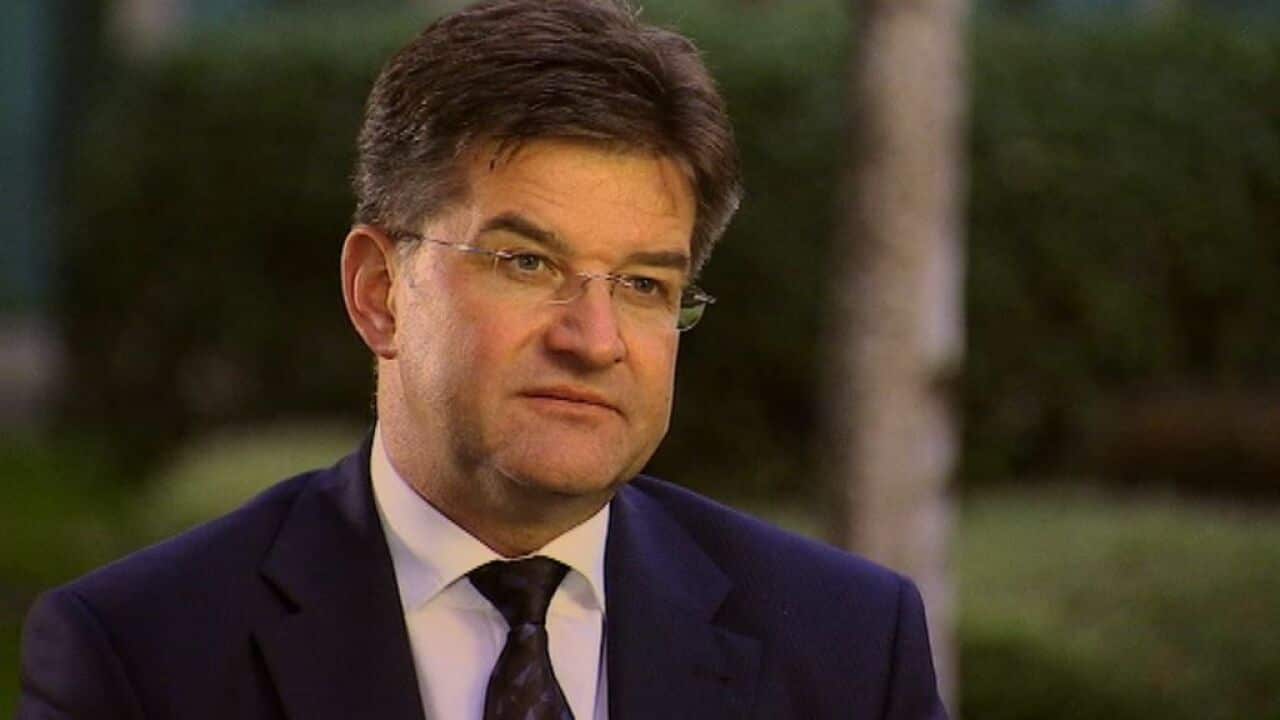
Slovakia's Deputy Prime Minister expects a "very firm and strong" response to any further advancement of military activities within neighbouring Ukraine and describes a new international era with "no defined rules."
Visiting Australia, Miroslav Lajčák says there are many "worrying signals" about the already fragile ceasefire in Ukraine.
A new video, released overnight, purports to show heavy shelling from weapons which would violate the ceasefire in the eastern village of Shyrokyne, close to the Russian border.
Russia has also been flexing its military muscles, with a surprise mass drill in the country's north west.
US President Barack Obama has accused Russia of an "increasingly aggressive posture" while NATO's Secretary-General, Jens Stoltenberg, says Russia has been engaging in "nuclear sabre-rattling" in Ukraine and beyond, which he says is "unjustified, destabilising and dangerous."
The Deputy Prime Minister of neighbour and NATO member Slovakia, Miroslav Lajčák, was in Ukraine last week prior to this week's tour of Australia.
Also the nation's Foreign Minister, he says NATO and the European Union are united in concern about what is happening in Eastern Europe.
"If there is a further advancement of military activities there will be a very firm and strong response," he told SBS.
"Russia already knows the price."
"I really hope we will be talking (soon) about the political, diplomatic solution, rather than the next round of military actions."
Miroslav Lajčák says Slovakia and Ukraine are friends, but he says there are "selfish" reasons to help its biggest neighbour become stable and prosperous.
"We are assisting Ukraine, because we can offer an authentic experience. Slovakia is a transition success. We have been through many reforms, many challenges recently," the Minister said.
The deputy Slovakian leader says the Ukraine crisis has caught Europe by surprise.
"We got too complacent in Europe. We would never expect that there would be a real war so close to our borders in European soil. This is a big concern and it changes the overall political and security landscape in Europe."
US President Barack Obama says it's a challenging time for NATO, Minister Lajčák goes further, saying the Ukraine crisis is a challenging issue for the entire international community.
"It looks like we have come to the end of one era, the Post-Cold arrangement, and we have entered without knowing that, a new era with no defined rules."
He says the "rules of the game" were quite clear during the Cold War, afterwards he says it was believed nations were striving for the similar democratic values, now he says "we have entered something new, less good, but we still don't know how to assess it, how to define it."
"I think it is a challenge for all politicians, and all international organisations such as the United Nations and the others to make sure that this new era protects our values and our people's interests."
During talks in Canberra this week with Australia's Foreign Minister Julie Bishop, he discussed the shooting down of Malaysia Airlines MH-17 over rebel held territory eastern Ukraine last July.
Ukraine and the West claim the plane was shot down by pro-Russian separatists with weapons supplied by Moscow. Russia firmly denies the charges.
298 people were killed in the disaster, including 38 Australians citizens and residents.
"This downing of the plane made Australia part of that unfortunate conflict, of that terrible tragedy," said Miroslav Lajčák.
"We have confidence that investigation will help us to establish the truth, and after that there has to be consequences .. there are political consequences, there are moral consequences, there are legal consequences."
"We will have to insist on revealing the full truth, and on insisting that those responsible will be punished."
Australia and Slovakia, which assumes the Presidency of the European Union in the latter half of next year, have just signed a reciprocal agreement for youth holiday and work exchanges.
Under the arrangement, up to 200 young holidaying Australians and Slovaks will be allowed every year to undertake short term work and study in the other country.
"We might be distant geographically, but today's world is, relatively speaking, shrinking. It is much easier to travel and even more easier to communicate."
"Australia is traditionally quite popular amongst Slovaks and well known. It has been for years one of the main destinations for our migration. We have a strong Slovakian community, Slovak diaspora here for many years. Some 15,000 Slovaks."
"It is part of the responsibility of my government to take care of them."
Australian and Slovakian soldiers fought side by side in Afghanistan's Uruzgan Province, forming a strong bond and, according to Minister Lajcuk, a shared responsibility for the future of the country.
"We want to make sure this was not a futile investment, we want to make sure this country will develop in a positive way," he said.
"This is also a responsibility we share together. It also creates mutual trust, because we have seen we can rely on each other in very difficult conditions. I believe it is a very powerful message also for other activities we intend to undertake together."
No matter what, Miroslav Lajčák promises Afghanistan won't be abandoned.





