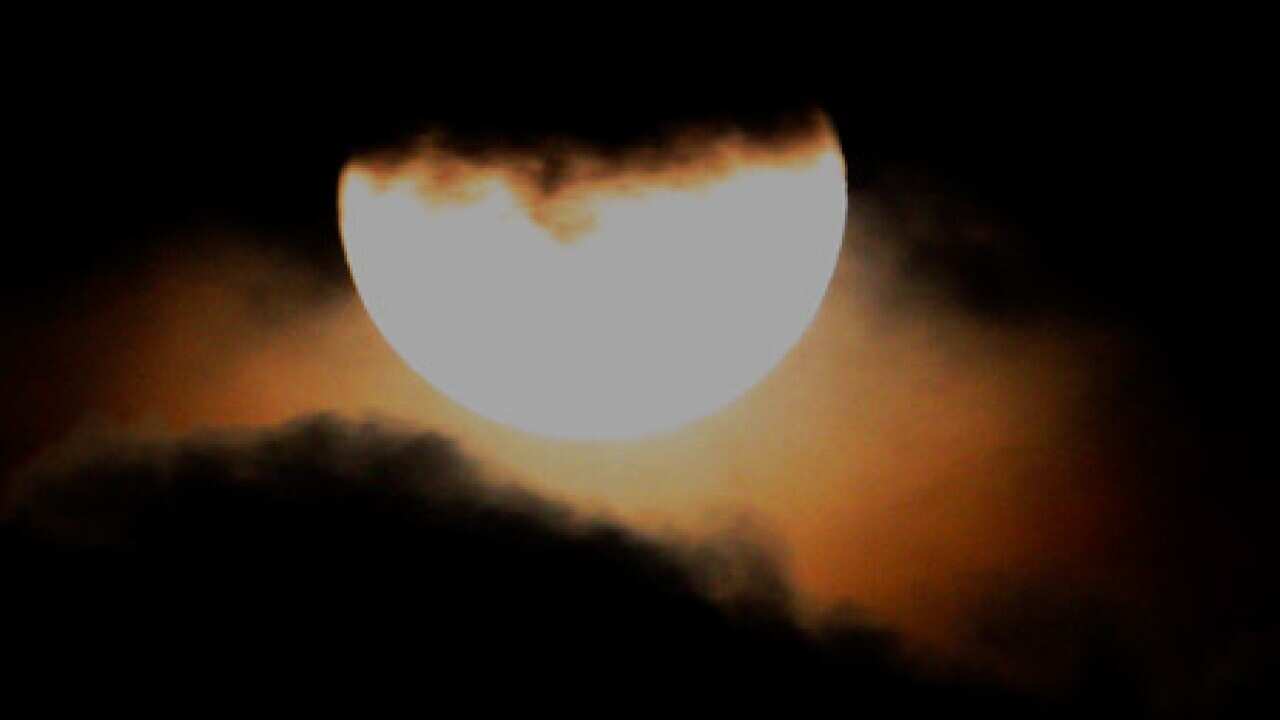
Eclipse junkies are set for a thrill this Sunday when, along an 11,000-kilometre track, the Sun will be covered by the Moon, its life-giving light replaced by a halo of gold in a sky of indigo.
Slicing across the South Pacific, the eclipse will notably darken Easter Island, home of the giant moai statues - the silent witnesses of an enigmatic society that thrived but then foundered in war, famine and cannibalism.
Omen-fearing football fans may also note that the eclipse coincides eerily with Sunday's World Cup final... although it will be on the other side of the world and not have any impact on the skies of South Africa.
News that makes sense
Your trusted source for staying up-to-date with the world around you. Get free daily news updates and analysis, straight to your inbox.
But superstition has forever been part of the cult of the eclipse.
Throughout history, awe and dread - the birth or death of kings, victories or defeats, bumper harvests or gnawing hunger -- have always attended that moment when the Moon slides in front of the Sun and darkness briefly cloaks the Earth at daytime.
"Nothing can be surprising any more, or impossible or miraculous, now that Zeus, father of the Olympians, has made night out of noonday, hiding the bright sunlight, and... fear has come upon mankind," wrote the Greek poet Archilochus after an eclipse in 648 BC.
"After this, men can believe anything, expect anything. Don't any of you be surprised in future if land beasts change places with dolphins and go to live in their salty pastures, and get to like the sounding waves of the sea more than the land, while the dolphins prefer the mountains."
Almost as remarkable as the sight of an eclipse is the mathematical quirk behind it.
The Sun is 400 times wider than the Moon, but it is also 400 times farther away. Because of the symmetry, the lunar umbra, or shadow, that falls on the face of the Earth is exactly wide enough to cover the face of the Sun.
The Moon is creeping away from Earth, at the rate of 3.8 centimetres (1.5 inches) per year, which means that ultimately it will be too far away to completely cover the Sun -- but that won't be for another 600 million years.
Sunday's eclipse begins at 1815 GMT, when the umbra falls on the South Pacific about 700 kilometers (440 miles) southeast of Tonga, says NASA's veteran eclipse specialist, Fred Espanak.
For those in a wide swathe to the north and south of the 250-km- (160-mile-) wide umbra, it will be a partial, not a total, eclipse.
Zipping in an easterly arc across the Pacific, the dark disc makes landfall on the Cook Islands before skimming just 20 kms (12 miles) south of Tahiti.
Eclipse chasers will be boarding cruise ships in Papeete, the Tahitian capital, to snatch the experience of totality.
At an uninhabited spot in the Pacific, the eclipse will be at its longest at 1933 GMT, lasting five minutes and 20 seconds.
The next landfall is at Easter Island, one of Earth's remotest places, where the Sun, hanging 40 degrees above the horizon, will be obscured for four minutes, 41 seconds.
Hotel rooms in the tiny Chilean island were booked years ago by an army of astronomers, eclipse fanatics and New Age cultists.
The Moon's shadow then sweeps across another 3,700 kms (2,300 miles) of open ocean before striking southern Chile at 2049 GMT, before expiring in southern Argentina three minutes later.
Total solar eclipses happen about every 18 months on average, but eclipse lovers have to wait nearly two and a half years before the next one.
It will take place on November 13 2012, flitting from Australia's Queensland eastwards across the South Pacific, says Espanak.







