
For many, Christmas arrives with more than tinsel, pine trees and carols — it comes layered with accents, aromas and a dazzling array of traditions.
Beneath the Australian summer sun, migrant communities bring their own spin to the season, turning the country into a tapestry of festive customs.
This tapestry is woven from Australia's rich multicultural makeup, and the multitude of Christmas traditions found across the globe.
To capture just a small slice of this diversity, foreign-born journalists across the SBS newsroom wrote about Christmas traditions in their countries of origin and, in some cases, how they've made the season their own in Australia.
Carols with a desi twang
News that makes sense
Your trusted source for staying up-to-date with the world around you. Get free daily news updates and analysis, straight to your inbox.
For many Indian Australians, Christmas is a lively blend of faith, music and food, infused with the sounds and flavours of home.
Traditional carols are often reworked with Punjabi beats and rhythmic twang, transforming familiar hymns into upbeat performances that invite clapping and joy.
Among Malayalees in Australia, Christmas is celebrated even more widely than Diwali, the Indian festival of lights that marks the triumph of good over evil.
This shouldn't be too much of a surprise, given that around 67 per cent of Australian Malayalee — a cultural group hailing from the southern Indian state of Kerala — identify as Christian, according to the 2021 Census.
The season is marked by the setting up of cribs depicting the birth of Jesus and lively carol processions, in which community members move from house to house, spreading Christmas cheer.
Food plays a central role in the festivities — breakfast often features appam (fermented rice pancakes) with rich duck stew, followed by festive spreads of biryani (mixed rice dish made with spices, meat or vegetables) and other cherished dishes shared with family and friends.
Timorese traditions: Food, picnics and card games
Beyond church services and festive feasts, card games have become a beloved Christmas tradition for Timorese families worldwide.
Games such as poker, rummy, and the popular seven-card game bring generations together around tables and picnic mats, with larger families often setting up multiple playing areas.
The stakes are minimal, sometimes as little as 10 cents, keeping the focus on fun and connection rather than potential gambling earnings.
Whether in living rooms or outdoors, the gentle shuffling of cards, mixed with laughter and storytelling, is a familiar soundtrack to the Christmas season in Timor-Leste.
This simple yet meaningful ritual has become a cultural cornerstone, uniting Timorese families at home and abroad during the year's most cherished holiday.
The Philippines' Mariah Carey and bottle cap tambourines
In the Philippines and for many Filipinos living around the globe, September signals the start of the Christmas season.
Around that time, social media pages are flooded with images of a Filipino Christmas icon and messages like 'Are you ready?', 'It's that time of year, 'Nearly there,' and many other phrases reminding Filipinos that Christmas is just around the corner.
This iconic Filipino singer is Jose Mari Chan, whose song Christmas In Our Hearts is widely considered the Philippines' answer to Mariah Carey's All I Want for Christmas Is You.
Christmas in Our Hearts, which was originally recorded with Chan's daughter, embodies the Filipino Christmas spirit, celebrating Catholic faith and family togetherness as the centre of all celebrations.
Christmas for Filipinos also means a playlist of carols echoing through shopping malls and church walls, with both the old and the young singing them.
Apart from the traditional carols, you can also see children singing around the neighbourhood with their own makeshift instruments, such as old cans as drums and flattened bottle tops, collected and bunched up in wire, as substitutes for tambourines.
A Filipino Christmas is an experience of not only music, faith and family, but also a table full of traditional ham, Filipino Christmas rice cakes like puto bongbong, bibingka, sikwate (hot chocolate) and queso de bola (cheese) on Christmas Eve, with leftovers for Christmas Day.
Under the mistletoe: Xmas romance in Japan
While many have probably heard of the peculiar Japanese tradition of eating KFC on Christmas, this isn't the only unique way the holiday is marked in Japan.
For many young couples, Christmas is often a romantic day spent exchanging gifts over a fancy dinner.
Consequently, for those without partners, it can be a challenging time of year.
While it's difficult to pinpoint the origin of this trend, it appears to be the result of successful marketing campaigns, much like the KFC 'tradition'.
In the 1980s, Japan experienced an economic boom that fuelled people's appetite for spending. Marketers seized the opportunity and aggressively promoted upscale date and gift ideas to coincide with holidays like Christmas.
Although many nowadays opt for more cost-efficient options, the custom is still very much alive.

So, what should you do if you are single and alone in Japan during Christmas? Don't worry, we won't judge … at least not openly!
Jokes aside, whether you are single or not, Christmas time in Japan is truly magical, with cities decorated with winter illuminations.
It sure is a sight to behold!
The Polish 'Chrissie' carp
For Poles, Christmas Eve is the highlight of the festive season, with celebrations starting when the first star appears.
Tables glow with candles, and hay under the tablecloth recalls the nativity as well as poverty and simplicity. A free chair is left for the 'late traveller', and families break the opłatek or Christmas wafer, exchanging wishes of love and forgiveness.
Tradition calls for twelve meatless dishes, reflecting a time when meat was a rare luxury and serving as a symbol of wholeness and perfection, while also honouring the twelve apostles of Jesus.
A Polish Christmas would also be incomplete without carp, something that surprises many in Australia, where it is considered an unpalatable invasive species.
At a Polish Christmas, it is served baked, fried, stuffed, stewed, or in jelly. The most traditional version, 'Jewish-style', is boiled with raisins and onions for a sweet-and-salty twist.
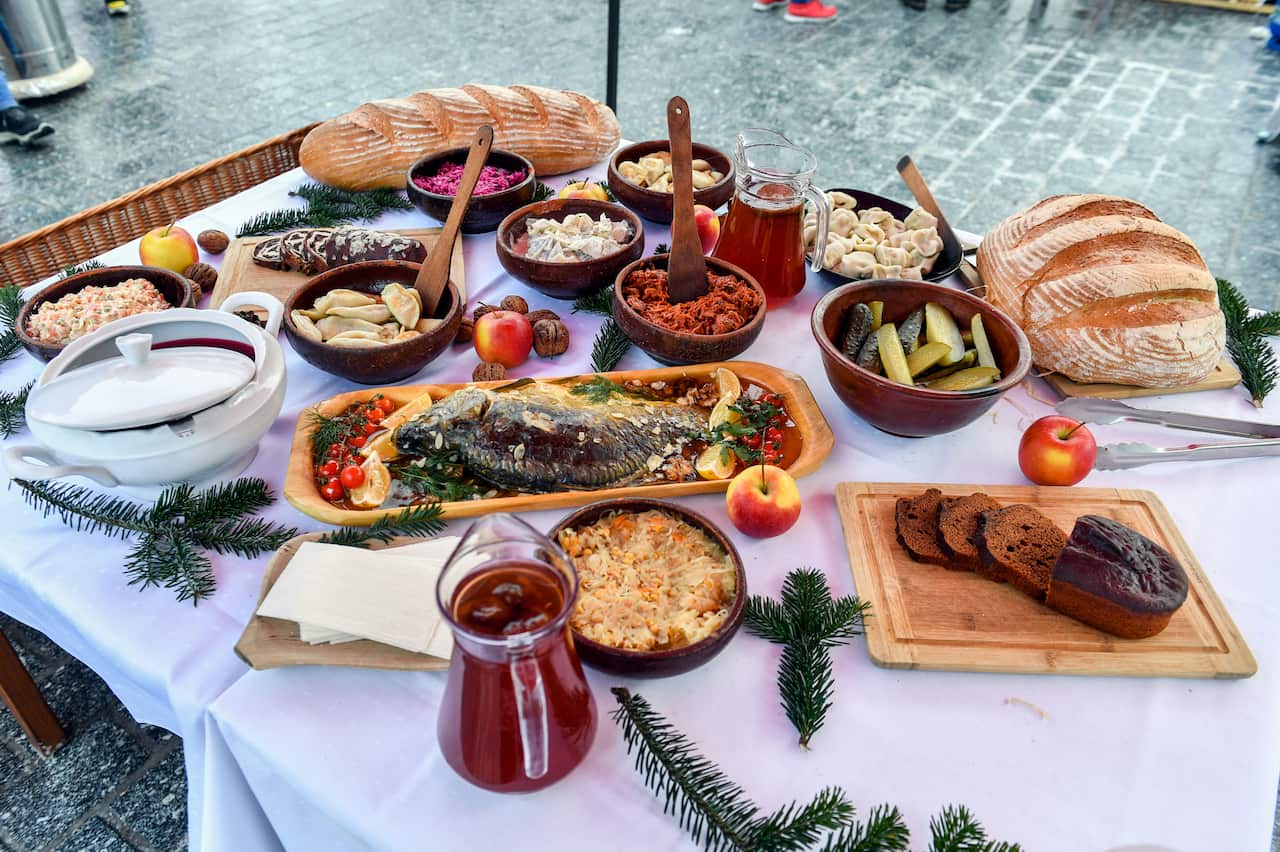
Carp arrived in Poland in the 12th century, brought by Czech Cistercians. It was just one of many freshwater fish enjoyed for centuries on the tables of nobility.
By the early 20th century, it had become a staple, especially in Jewish households.
At a modern Polish restaurant in Brunswick East — Melbourne's hip, inner-north suburb — chef Ola Gładysz says carp is surprisingly popular, even though it only appears on the menu for special occasions.
"I don't know any other restaurant that serves carp. This year we're expecting lots of Polish guests for Christmas Eve," she says.
Australians, however, often approach it with caution.
"People are a bit unsure because they've never tried it. I soak the carp in milk with onion for six hours to remove the muddy flavour, then dry it thoroughly, season it, and fry it in breadcrumbs. That crispy coating is our way of winning Aussies over," she says.

"Most people who come for our Christmas events are Poles missing home. For them, carp is a taste of childhood," Gładysz says.
In the 1940s, a communist official famously declared: "Carp on every Christmas Eve table in Poland." However, as World War Two had left the Baltic Sea fishing fleet in ruins, the government promoted fish farming in ponds, and workers often received carp as bonuses.
This gave rise to the tradition of bringing home live fish — a necessity in communist Poland, where shortages meant people had to secure their meals a few days in advance.
Today, carp remains a Christmas fixture, served in a variety of ways.
For the latest from SBS News, download our app and subscribe to our newsletter.







