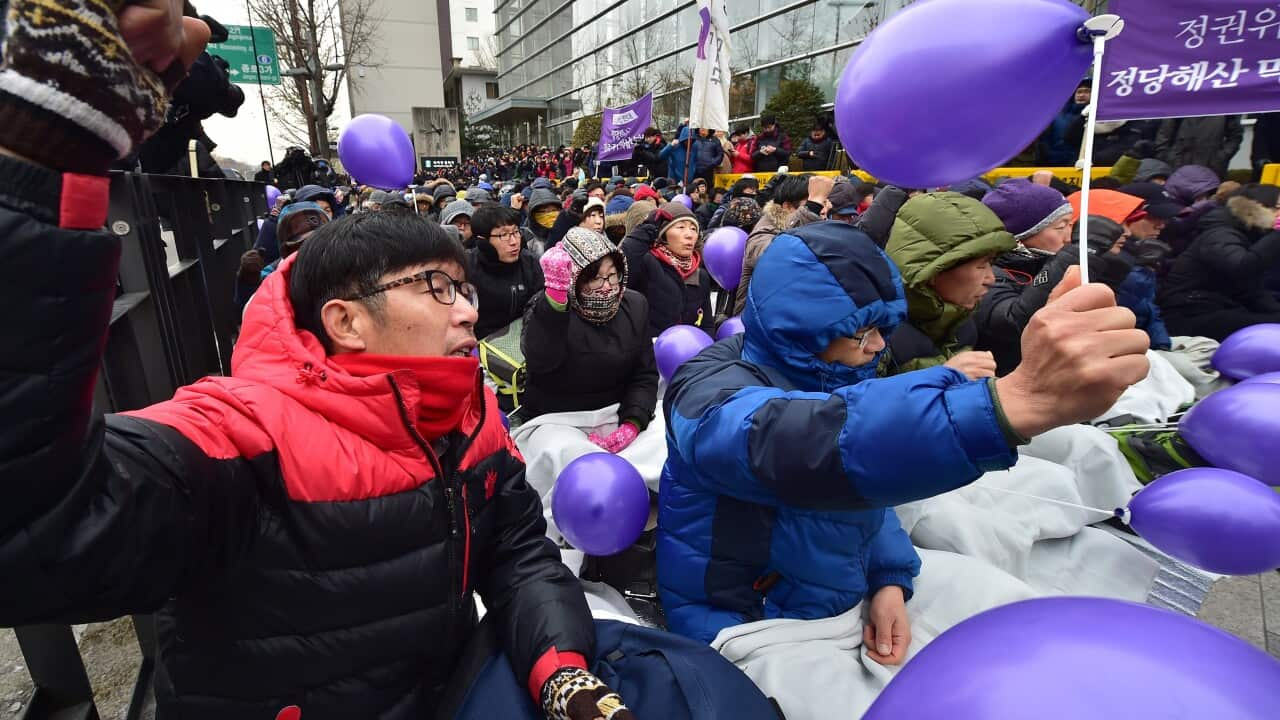
In an 8-1 decision, judges endorsed the government's petition to disband the Unified Progressive Party (UPP) and ordered the forfeiture of all of its five seats in parliament.
The court ruled the party's platform ran counter to the basic democratic order of the constitution by supporting North Korea's ideological doctrine.
"I hope today's decision will terminate the time-consuming ideological debate in our country," Park Han-Chul, the court's chief judge, said before reading a verdict.
"There is no other choice but to disband the party ... as its principles and activities endanger our democratic order," he said, adding that pro-North Korean activities should be banned because the two Koreas are still technically at war.
South Korea's election authorities took quick action to freeze the party's assets.
The court was tightly guarded by about 1,000 riot police as hundreds of people from rival groups gathered in the nearby streets, according to images broadcast on television.
About 200 conservative activists, including some veterans clad in military uniforms, hailed the court's decision, waving national flags.
Across the street, some 400 UPP members demonstrated against President Park Geun-Hye, accusing her government of trampling over democratic principles.
"Today the constitutional court opened a dark age with an authoritarian decision," said UPP leader Lee Jung-Hee, who ran in the presidential race in late 2012 and made a big splash in a televised debate with a personal attack on Park.
Prime Minister Jung Hong-Won welcomed the court's decision saying it proved that the UPP had tried to topple "our democratic system and establish a North Korean style of socialism".
Rights groups denounced the decision saying that it flew in the face of freedom of expression.
"The ban on the UPP raises serious questions as to the authorities' commitment to freedom of expression and association," Roseann Rife, Amnesty International's East Asia research director, said in a statement.
Human Rights Watch called the decision "draconian".
"President Park's government should not be using it's overly broad national security law to curtail basic civil and political rights, and clamp down of opposing political views," Phil Robertson, HRW's deputy Asia director, said.
"This draconian political tactic is the sort of thing that one would have expected from an authoritarian like her father decades ago, and not from the leader of the modern, democratic country that South Korea has become in the 21st century," he added.
The leftist party has been at the centre of political debate since UPP lawmaker Lee Seok-Ki was arrested last year on charges of plotting an armed revolt in support of North Korea.
The lawmaker, who is on trial, was accused of seeking to "revolutionise" the South in pursuit of North Korean aims.
The main opposition Democratic Party approved of his arrest but opposed the cabinet petition.
Share


