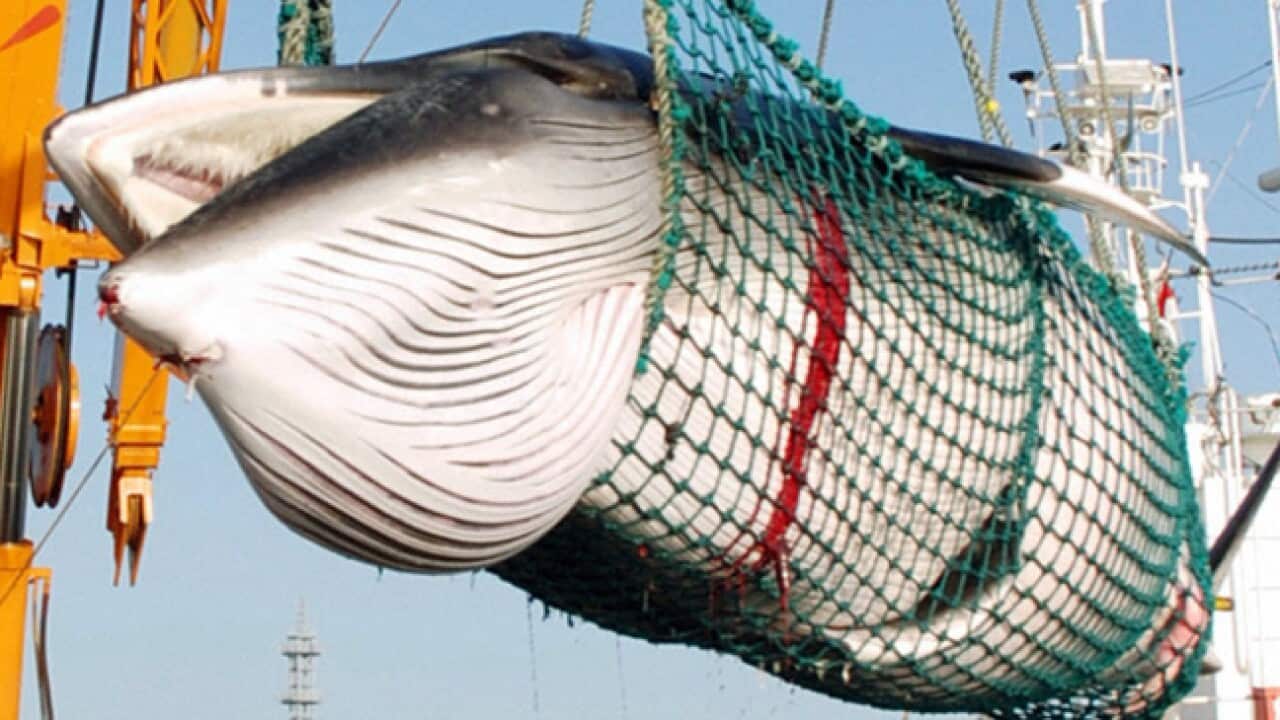
International condemnation has followed South Korea's announcement that it will follow Japan's lead in pursuing whaling for scientific purposes, but why are they?
The International Whaling Commission's "loophole" (Article 8 of the Convention) which South Korea plans to utilise allows for lethal research on whales, with the meat then going to consumption.
In his statement to the 64th annual meeting of the International Whaling Commission (IWC) Panama City yesterday, the head of the South Korean delegation Dr Joon-Suk Kang has not outlined numbers, areas or a timeline for scientific whaling.
It's expected South Korea would target minke whales in the Sea of Japan.
ROOTS IN TRADITION
Ulsan, a province of in the south-east of the Republic of Korea, comes with contradictions: its “prehistoric traditions” of whaling sit side-by-side with the world's largest automotive plant.
Dr Kang said he wished remind the commission “that the Republic of Korea has been endowed with a very long history of active whaling.”
He likened the substance fishing done there on up to 35 species of whales as similar to the Aboriginal Subsistence Whaling (ASW) done in Iceland and Greenland.
South Korea officially respected the 1986 moratorium on commercial whaling, but conducted one season of scientific whaling in 1987.
“However, the long coastal whaling tradition for livelihood and nutritional purposes was suspended in 1986 in compliance with the IWC decision,” Dr Kang said.
“The Ulsan community has long been waiting for the IWC to lift the ban for more than a quarter of a century,” he said.
ECOLOGICAL RECOVERY
South Korea argues that the minke whale population in the north Pacific has recovered considerably to the level maintained before the Moratorium.
“In the 1970s and 1980s up to the Moratorium, for example, about 1,000 minke whales were captured annually around the Korean peninsula,” Dr Kang said.
Experts say that a key species like the whale are critical to maintaining a balanced ecology and managing commercial fishing interests.
IMPACT TO FISHING INDUSTRY
South Korea points out that this revival of cetacean numbers in their EEZ waters has led to calls by commercial fisherman for limited whaling.
“This is because they are experiencing disturbances in their fishing activities due to frequent occurrences of cetaceans in their fishing grounds,” Dr Kang said.
“An increasing number of minke whales are eating away large amount of fish stocks which should be consumed by human beings,” he said.
SUMMARY
South Korea, under internal pressure from commercial fishing bodies, says that it cannot conduct an impact survey on fish stocks via non-lethal means.
Their additional argument is that all members of the IWC are allowed to exercise cultural rights and to respect those of other member countries.
But as with all conservation and commercial matters, diplomacy is at its heart.
While neighbouring Japan continues whaling, why should South Korea abide by the IWC moratorium?
Professor Don Rothwell told ABC 24 that the IWC has proved to be “a toothless tiger” in dealing with Japan and that South Korea would be awaiting a decision by the International Court of Justice next year over Japan's use of the loophole.
“Whatever decision the ICJ comes down with on interpreting Article 8, with respect to the Japanese whaling program in the Southern Ocean, will be very significant in terms of the legitimacy any whaling South Korean is seeking to undertake,” Dr Rothwell said.
In the sometimes uneasy relationship between South Korea and Japan, as evident in South Korea's insistence to call the Sea of Japan the “East Sea”, fishing rights are the newest diplomatic microcosm that has a ripple effect out over the Pacific.
Share


