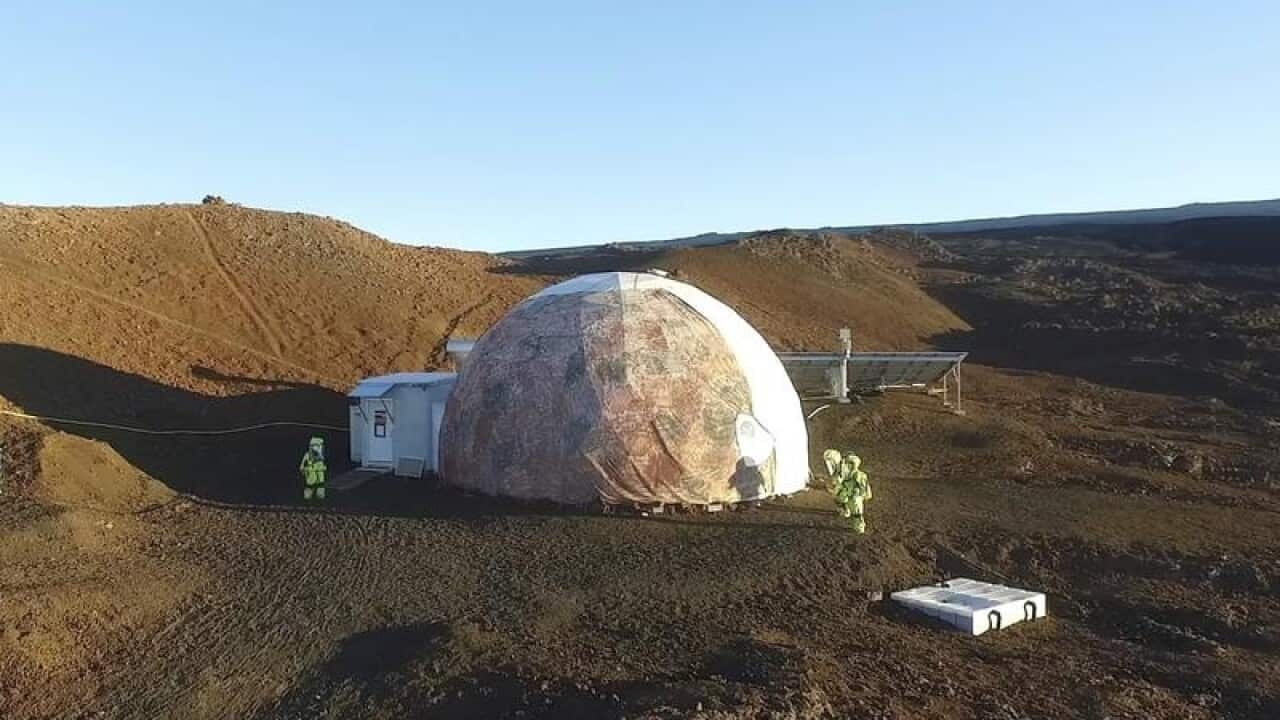
After eight months of living in isolation on a remote Hawaii volcano, six NASA-backed research subjects will emerge from their Mars-like habitat on Sunday and return to civilisation.
Their first order of business after subsiding on mostly freeze-dried and canned food?
Feast on fresh-picked pineapple, papaya, mango, locally-grown vegetables and a fluffy, homemade egg strata cooked by their project's lead scientist.
The crew of four men and two women were quarantined on a vast plain below the summit of the world's largest active volcano in January.
All of their communications with the outside world were subjected to a 20-minute delay - the time it takes for signals to get from Mars to Earth.
News that makes sense
Your trusted source for staying up-to-date with the world around you. Get free daily news updates and analysis, straight to your inbox.
They are part of a study designed to better understand the psychological impacts that a long-term manned mission to space would have on astronauts.
The data they gathered will help NASA better pick crews that have certain traits and a better chance of doing well during a two-to-three year Mars expedition.
The space agency hopes to send humans to the red planet by the 2030s.
The Hawaii team wore specially-designed sensors to gauge their moods and proximity to other people in the small, 1,200 square-foot dome where they have lived.
The devices monitored, among other things, their voice levels and could sense if people were avoiding one another. It could also detect if they were next to each other and arguing.
The crew played games designed to measure their compatibility and stress levels.
When they got overwhelmed by being in such close proximity to teach other, they could use virtual reality devices to escape to tropical beaches or other familiar landscapes.
The project's lead investigator, University of Hawaii professor Kim Binsted, said the crew members also kept written logs about how they were feeling.
"This is our fifth mission, and we have learned a lot over those five missions. We've learned, for one thing, that conflict, even in the best of teams, is going to arise," Binsted said.
"So what's really important is to have a crew that, both as individuals and a group, is really resilient, is able to look at that conflict and come back from it."
The crew's vinyl-covered shelter is about the size of a small two-bedroom home, has small sleeping quarters for each member plus a kitchen, laboratory and bathroom. The group shares one shower and has two composting toilets.







