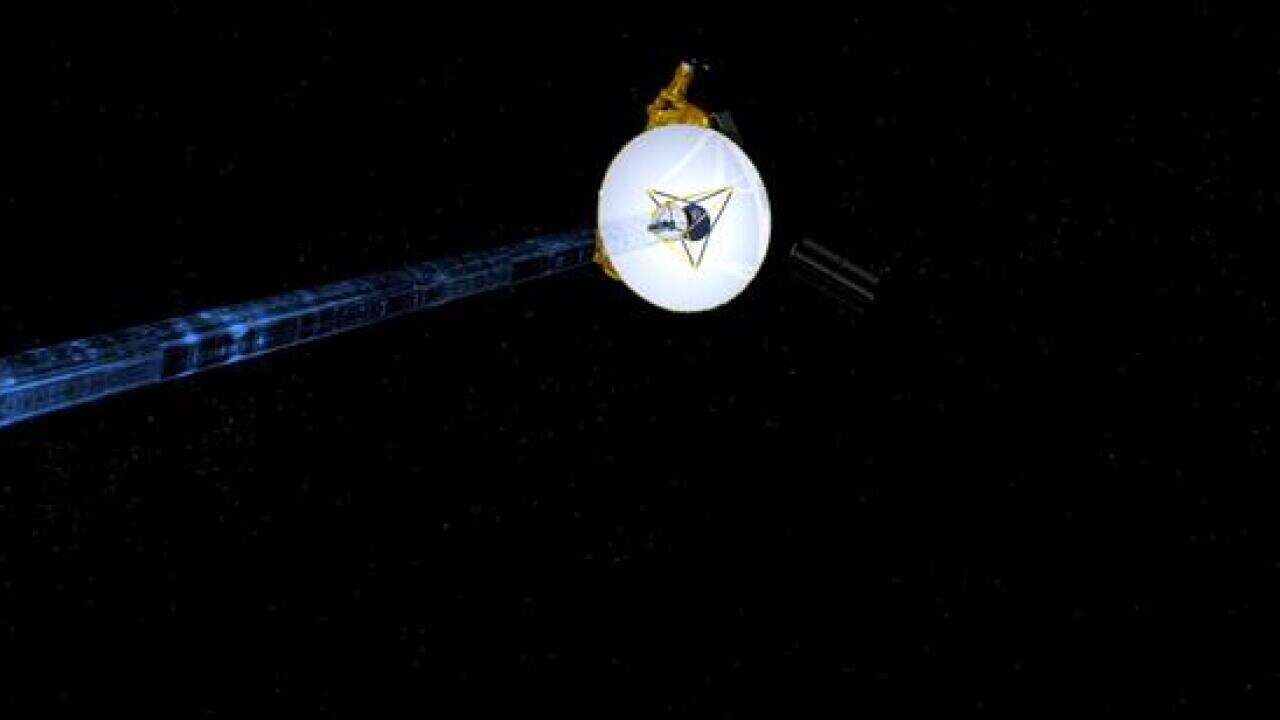
A lonely spacecraft is nearing Pluto after a three billion-mile journey lasting almost nine years.
NASA's New Horizons probe awoke from hibernation on December 6 and is preparing to explore the solar system's mysterious "ninth planet".
Discovered in 1930, Pluto was until recently described as the planet furthest from the Sun - an average distance of 3.67 billion miles.
In 2006 it was reclassified as a newly defined "dwarf planet" within the Kuiper Belt, a swarm of icy objects beyond the realm of true planets such as the Earth and Mars.
The Kuiper Belt is one of the last unexplored regions of the solar system along with the even more distant Oort Cloud, another band of icy bodies.
Both are thought to be the source of comets.
New Horizons will start observing the Pluto system on January 15.
It will make its closest approach to the dwarf planet on July 14 and by mid-May is expected to beam back images of Pluto and its moons better than any obtained by the Hubble Space Telescope.
Project scientist Hal Weaver, from the Applied Physics Laboratory at Johns Hopkins University in Maryland, US, said: "New Horizons is on a journey to a new class of planets we've never seen, in a place we've never been before.
"For decades we thought Pluto was this odd little body on the planetary outskirts; now we know it's really a gateway to an entire region of new worlds in the Kuiper Belt, and New Horizons is going to provide the first close-up look at them."
When New Horizons was brought out of hibernation 162 million miles from Pluto it was described as a "watershed event".
Scientists received a signal telling them the probe's pre-programmed computer had switched it to "active" mode that took four hours and 26 minutes to reach the Earth.
Since its launch on January 19, 2006, New Horizons has spent 1873 days - about two-thirds of its flight time - in hibernation to save wear and tear on electrical components and reduce the risk of system failures.
Share


