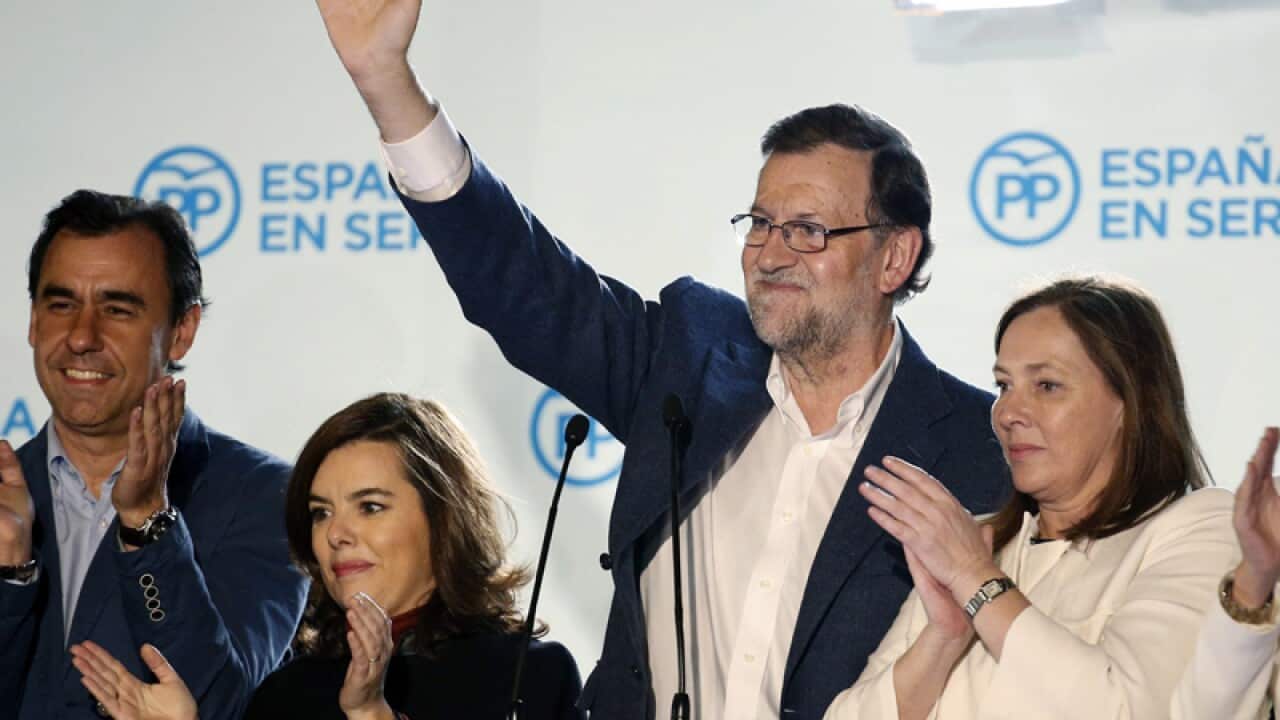
Spanish Prime Minister Mariano Rajoy says his centre-right People's Party (PP) will talk to like-minded rivals in a bid to form a government after an inconclusive election, but his chances look slim without support from left-wing parties.
Rajoy's PP won the most votes in Sunday's national election but fell well short of the 176 seats needed for a parliamentary majority, setting the scene for weeks of complex negotiations on building pacts to govern.
The two biggest left-wing blocs - the opposition Socialists and newcomer Podemos ("We Can") - have already signalled they would not back a PP-led government, complicating Rajoy's attempts to find allies who will at the very least abstain to let him form a government.
Rajoy said he would approach talks with opponents with an open mind, saying the PP had a lot in common with other parties and appearing to open the door to talks with the Socialists, though he declined to specify what pacts he had in mind.
The PP has a clear democratic mandate to form a government after winning 123 seats, he told a news conference.
News that makes sense
Your trusted source for staying up-to-date with the world around you. Get free daily news updates and analysis, straight to your inbox.
"The People's Party believes it has a responsibility and a mandate to start a dialogue and explore the viability of a stable government that can offer the necessary certainty inside and outside Spain," Rajoy said.
Anti-austerity Podemos and fellow newcomer Ciudadanos ("Citizens"), a business-friendly party, entered the mainstream for the first time in the closely-contested election, ending domination by the PP and Socialists stretching back to soon after dictator Francisco Franco's death in 1975.
The two parties won scores of seats in parliament, tapping widespread anger over a recently-ended economic slump and high-level corruption in the European Union's fifth-largest economy.
The close vote, which put the Socialists in second place ahead of Podemos and Ciudadanos, makes it extremely difficult for any party to win majority support, raising the possibility of a deadlock that could force new elections in the new year.
Rajoy set a deadline of January 13 for a first round of talks between parties, coinciding with the day parliament is due to resume.
Markets were spooked by the political uncertainty and nervous investors moved out of Spanish assets, sending the country's shares lower and benchmark bond yields higher.
Rajoy said he will talk to those that want to preserve Spanish unity - a stance that would rule out Podemos, which supports a referendum on independence in the Catalonia region.







