Spain's ruling Socialists reeled from spectacular local election losses Sunday as protesters vented outrage over the highest jobless rate in the industrialized world.
Support for the government collapsed in the face of the beleaguered economy, soaring unemployment and massive street protests, a grim omen for 2012 general elections.
With 98.21 percent of the municipal ballots counted, the Socialists had just 27.81 percent of the total vote compared to 37.58 percent for their conservative Popular Party opponents.
News that makes sense
Your trusted source for staying up-to-date with the world around you. Get free daily news updates and analysis, straight to your inbox.
"The results of the vote show that the Socialist Party has clearly lost today's elections. We have suffered a broad setback compared to four years ago," Prime Minister Jose Luis Rodriguez Zapatero said.
Three years of economic crisis took their toll, the prime minister told a news conference.
"It destroyed thousands of jobs. It is a crisis that had profound effects on citizens' morale. I know that many Spaniards suffer great hardship and fear for their futures," Zapatero said.
"Today, without doubt, they expressed their discontent," he said.
But the prime minister refused to contemplate calling early elections, vowing to pursue reforms to fix the economy and grow jobs until the end of his mandate.
Grinding in the humiliation, Socialists lost historic bastions Seville and Barcelona, a city they had run since the first municipal vote in 1979, four years after the death of General Francisco Franco.
About 65 percent of the 34 million elegible voters cast a ballot to choose 8,116 mayors, 68,400 town councillors and 824 members of regional parliaments for 13 of the 17 semi-autonomous regions.
The big winner of the night was the opposition leader Mariano Rajoy's Popular Party, widely forecast to sweep into government next year for the first time in eight years.
Crowds of cheering supporters waving blue Popular Party flags rallied outside the party headquarters in central Madrid to celebrate the victory, built on widespread anger over the economy.
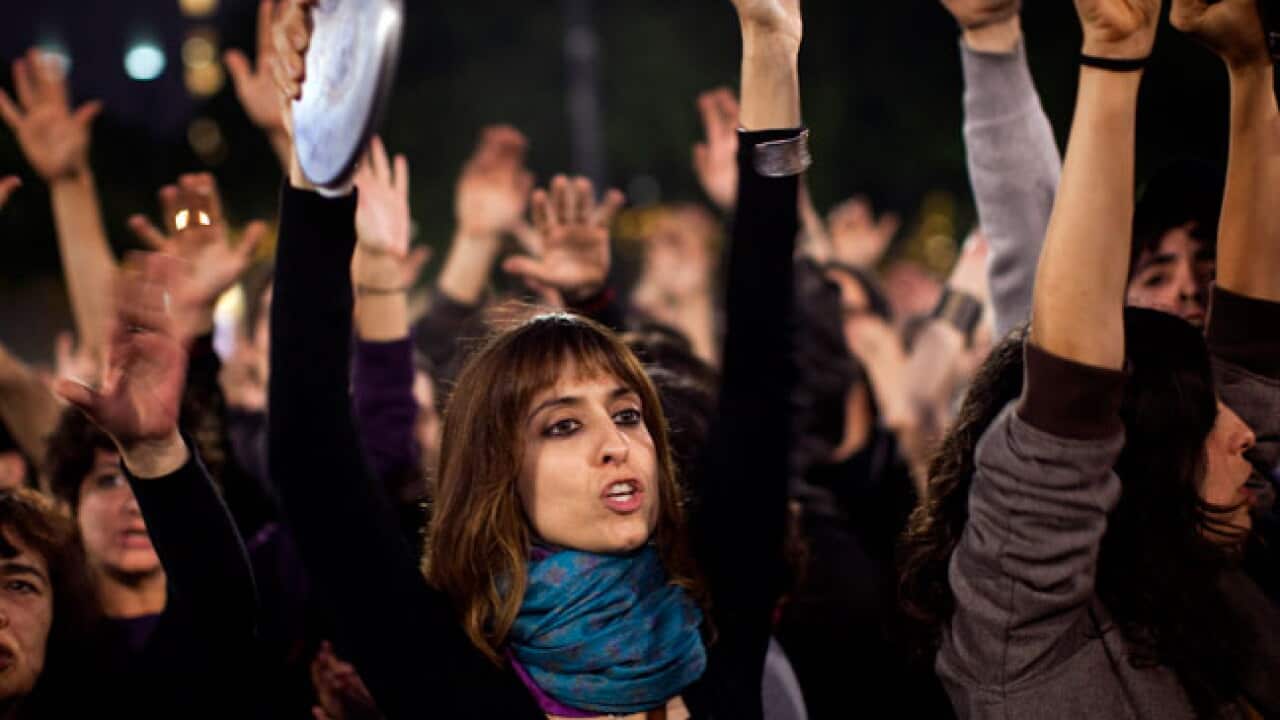
Demonstrators packed city squares from Barcelona to the holiday island of Majorca, refusing to budge as they accused the major Spanish parties of leading the country to economic ruin.
In a plastic-covered protest camp in central Madrid's Puerta del Sol square, spearhead of the nationwide action, thousands of people rallied late Sunday after activists vowed to stay put until May 29 at least.
The spontaneous popular protests, slickly organized via Twitter and Facebook since May 15, were the largest since Spain's property bubble collapsed in 2008 destroying millions of jobs.
Even as the economy grew gingerly this year, the unemployment rate shot to 21.19 percent in the first quarter, the highest in the industrialised world. For under-25s, the rate in February was 44.6 percent.
Protesters describe themselves as the "indignant", and are known variously as "M-15" in reference to their demonstration's birth date, "Spanish Revolution" and "Real Democracy Now".
"I have never voted in my life because I don't see myself reflected in the politicians, I never felt they listen to us," said 20-year-old Javier Pena Pintor in Madrid.
In Barcelona, the Catalan nationalist party CiU led the vote and was set to take 14-16 seats in the 41-seat chamber, up from 12 now, said an exit poll by Ipsos Ecoconsulting for Catalan public television TV3.
The Socialists, who had run a minority government in Barcelona with 14 seats since the last elections four years ago, were poised to take just 10-12 seats, it said.
The conservative Popular Party of Catalonia was set to win seven-eight seats, compared to seven now, the exit poll said.
Despite Zapatero's promise not to stand in the next general elections due next year, partial ballot counts suggested other big losses. In regional elections, the Popular Party was poised to snatch the central region of Castilla-La Mancha, another Socialist stronghold.
In the northern semi-autonomous Basque Country, the focus was on a new political force, Bildu, which fielded candidates after a court battle to prove it was not a mouthpiece for armed separatist group ETA.
In municipal elections, Bildu exceeded expectations and was set to win control of the region's second largest city, San Sebastian.
Overall in the Basque country, Bilduu was running second in the municipal vote; behind the Basque Nationalist Party but ahead of the Socialists.







