
In brief
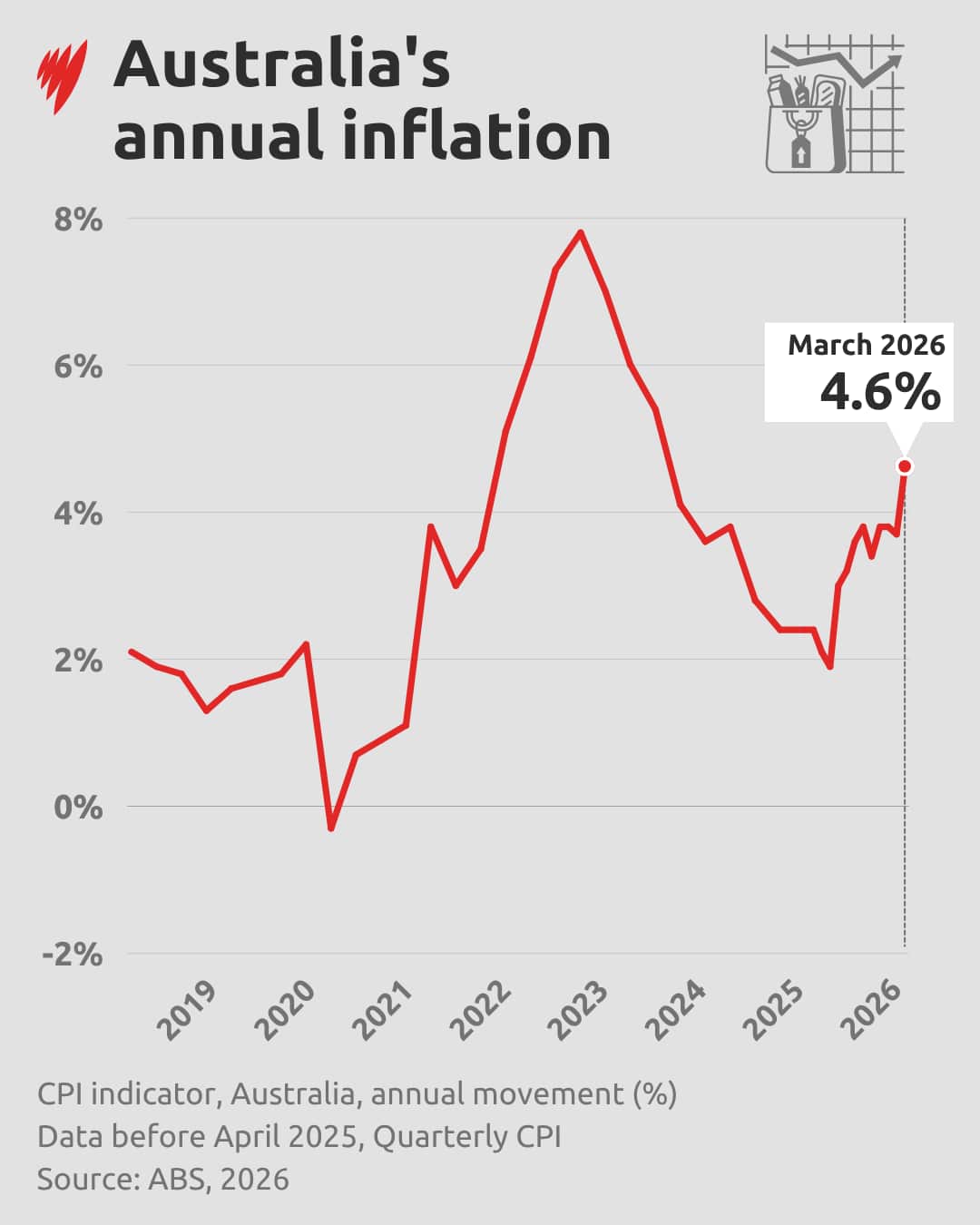
- The Australian Bureau of Statistics has revealed that headline inflation grew to 4.6 per cent in March.
- The steep climb is expected to trigger a rate rise from the Reserve Bank of Australia next week.
Inflation has risen to its highest level since 2023, surging from 3.7 per cent to 4.6 per cent in March.
New data released by the Australian Bureau of Statistics on Wednesday shows that the cost of fuel, driven by the war in the Middle East, has pushed the Consumer Price Index up 0.9 per cent.
The trimmed mean, the Reserve Bank of Australia's preferred method of gauging inflation, remained steady at 3.3 per cent for March year-on-year.
First quarter data for 2026, also released today, show that the quarterly trimmed mean rose to 3.5 per cent, the strongest pace since 2024.
Transport costs, driven by rising fuel prices, saw the biggest jump in monthly inflation, growing by 9.2 per cent in March. The average price for regular unleaded petrol rose 33 per cent, increasing from 171 cents per litre in February to an average price of 228 cents per litre in March.
News that makes sense
Your trusted source for staying up-to-date with the world around you. Get free daily news updates and analysis, straight to your inbox.
Diesel, which contributes 10 per cent of the automotive fuel expenditure class, had a 41 per cent rise in average price, increasing from 181 cents per litre in February to 256 cents per litre in March.
Housing, which is the highest weighted group in the CPI basket, was the largest contributor to annual inflation in March, with a rise of 6.5 per cent year-on-year. It increased 0.1 per cent in March.
ABS categories of clothing and footwear, furnishings, household equipment, and services, and recreation and culture all saw drops in spending of between -0.3 and -0.6 per cent.
What does this mean for consumers?
Economists are predicting that the inflation data will most likely trigger a rate hike from the RBA on Tuesday.
"We continue to expect the RBA will hike 25 basis points in May, taking the cash rate to 4.35 per cent," ANZ economists Madeline Dunk and Adam Boyton told the Australian Associated Press before the figures were released.
However, early data from the London Stock Exchange Group suggested that traders were less certain of a rate hike in May off the back of the figures, with 75 per cent now predicting one, down from the 86 per cent prior to the release.
"The underlying rate of inflation is actually in a better position than at first thought," Tim Harcourt, industry professor and chief economist at the Institute for Public Policy and Governance at the University of Technology Sydney, told SBS News.
"[A rate rise] will be line ball as some of the RBA board members are keeping a close watch on the labour market," he added.
Tony Sycamore, market analyst at trading platform IG, has said that today's inflation figures are "hot, but not as hot as feared".
"There's a counterargument for keeping rates on hold and waiting for more information.
"Petrol prices have fallen in recent weeks back to near pre-conflict levels, which means the RBA could potentially look through this month’s inflation spike and opt to keep rates on hold."
If Australia has now passed the acute phase of the inflation shock prompted by the war, the trimmed-mean may not exceed the RBA's own 3.7 per cent forecast by June, Sycamore said.
What is driving inflation?
Treasurer Jim Chalmers has said that the conflict in the Middle East has driven inflation growth as he prepares to hand down the federal budget next month.
"We know the Australian economy is not immune from all of this global uncertainty and volatility and unpredictable conditions, but we are better placed and better prepared and have faster growth than any other advanced economy to finish up 2025," he told reporters in Brisbane on Wednesday.
"Even with the spike in inflation from higher fuel prices coming out of the Middle East, we still have inflation substantially lower than what we inherited and what we saw in 2022."
Chalmers pointed to the government's halving of the fuel excise in response to the crisis as one of the ways in which it is trying to "take the sting" out of the global turbulence.
Automotive fuel prices surged 32.8 per cent from February to March, which contributed to inflation, though the data predates the halving of the fuel excise on 1 April.
Sycamore said that a rate hike would become much less likely if "concrete signs of progress to reopen the Strait of Hormuz" happened between now and next Tuesday.
"However, with Iran's recent olive branch earlier this week failing to include any discussion of its nuclear program, a genuine breakthrough remains elusive," he said.
When will the full effects of the war be felt?
The conflict in the Middle East broke out on 28 February when the United States and Israel launched joint strikes on Iran, which responded by attacking its Gulf state neighbours, damaging fossil fuel infrastructure, and blockading the Strait of Hormuz.
The waterway is a vital shipping lane through which roughly a fifth of the world's oil and gas is transported, with its closure spiking prices globally.
Brent crude has surged from below US$70 ($97.60) per barrel to over US$110 ($153.38) per barrel and remains high as peace talks between the US and Iran continue to stall.
"[The impact of the conflict] will be around for 3-6 months, even if there was a total ceasfire – it would take a couple of months to settle," Harcourt said.
The flow-on effects of the disruption to global trade – which has also hampered supplies of fertiliser, aluminium, and other industrial components crucial to everyday items – are expected to take months to be fully clear in Australia.
"We think the underlying picture will deteriorate in the June quarter when we see second and third round effects come through," Besa Deda, chief economist at accounting and advisory firm William Buck, told ABC News on Wednesday before the data was released.
"It's almost, I think, inevitable that we will see more tightening, particularly given that inflationary pressures were already building before these hostilities broke out, and now the hostilities in the Middle East have really amplified those inflationary pressures."
How will this impact borrowers?
More than a quarter of Australians with a mortgage are "at risk" of "mortgage stress" following the two consecutive rate hikes in February and March.
New data from polling company Roy Morgan shows that 1.44 million borrowers are now in the at-risk category, up by 130,000 in the past month. The data found 18.9 per cent are thought to be "extremely at risk", a significant jump above the two-decade average of 16.3 per cent.
The RBA targets a 2-3 per cent band of inflation, and uses lending rate increases to cool discretionary consumer spending. Banks pass on the cash rate rise to borrowers, and mortgage payments increase as a result.
Roy Morgan CEO Michele Levine has said that potential rate hikes in May and June would push interest rates to their highest level in nearly 15 years.
While the conflict in the Middle East has "introduced a considerable amount of uncertainty into global economic forecasts", she has said that there are positive economic indicators for the country.
"The good news — at least for the short-term — is that the Albanese government has been quick to assure Australians the country is well supplied with energy over the next four to six weeks at least.
"The employment market has been strong over the last four years (Roy Morgan estimates show over 1.2 million new jobs have been created since the Albanese government was elected in May 2022) and this has provided support to household incomes, which have helped to moderate levels of mortgage stress despite interest rates being significantly higher than in May 2022.”
— With additional reporting by the Australian Associated Press.
For the latest from SBS News, download our app and subscribe to our newsletter.







